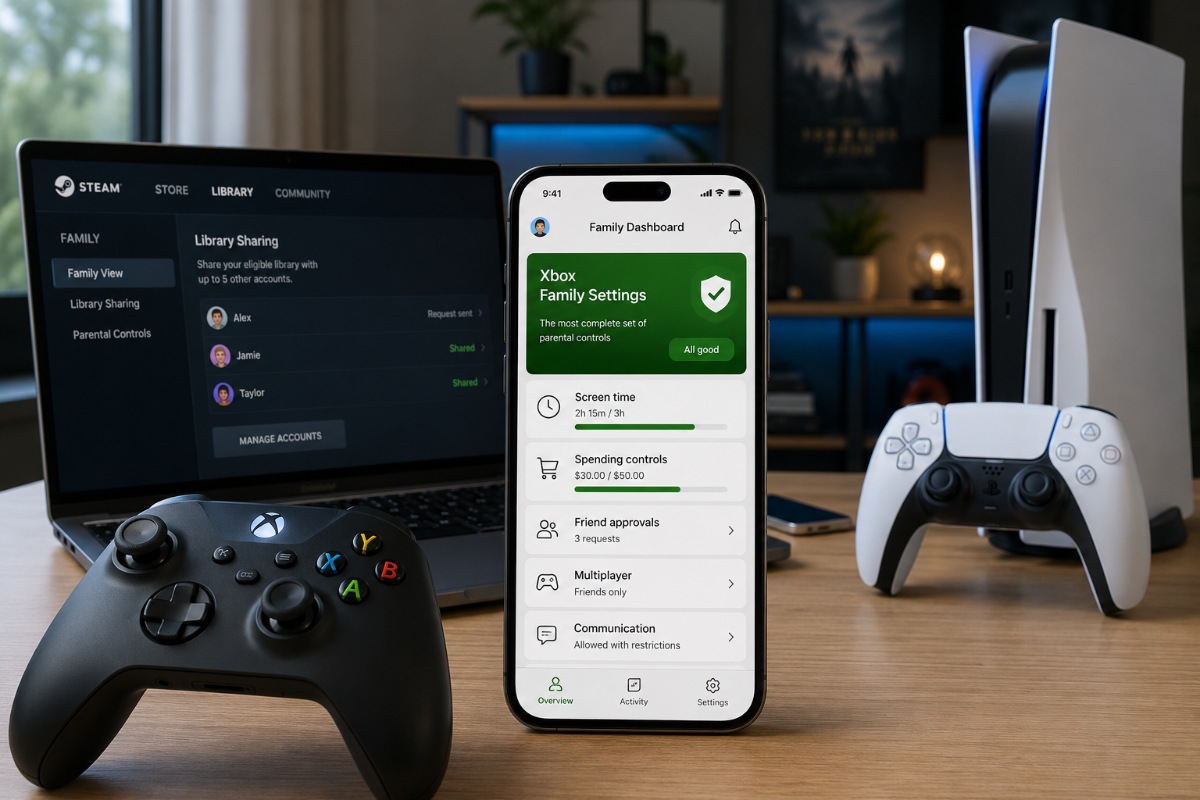
Xbox parental controls: Steam offers better game sharing and PlayStation has improved its mobile tools, but Xbox remains the easiest platform for parents to manage.
Managing screen time across a household of consoles and gaming PCs once meant digging through separate menus, websites, and account settings. Steam, Xbox, and PlayStation now provide capable family tools, but they approach the job very differently.
Steam focuses on sharing purchased games between members of the same household. PlayStation offers a newer mobile app for supervising children on PS4 and PS5. Xbox combines console controls with parts of Microsoft’s wider family system, giving parents one place to manage playtime, spending, friends, communication, and online access.
Each platform covers the basics. Steam’s generous library sharing comes with strict membership rules. Sony’s app is polished but relatively new. Microsoft offers the most mature dashboard for parents who want to make quick changes without opening a console settings page.
Xbox Remains the Gold Standard for Parents
The Xbox Family Settings app brings most daily controls into one mobile dashboard. Parents can create different schedules for each day, pause game time, review activity, approve purchases, and respond to requests for extra time.
Microsoft also gives parents direct control over friend lists and online access. They can approve incoming friend requests, remove contacts, restrict multiplayer, and decide who can communicate with a child. Those tools matter when parents want to limit toxic voice chat or messages from unknown players.
Xbox reaches beyond the console as well. Parents can apply screen time and content limits to a Windows 11 PC when the child uses a Microsoft account and Xbox profile connected to the same family group.
Steam Sharing Comes With Strict Conditions
Steam Families officially left beta on September 11, 2024. It allows up to six close family members to share supported games while keeping separate saves, achievements, and workshop files. Different members can play different titles at the same time. If two people want to play Elden Ring together, however, the household needs two copies.
Not every Steam title qualifies. A game must support Family Sharing, and its publisher can opt out at any time. Games that require a separate third-party account, activation key, or subscription are excluded. Free-to-play titles, private games, region-restricted content, and games that do not support the other member’s operating system also remain unavailable. A paid live-service game is not automatically excluded, but separate account or subscription requirements may block it.
Valve also provides playtime limits, activity reports, store restrictions, game approvals, and controls for community features. Its rules become less flexible when somebody joins the wrong family or moves between households. Community frustration surfaced immediately after the wider launch, with one user arguing, “One-year cooldown is too much.”
That grievance highlights the biggest catch in Valve’s otherwise generous sharing system. Adults face a one-year wait before joining or creating another Steam Family, while each vacated membership slot receives its own one-year cooldown. Children cannot leave by themselves. An adult member or Steam Support must remove them.
Sharing also carries an unusual technical risk. If a family member cheats while using someone else’s copy of a protected game, the owner may also receive a permanent VAC ban for that title.
PlayStation Finally Catches Up
Sony launched its standalone PlayStation Family app in September 2025. Parents can review activity, set daily schedules, approve extra time, manage spending, restrict content, and control social features from a phone.
Its age-based presets automatically apply recommended settings for different age groups, saving parents from adjusting every option during setup. Each control remains customizable afterward.
PlayStation now competes closely with Xbox inside a dedicated console household. Steam remains the stronger choice for sharing a large PC library. For parents managing several devices and online accounts, Xbox still offers the least frustrating and most complete toolkit.
Also Read: Asus ROG Strix G18 Hits Global Markets With 1,200 Nit Mini LED Display

Anup Singh is an independent technology journalist and content writer covering Apple, Android, AI, laptops, gaming, and the consumer tech industry. He focuses on delivering factual, well researched, and easy to understand reporting while explaining how new technologies impact everyday users.
1 thought on “Why Xbox Still Dominates Parental Controls Over Steam and PlayStation”