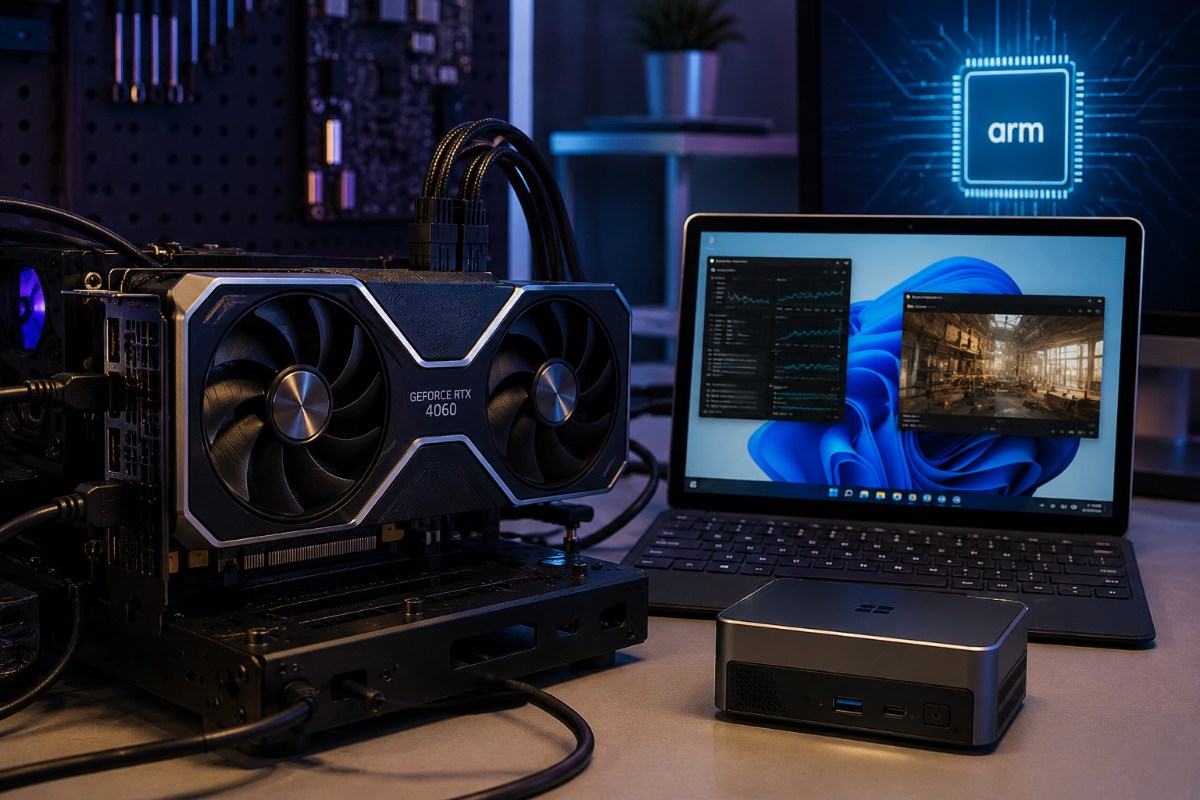
Nvidia RTX 4060: An experimental driver modification proves that dedicated GeForce graphics can work with Arm based Windows PCs, although major technical barriers remain.
Windows 11 on Arm has improved quickly, but dedicated graphics support remains one of its biggest weaknesses. Most consumer systems still rely on Qualcomm integrated graphics, leaving gamers and creators without the GeForce options available on traditional Windows PCs.
Developer VoidTech has now shown that the limitation is not absolute. In his original Bilibili demonstration, he installed a desktop RTX 4060 inside a Huawei Qingyun W510 workstation powered by a 24 core Kunpeng 920 processor. The system successfully enabled DirectX 12, Vulkan and CUDA acceleration.
The result was functional, but far from polished. Games struggled to reach 25 FPS, while the card refused to produce a video signal through HDMI or DisplayPort. VoidTech instead streamed the desktop to another device using Sunshine and Moonlight.
Hardware creator Chaowanke then published a separate demonstration using an RTX 4060 and a Lenovo Yoga Air 14s powered by Qualcomm’s Snapdragon X Elite processor. That test brought the experiment closer to the consumer laptops people can actually buy.
The Hack Required More Than Installing A Driver
Huawei designed the Qingyun workstation for Linux, which meant Windows could not correctly read its hardware configuration. VoidTech first applied a community ACPI patch. ACPI is the framework Windows uses to identify components, manage power and understand how a computer is configured.
The graphics driver presented a harder problem. Windows can run many traditional x64 applications through Prism, Microsoft’s emulation layer for translating software to Arm instructions. Prism cannot do the same job for low level hardware drivers, so the RTX 4060 needed native Arm64 code.
VoidTech extracted Nvidia’s RTX Spark developer driver, modified the package so it would recognise the desktop GeForce card and installed it manually. Windows then detected the GPU and enabled hardware acceleration.
“Graphics card function is normal, no video output signal, suitable for use with streaming,” VoidTech said during his demonstration.
Nvidia has officially introduced RTX Spark as a Windows platform combining an Arm processor with Blackwell graphics. The company has also released a developer preview that allows software teams to begin preparing Arm64 applications before supported systems arrive. Neither step provides official support for desktop GeForce cards connected to existing Snapdragon or Huawei computers.
That lack of official support explains the rough performance. The benchmarks measure an improvised combination of ageing server hardware, emulated software and a driver never intended for this graphics card. They do not show what a properly supported GeForce system on Arm could achieve.
Early Benchmarks Expose The Bottlenecks
Genshin Impact ran at roughly 20 to 25 FPS at 1080p. The Black Myth: Wukong benchmark averaged 21 FPS, while Nvidia’s Star Wars Reflections demo stayed between 23 and 25 FPS.
Time Spy produced a graphics score of 6,369. The same RTX 4060 scored 10,939 in a comparison system powered by a Ryzen 7 5800X, showing how much performance the experimental platform left behind.
The GPU was not solely responsible. The Kunpeng 920 offers weak single core performance by modern gaming standards, while most games also passed through x64 emulation. Those 2 bottlenecks slowed the system before the RTX 4060 could render each frame.
Native Arm64 versions of several 3DMark workloads performed more consistently. Blender also recognised CUDA, confirming that the card could accelerate rendering and computing tasks even when gaming remained limited.
Chaowanke’s Snapdragon setup offered a more relevant consumer test. He connected the RTX 4060 through USB4, extracted the preview driver and manually selected its Arm64 information file after Nvidia’s installer rejected the hardware. The card powered an external monitor and launched Cyberpunk 2077 and Forza Horizon 6, although no detailed benchmark scores were published.
GeForce Support Still Has A Long Way To Go
PC enthusiasts clearly want something more capable than Qualcomm’s integrated graphics. These experiments prove that Nvidia’s Arm drivers can communicate with a wider range of GeForce hardware than originally intended.
They do not provide a practical upgrade path yet. Users still need preview drivers, compatibility overrides and unsupported external hardware. Reliable installation, stable gaming performance and official vendor support all remain unresolved.
Still, the central question has changed. A desktop GeForce card can run inside Microsoft’s Arm ecosystem. Now Nvidia and Microsoft must decide whether to turn that possibility into something PC users can install without rebuilding the software stack themselves.
Also Read: Valve’s $1,049 Steam Machine Trades Raw 4K Power for Premium Living Room Simplicity

Anup Singh is an independent technology journalist and content writer covering Apple, Android, AI, laptops, gaming, and the consumer tech industry. He focuses on delivering factual, well researched, and easy to understand reporting while explaining how new technologies impact everyday users.
2 thoughts on “A Clever Driver Hack Brings Nvidia’s RTX 4060 to Windows 11 on Arm”