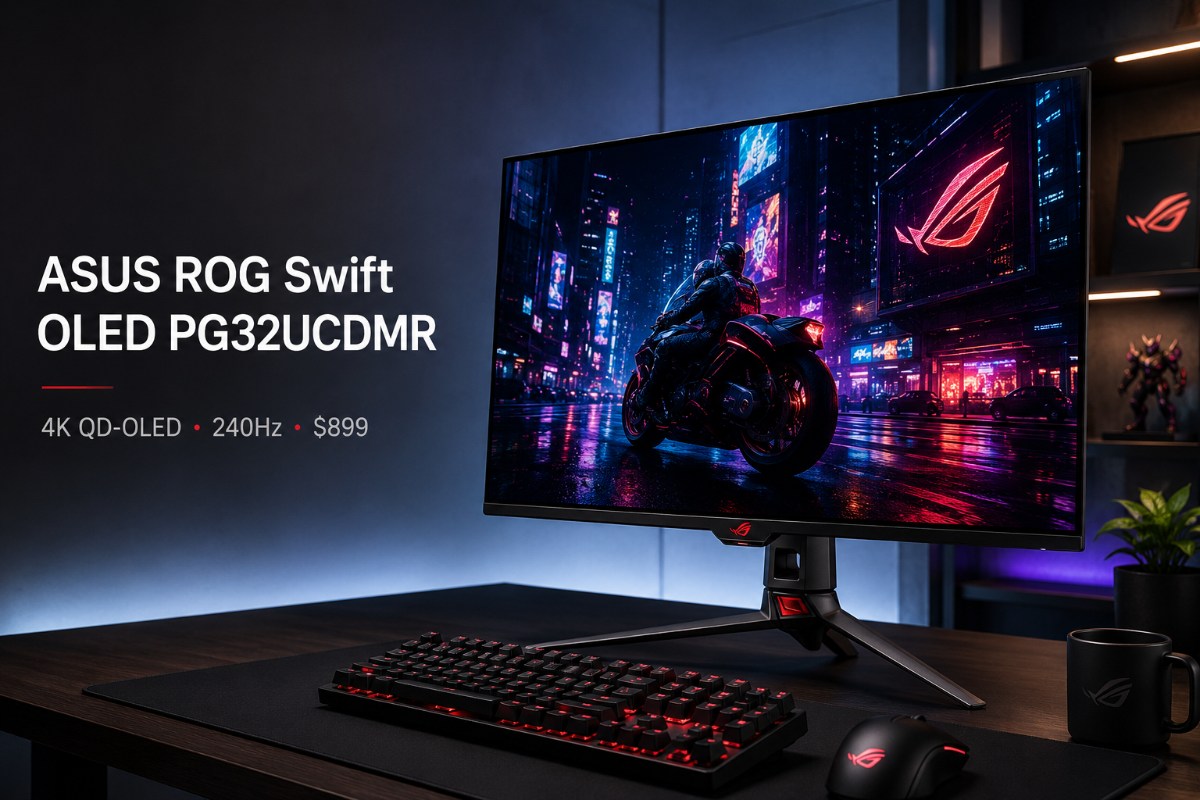
The discount brings enthusiast-level display hardware closer to a wider group of PC and console buyers.
ASUS 4K 240Hz QD-OLED monitor: Top-tier 4K OLED gaming monitors have stayed above the $1,000 mark for years. ASUS is now pushing one of its flagship displays below that line. The ROG Swift OLED PG32UCDMR has fallen from $1,299.99 to $899.99, cutting about $400 from the original price.
Buyers get a 31.5-inch 4K QD-OLED panel with a 240Hz refresh rate and a 0.03ms response time. Connectivity includes full-bandwidth DisplayPort 2.1a, dual HDMI 2.1 ports, a USB hub, and USB-C video with 90W power delivery. That is enough to keep many 14-inch work laptops charged and support lighter use on some 16-inch machines without their usual power bricks.
A built-in KVM switch lets 1 keyboard and mouse control 2 connected computers. The monitor can therefore anchor a desk that runs a gaming PC or PS5 at night, then connects to a work laptop during the day.
The $900 Sweet Spot
Make no mistake, $900 is still a major investment for a monitor. The value looks stronger when compared with the original $1,300 price, especially because DisplayPort 2.1a can carry uncompressed 4K video at 240Hz.
Buyers should also pay attention to the Swift label. ROG Swift is ASUS’s flagship gaming-monitor family, while ROG Strix generally sits below it. Some deal listings use the Strix name, but this model is a Swift. That makes the price more significant than the mislabeled listings suggest.
The panel can display 240 frames per second, although the connected hardware still matters. Even an RTX 4090 needs aggressive DLSS upscaling and frame generation to chase that target in Cyberpunk 2077. Lighter competitive games such as Valorant can reach the monitor’s upper range much more easily.
Its 99% DCI-P3 color coverage also gives the display uses beyond gaming. Photographers, video editors, and other creators can benefit from its deep contrast and broad color range, although professional work still requires proper calibration.
The Burn-In Caveat
Like every OLED display, this panel remains vulnerable to permanent burn-in when static images stay on screen for long periods. The Windows taskbar, Chrome tabs, and an Adobe Premiere Pro timeline are common examples.
To reduce the risk, ASUS includes OLED Care Pro, a custom heatsink, and a proximity sensor that turns the screen black when the user steps away. The 3-year warranty also covers burn-in under normal use.
These safeguards offer useful protection, but they do not make OLED ideal for every desk. Anyone who spends 8 hours a day looking at the same spreadsheet or editing interface should think carefully before choosing this panel.
Why The Price Is Falling Now
ASUS has already introduced the newer PG32UCDM3. That model uses Tandem QD-OLED, which stacks 2 light-emitting layers to increase peak brightness and extend the panel’s working life. It also adds a BlackShield coating that ASUS says delivers 2.5 times better scratch resistance and up to 40% deeper perceived blacks in brighter rooms.
With the Gen 3 version entering the market, the $400 reduction looks like a familiar inventory-clearing move, even though ASUS has not described it that way. The older display still delivers the features most buyers are likely to notice: 4K resolution, 240Hz speed, strong contrast, modern connectivity, and practical desk-sharing tools.
The discount does not make premium OLED monitors cheap. It does show how quickly the category is moving toward prices that more high-end PC builders can realistically consider.
Also Read: Black Flag Resynced Finally Makes PS5 Pro Feel Worthwhile

Anup Singh is an independent technology journalist and content writer covering Apple, Android, AI, laptops, gaming, and the consumer tech industry. He focuses on delivering factual, well researched, and easy to understand reporting while explaining how new technologies impact everyday users.
1 thought on “ASUS Slashes $400 Off Its Premium 4K 240Hz QD-OLED Gaming Monitor”