Valve Steam Machine: Early revenue tracking points to a profitable niche, though Valve’s lottery system makes demand hard to measure.
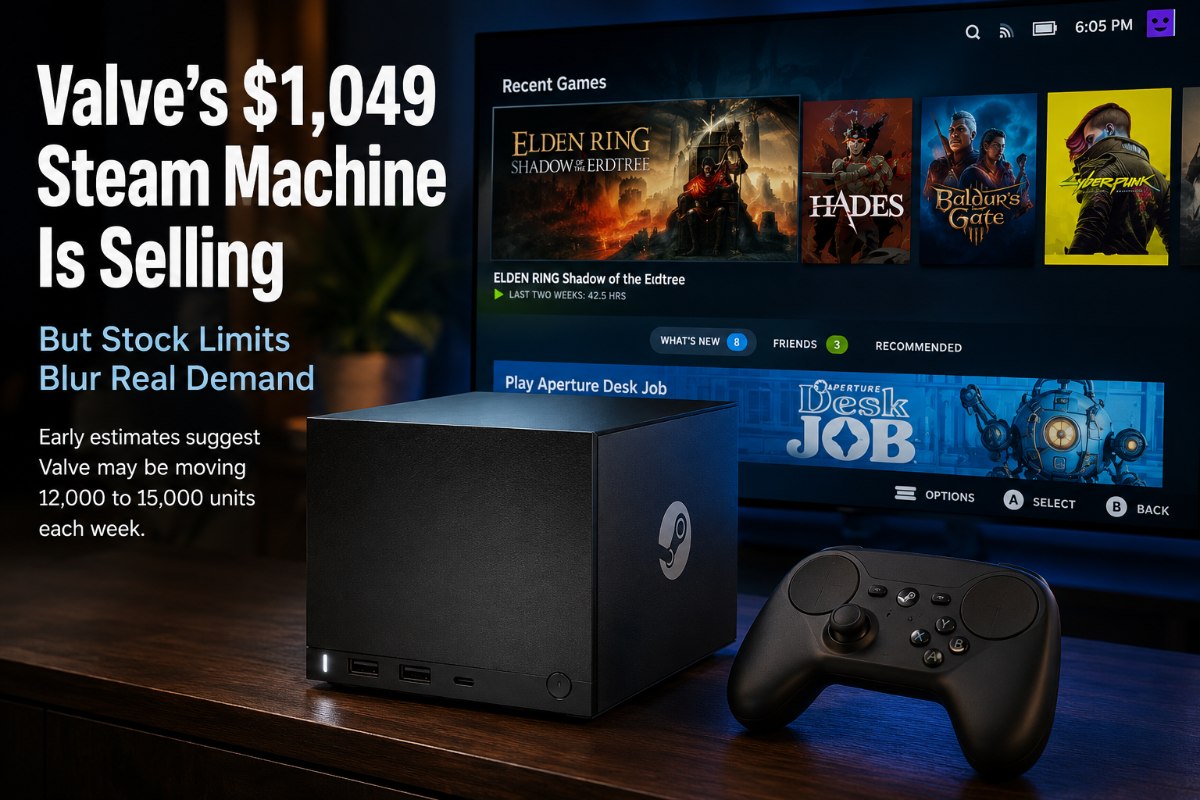
At $1,049, Valve’s revived Steam Machine is expensive for a living room gaming box. Early figures still suggest PC gamers are buying every limited batch the company can release. Boiling Steam projects weekly sales of roughly 12,000 to 15,000 units after the hardware climbed to second place on Steam’s Global Top Sellers chart.
Valve refuses to publish hardware sales, so the calculation requires detective work. Boiling Steam reverse engineered the ranking by using Counter Strike 2 above the machine as a revenue ceiling and popular software below it as a floor. That produced a weekly range of $10 million to $18 million. The site then applied an average purchase price near $1,150, based on an assumed mix of the $1,049 and $1,349 models.
The math offers a credible baseline. It cannot reveal how many buyers remain in Valve’s reservation queue.
The Chart Measures Money, Not Machines
Steam ranks products by gross revenue rather than unit volume. This quirk allows a $1,049 device to outrank a popular $60 game with far fewer transactions.
The chart uses a rolling 24 hour window and gives extra weight to purchases from the most recent 3 hours. Whenever Valve emails a fresh batch of invitations, the Steam Machine can briefly rocket upward even if broader demand has not changed.
Valve randomized the original reservation lists before launch and now offers units as stock becomes available. Sales velocity is controlled by Valve’s lottery and production capacity as much as customer appetite. A weekly total of 15,000 may represent strong demand, the company’s supply ceiling, or both.
A Compact PC With Desktop Class Graphics
Valve built the Steam Machine for PC gamers who want console simplicity without leaving their Steam libraries. Its 6 inch cube contains a 6 core AMD Zen 4 processor and a discrete custom RDNA 3 graphics chip with 8GB of GDDR6 video memory. That desktop class GPU separates it from the integrated design inside the Steam Deck.
The system also carries 16GB of DDR5 memory and either 512GB or 2TB of NVMe storage. Even so, the entry model costs $450 more than Sony’s $599 PlayStation 5 Digital Edition. Valve is charging for compact engineering, SteamOS, and PC flexibility rather than competing as a subsidized console.
This is Valve’s second attempt at the concept. Its 2015 Steam Machines relied on outside manufacturers and faded after weak sales. The new model comes directly from Valve, giving the company control over the hardware and software.
AI data centers have absorbed RAM and storage, tightening supply across consumer technology. Valve said the shortage destroyed its cheaper pricing target and sometimes left key parts unavailable at any price.
Valve engineer Pierre Loup Griffais described how suppliers now dictate both the monthly price and the quantity available.
“They give us a price every month or something and they say, ‘you can buy that many,’ and it’s yes or no,” Griffais said.
Valve Only Needs A Profitable Niche
PC hardware forums remain split. Some call the premium a small form factor tax for quiet cooling, compact design, and easy setup. Others see an underpowered computer carrying a large Valve premium, especially because the controller costs extra.
The early calculation cannot settle that argument. It does show that a meaningful group of buyers accepts the price.
Valve does not need PlayStation numbers to call this hardware a success. Moving close to 15,000 premium living room PCs each week would prove that a hungry niche exists. The randomized waitlist still leaves everyone guessing at the true ceiling of long term demand.
Also Read: Sony’s 2026 PS Plus Lineup Reopens the Digital Ownership Debate

Anup Singh is an independent technology journalist and content writer covering Apple, Android, AI, laptops, gaming, and the consumer tech industry. He focuses on delivering factual, well researched, and easy to understand reporting while explaining how new technologies impact everyday users.
1 thought on “Valve’s $1,049 Steam Machine Is Selling, But Stock Limits Blur Real Demand”