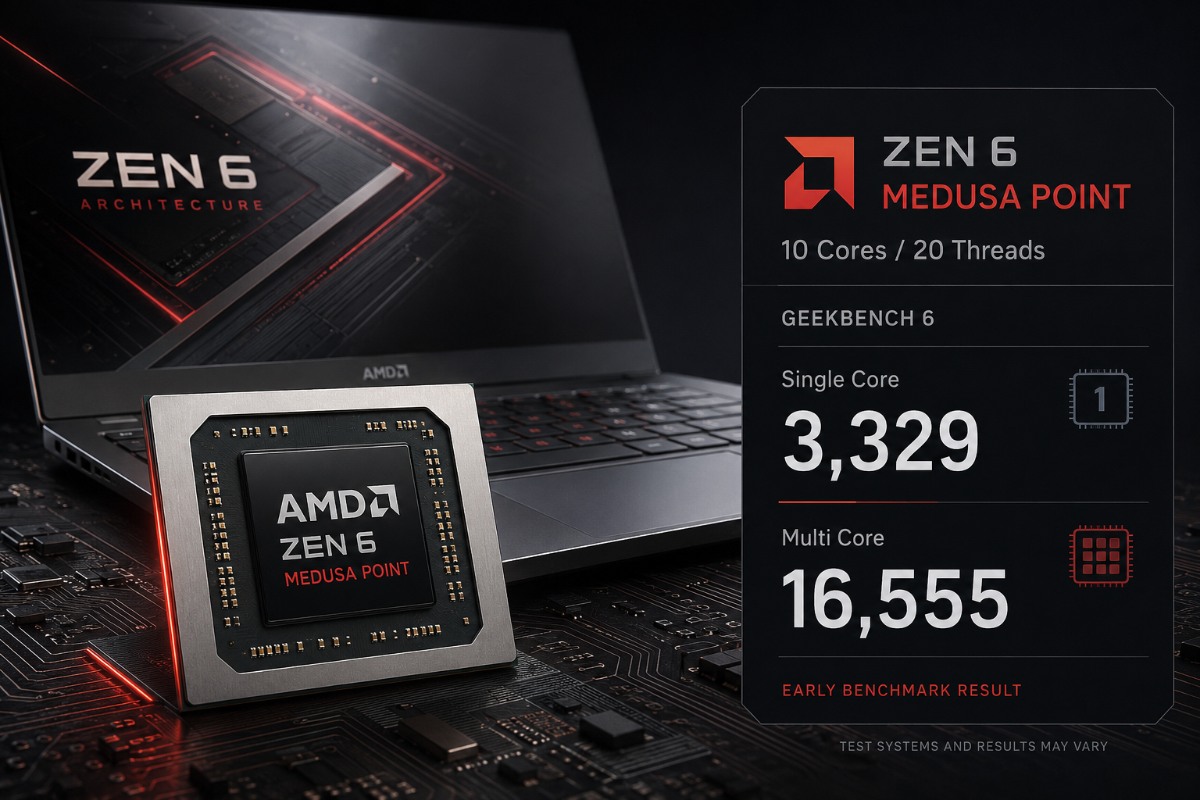
AMD Zen 6 Medusa: The 10 core engineering sample beats a current Strix Point comparison, but its clock speeds, power limits, and final laptop performance remain unsettled.
AMD’s 2027 laptop roadmap is already beginning to surface through benchmark leaks. A new Geekbench 6 result for an unreleased Medusa Point processor offers an early glimpse at how Zen 6 could compare with today’s Ryzen AI chips.
The engineering sample scored 3,329 in the single core test and 16,555 in the multi core test. For comparison, the 10 core Ryzen AI 9 365 averages about 2,470 and 12,407 in the figures used for this test. That gives the new sample a lead of nearly 35% in single core performance and about 33% across all cores.
Hardware leaker HXL originally surfaced the result. The entry identifies the processor as a 10 core, 20 thread chip running on AMD’s Plum MDS1 test platform. It also lists 32 MB of L3 cache, 10 MB of L2 cache, AVX 512 support, and AMD’s newer FP10 BGA package for mobile processors.
Decoding The Benchmark
The chip appears to use a 4 plus 6 core arrangement. Current reporting interprets that layout as 4 standard Zen 6 cores paired with 6 smaller Zen 6c cores. AMD has not officially confirmed that configuration, so it should still be treated as an informed reading of the engineering data.
Zen 6c cores are expected to deliver the same basic instruction support as standard Zen 6 cores while using less silicon area. They are designed to improve core density and efficiency rather than act like Intel’s more limited efficiency cores.
Hardware enthusiasts are taking note of the sheer gap. This early sample is clearing the current Ryzen AI 9 365 by roughly 859 points in single core performance without adding more CPU cores.
That points toward a large gain from higher clock speeds, improved IPC, or a combination of both.
The 5.37 GHz Question
The leaked telemetry reportedly captured the Medusa Point sample boosting as high as 5.37 GHz. That speed provides important context for the 35% advantage, since the Ryzen AI 9 365 can reach up to 5.0 GHz.
However, the public benchmark information has shown inconsistent frequency reporting. Early firmware or incomplete monitoring support could explain the difference. Another possibility is that the internal boost reading did not appear correctly on the public summary page.
A benchmark without confirmed clock speeds or power limits tells only half the story. If the sample needed unusually high power to reach 5.37 GHz, retail laptops may struggle to sustain that performance without more heat, fan noise, or battery drain.
CPU Performance Is Not AI Performance
AMD has confirmed that the Medusa family is planned for 2027, with improvements expected across performance per watt, efficiency, and NPU capability. While outlining its client processor roadmap, AMD said its “AI compute performance trajectory continues to outpace the industry.” The company has not announced this processor’s final name, specifications, or neural processing hardware.
That distinction matters. Geekbench measures general CPU performance. It does not test the dedicated NPU that handles many local AI workloads.
AMD builds its Ryzen AI NPUs around the XDNA architecture. These dedicated engines process tasks such as background effects, image recognition, and supported generative AI features more efficiently than the CPU. A faster Zen 6 processor may help software and development workloads, but the leaked scores reveal nothing about Medusa Point’s NPU speed.
What It Could Mean For 2027 Laptops
Strong single core performance can improve older game engines, some Adobe Creative Cloud operations, large Excel models, browser responsiveness, and code compilation. The 16,555 multi core result could also benefit rendering, software builds, and heavy multitasking.
Ultimately, thermal efficiency will dictate the chip’s success. AMD could strengthen its position in premium laptops if these gains survive in retail silicon under normal power limits.
For now, the benchmark provides a credible sign of Zen 6 progress. It does not yet provide a definitive measure of Medusa Point’s final performance.
Also Read: Why Xbox Still Dominates Parental Controls Over Steam and PlayStation

Anup Singh is an independent technology journalist and content writer covering Apple, Android, AI, laptops, gaming, and the consumer tech industry. He focuses on delivering factual, well researched, and easy to understand reporting while explaining how new technologies impact everyday users.
1 thought on “Early AMD Zen 6 Medusa Point Benchmark Shows 35% Single Core Gain”