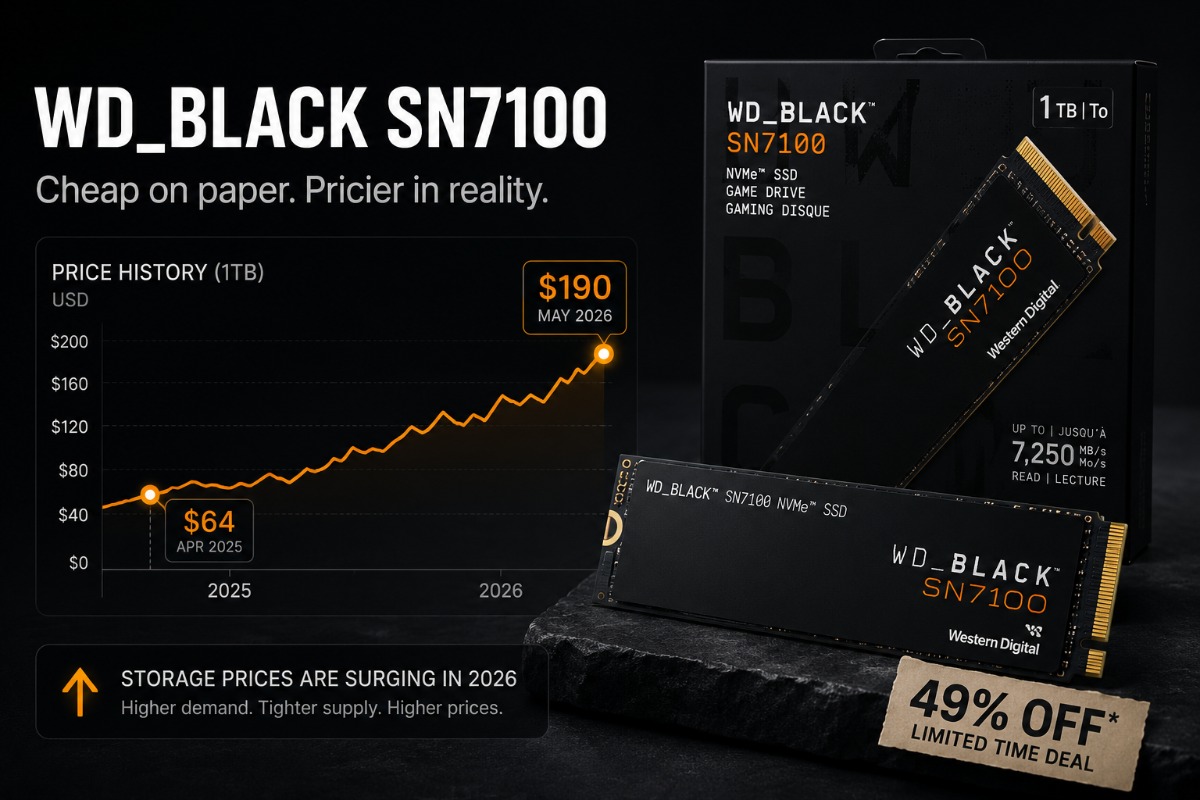
The 1TB SSD costs less than the 500GB model, but its price history makes the advertised saving look far less generous.
A 49% discount on a fast SSD should signal an easy bargain. The WD_BLACK SN7100 1TB complicates that assumption. Amazon is listing the PCIe Gen4 drive for about $190, against a stated reference price of $375. The larger model also costs less than the 500GB version in the same product family, which makes the offer look unusually strong.
Recent pricing history tells a different story. Pangoly’s SN7100 price tracker recorded a low of $63.66 in October 2025 and shows the drive up about 158% across the past year. Tom’s Hardware listed the 1TB model at $84.99 when it reviewed the SN7100 in March 2025.
The current promotion is therefore a discount from a very high reference price, not a return to the levels buyers saw last year. That gap reflects a wider shift in the storage market as suppliers direct more resources toward enterprise products.
What the WD_BLACK SN7100 Actually Offers
The branding requires some explanation. Sandisk became independent from Western Digital in February 2025 and now manages the flash storage business. The company continues to sell products under established names inherited from Western Digital, including WD_BLACK.
The SN7100 uses a PCIe Gen4 connection and 218 layer TLC NAND. TLC stores 3 bits in each memory cell, balancing speed, durability and manufacturing cost. Its M.2 2280 format is the standard physical size used by many modern laptop and desktop motherboards.
Sandisk rates the 1TB model for read speeds of up to 7,250MB/s and write speeds of up to 6,900MB/s. The drive has no dedicated DRAM chip. Instead, it uses a small amount of system memory to track data locations.
The Tom’s Hardware review found excellent power efficiency and strong random read performance. Its testing also described broader performance as mediocre and noted that competing drives cost about 10% less at the time. Those results make the SN7100 attractive for laptops and compact systems, but harder to justify at $190.
AI Demand Is Reshaping Storage Prices
Consumer SSDs and enterprise storage systems rely on NAND Flash memory. A TrendForce market report expects NAND contract prices to increase another 10% to 15% during the third quarter of 2026.
“Demand for NAND Flash will continue to be driven primarily by AI inference,” TrendForce said, while pointing to large data center deployments as a major source of pressure on supply.
AI systems need fast storage to hold model files and keep large volumes of information ready for processing. Cloud companies are placing substantial orders for high capacity enterprise SSDs, which can offer suppliers larger contracts and stronger margins than consumer drives.
This shift leaves less production capacity available for cheaper PC storage. It also helps explain how an SSD can carry a large discount while still costing far more than it did 1 year earlier.
Retail reference prices add another layer of confusion. A percentage reduction measured against an unusually high list price can make an ordinary market price look exceptional.
What the Discount Means for Buyers
People who need an SSD immediately should compare the SN7100 with other 1TB and 2TB Gen4 models at current prices. Its efficiency and laptop friendly design remain genuine strengths. Buyers who can wait should continue watching price trackers, since the $190 offer is nowhere near the drive’s 2025 level.
The unusual price advantage over the 500GB version likely reflects uneven retailer pricing rather than a genuine doubling of value. Laptop and handheld gaming users may still appreciate the SN7100’s low power consumption. Desktop buyers have more room to consider competing models with stronger sustained performance.
Waiting does not guarantee lower prices while NAND supply remains tight. Still, the 49% label should not serve as the main measure of value. Recent price history and the cost of comparable drives provide a much clearer picture.
Read More: Hidden RTX 50 Hotspot Data Reveals 107°C Throttling Missed By Windows Tools

Anup Singh is an independent technology journalist and content writer covering Apple, Android, AI, laptops, gaming, and the consumer tech industry. He focuses on delivering factual, well researched, and easy to understand reporting while explaining how new technologies impact everyday users.
1 thought on “WD_BLACK SN7100 Deal Highlights the Surging Cost of PC Storage in 2026”