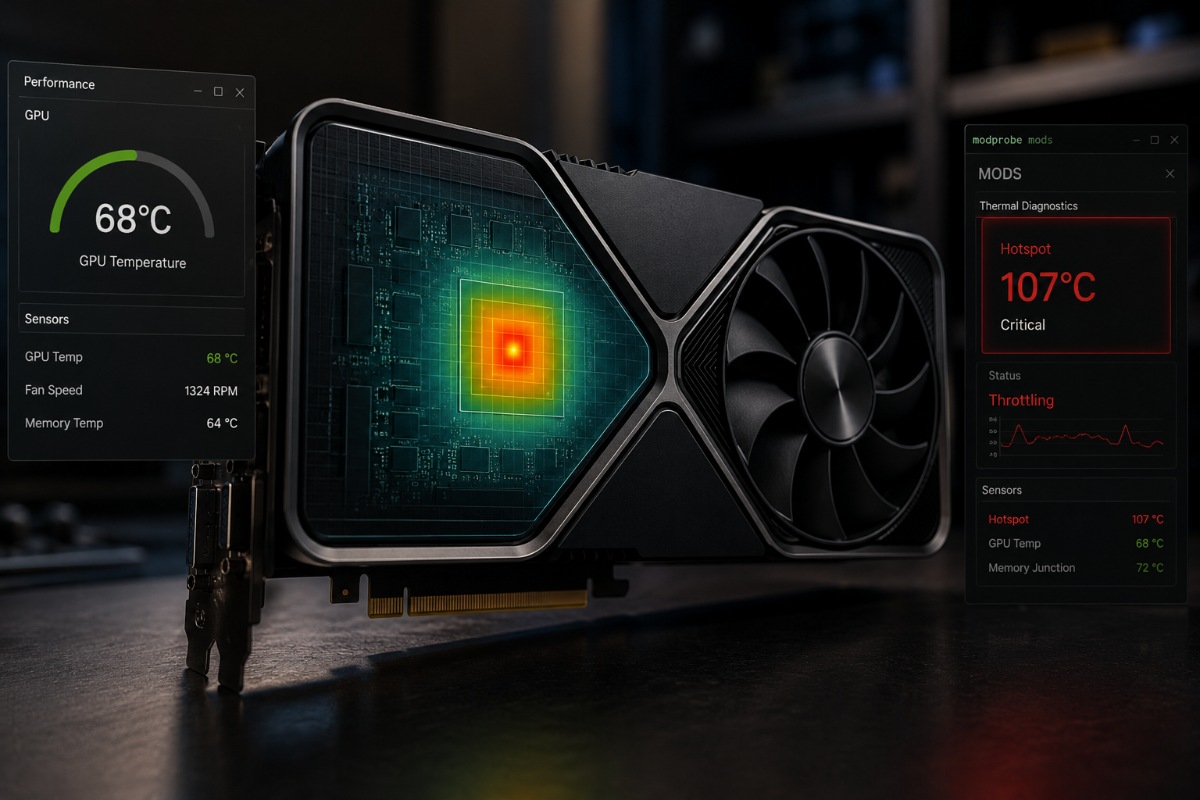
RTX 50 hotspot data: An internal NVIDIA diagnostic suite exposed a critical temperature gap that ordinary owners cannot see.
An RTX 5070 Ti can appear healthy in Windows while one part of its processor is already running at 107°C.
Brazilian repair specialist Paulo Gomes and his team uncovered that gap while diagnosing a Gigabyte card with loud fans and falling clock speeds. Standard monitoring programs reported a GPU temperature of roughly 67°C to 68°C. NVIDIA’s internal software showed the hotspot at the reported 107°C throttle limit for Blackwell GeForce hardware.
The software was MODS, short for Modular Diagnostic Software. NVIDIA uses the proprietary suite for factory validation and warranty testing. It is not officially available to consumers and requires a specialized Linux environment rather than a simple Windows installation.
RTX 50 owners cannot read the same hotspot value through common monitoring programs. The sensor is active. The hardware records the data. NVIDIA’s public software interface simply does not expose it.
What A Hotspot Reading Actually Measures
The main GPU temperature provides a broad reading for the processor. The hotspot figure reports the hottest measured point across the chip.
Those numbers can differ sharply when the cooler does not make even contact with the silicon. A massive gap often points to a physical fault, such as degraded thermal paste, uneven mounting pressure or a poorly seated cooler.
NVIDIA removed access to RTX 50 hotspot data from the public telemetry interface used by consumer software. HWiNFO later removed the field because the cards no longer supplied a valid reading through that route. MSI Afterburner faces the same restriction.
A user in a hardware enthusiast discussion wrote, “So it exists, Nvidia just hides it for some reason.”
That frustration reflects a practical problem. The missing figure is not merely an extra statistic for enthusiasts. In this case, it separated a normal temperature report from a graphics card actively reducing performance at its thermal ceiling.
There is no evidence that NVIDIA is hiding a widespread cooling crisis. Still, the software restriction can conceal valuable evidence when a genuine hardware fault occurs.
The 107°C Repair Case
Gomes and his team opened the Gigabyte RTX 5070 Ti after MODS exposed the throttle condition. They found poor thermal interface material coverage, with paste pushed toward the edges and a dry area near the center of the processor.
Poor factory application can create this pattern. Weak mounting pressure may also prevent the cooler from making consistent contact across the chip.
After replacing the paste, the team recorded a hotspot of about 100°C. The card also stopped throttling during the same workload.
A single faulty Gigabyte card does not prove that every RTX 50 Series model has a cooling defect. It does confirm that the onboard hotspot reading remains active and useful. Reviewers now need to test more cards to determine whether this was an isolated assembly failure.
Why NVIDIA Might Restrict The Reading
Hardware companies sometimes limit access to raw sensor data because brief temperature spikes can look alarming without posing a real danger. A hotspot may rise quickly for a fraction of a second while the average chip temperature remains safe.
Exposing every transient reading could trigger unnecessary support calls, returns and warranty requests from owners who mistake normal behavior for a defect. That is a plausible industry explanation for restricting the metric, but it is not a complete justification. The same data becomes essential when a card suffers sustained throttling, extreme fan speeds or unstable performance.
Without hotspot access, owners may see acceptable core temperatures while the processor protects a much hotter area by cutting clock speeds. The restriction can also complicate warranty claims. Standard logs may show normal temperatures without explaining why performance collapsed.
Ultimately, this is a question of diagnostic transparency. Restoring access would not repair bad paste or weak cooler pressure. It would turn a frustrating guessing game into a faster, targeted diagnosis. On premium graphics cards, that is basic visibility into how the hardware is operating.
Also Read: Xbox Disc To Digital Rumour Tests Trust As Sony Ends New Game Discs

Anup Singh is an independent technology journalist and content writer covering Apple, Android, AI, laptops, gaming, and the consumer tech industry. He focuses on delivering factual, well researched, and easy to understand reporting while explaining how new technologies impact everyday users.
1 thought on “Hidden RTX 50 Hotspot Data Reveals 107°C Throttling Missed By Windows Tools”