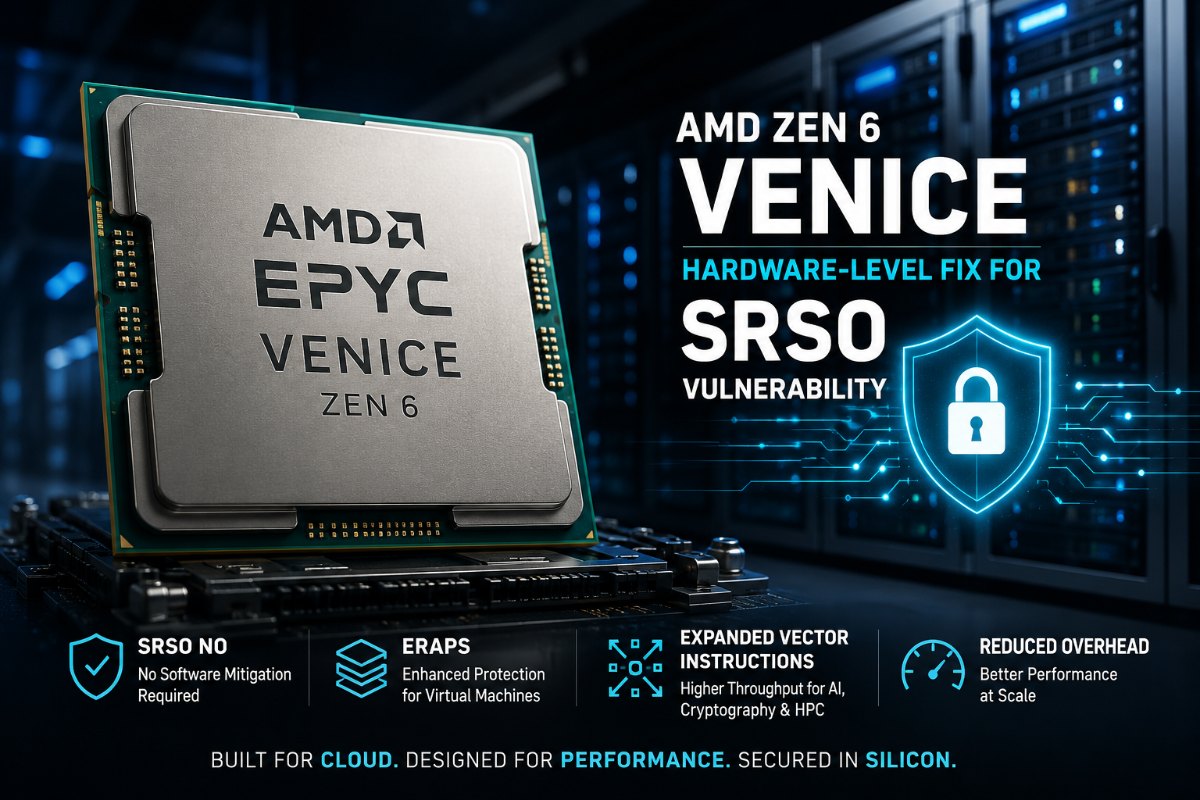
AMD Zen 6 Venice: Early QEMU code points to a silicon fix, broader vector support and practical gains for cloud operators.
Data center operators may soon get relief from one of AMD’s most persistent speculative execution problems. A QEMU patch submitted by AMD engineer Ben Cheatham adds an EPYC Venice processor model based on the Zen 6 architecture. The code sets the SRSO NO flag, which tells operating systems and hypervisors that the processor is not vulnerable to Speculative Return Stack Overflow.
SRSO, also known as Inception, manipulates the CPU’s return prediction system. A successful attack can steer speculative execution toward an attacker controlled address and potentially expose protected data. Older Zen processors rely on software mitigations, including branch prediction flushes when systems switch between users or virtual machines. Those protections consume processor time and can reduce performance in busy cloud environments.
An OpenBenchmarking entry from a Venice engineering sample separately reports that the silicon is not affected. AMD has not published final specifications, but the matching records provide a strong early look at its security direction.
Security Moves Into The Silicon
AMD’s security guidance states that processors reporting SRSO NO do not require software mitigation for the vulnerability. Cloud operators could therefore recover performance currently spent clearing branch prediction state during context switches. Across large server fleets, even a modest reduction in overhead can lower operating costs.
The Venice model also enables Enhanced Return Address Prediction Security, or ERAPS. Early documentation suggests the feature controls how much return address history the predictor tracks for each guest operating system. That matters in virtualized servers, where several customers may share a single physical processor.
QEMU and KVM environments stand to benefit most directly because the Venice model is already being added to that virtualization stack. Xen based clouds and OpenStack deployments using KVM could also gain from stronger separation between guest operating systems on shared EPYC hosts.
Cheatham wrote in the QEMU submission that the patch series adds support for AMD’s upcoming EPYC Zen 6 CPU models. The wording confirms that the code is part of AMD’s formal software preparation for Venice rather than an unofficial community effort.
System administrators will still need firmware and operating system updates. Moving the main SRSO defense into hardware should reduce the administrative burden and remove a recurring source of performance loss.
Venice Also Expands Vector Processing
The new CPU model adds AVX512 FP16, AVX IFMA, AVX NE CONVERT, AVX VNNI INT8 and AVX512 Bit Matrix Multiply support. These instructions allow the processor to complete more mathematical work with each operation.
Cloud providers could use them for local AI inference, data conversion, cryptography and scientific computing. Hardware analyst InstLatX64 wrote in a post on X that AVX VNNI INT8 may offer roughly 2 times the throughput of Zen 5. That remains an architectural estimate rather than a measured benchmark result.
Developers must compile or update their software to use the new instructions. Actual gains will depend on clock speeds, memory bandwidth, power limits and workload design.
Beyond those software requirements, the patch also offers a closer look at Venice’s physical cache architecture. It lists a 48 KB L1 data cache and a 32 KB L1 instruction cache per core, unchanged from Zen 5 Turin. The model also includes 1 MB of L2 cache per core and 64 MB of L3 cache shared at the die level.
AMD Is Days Away From A Fuller Reveal
QEMU support gives developers and cloud providers time to prepare virtual machine definitions and guest operating system support. It does not confirm pricing, shipping dates, memory specifications or final core counts.
AMD CTO Mark Papermaster has said the company will introduce the Zen 6 generation at its Advancing AI event in San Francisco on July 22 and 23. Full Venice details should clarify how broadly AMD applies these security and compute changes.
Independent benchmarks will determine Venice’s competitive position. Removing the software overhead tied to SRSO mitigation is already a practical improvement for operators running dense virtual environments.
Also Read: CXMT DDR5 Hits 8600 MT/s, But Stability Will Drive Mainstream PC Adoption

Anup Singh is an independent technology journalist and content writer covering Apple, Android, AI, laptops, gaming, and the consumer tech industry. He focuses on delivering factual, well researched, and easy to understand reporting while explaining how new technologies impact everyday users.
1 thought on “AMD Zen 6 Venice CPUs Add Hardware Level Fix For SRSO Vulnerability”