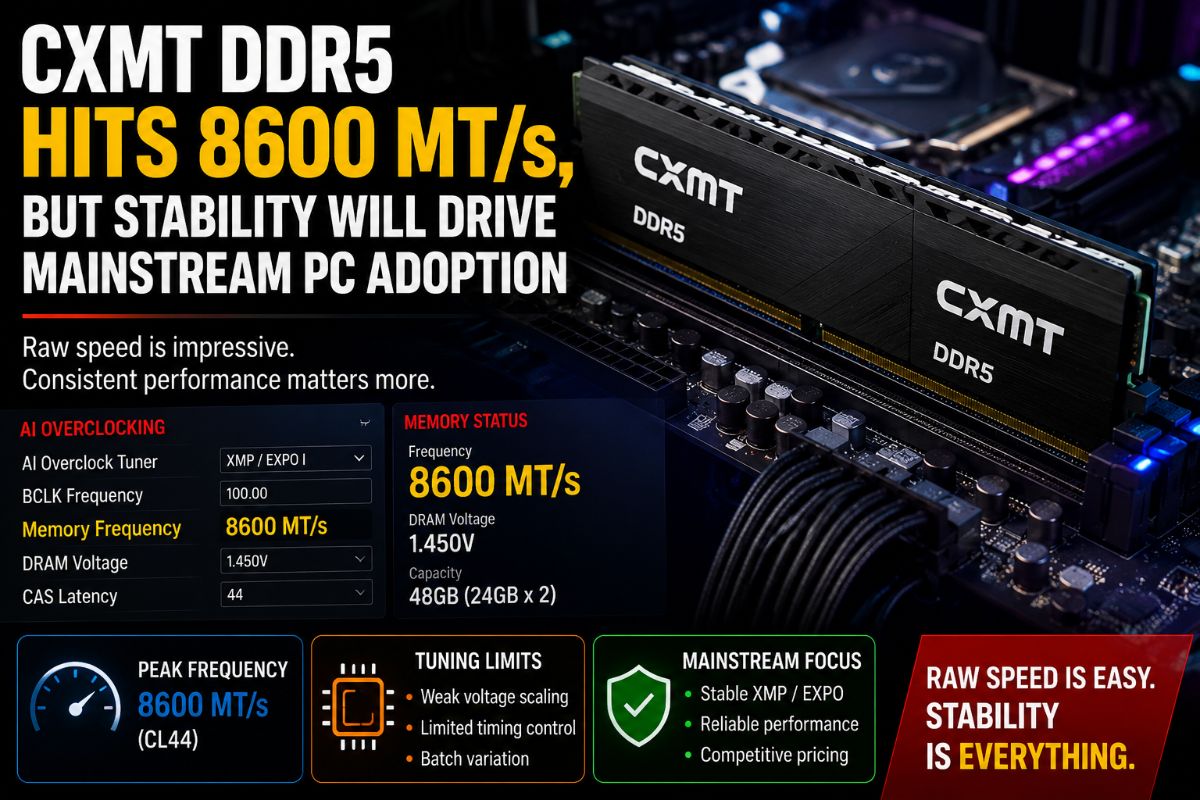
CXMT DDR5: China’s rising memory supplier can now reach impressive frequencies, though consistent retail performance matters more than a single overclocking result.
Chinese memory maker CXMT is pushing DDR5 into territory once dominated by established suppliers. A KingBank 48GB kit using two 24GB modules recently reached 8600 MT/s after starting from a rated DDR5 6000 CL36 profile. That result shows how quickly China’s domestic memory industry is closing the raw frequency gap.
Speed alone does not make the kit a direct rival to premium SK Hynix memory. Overclocker SafeDisk found weak voltage scaling, limited timing flexibility and large differences between CXMT production batches. Uniko’s Hardware later shared those findings. Testers have yet to publish a complete set of gaming, application and latency benchmarks.
This represents one tested kit rather than the average retail module. Still, the result matters during a global DRAM supply squeeze. Samsung and SK Hynix are directing more capacity toward expensive high-bandwidth memory and server products for artificial intelligence systems, leaving PC manufacturers searching for additional suppliers.
Raw Speed Meets Technical Limits
Jumping from DDR5 6000 to 8600 MT/s naturally increases available bandwidth. SafeDisk reportedly achieved that frequency at CL44, which remains a respectable result for a budget-tier memory kit.
Other timings proved harder to improve. Settings such as tRCD and tRP control how long memory waits before the processor can begin reading data from a newly opened row. CXMT chips resisted tighter values, while adding voltage produced little extra tuning room.
Because of those loose timings, an 8600 MT/s screenshot does not guarantee premium enthusiast performance. SK Hynix still holds an advantage for buyers chasing the lowest possible latency in expensive gaming systems.
Mainstream customers use a simpler standard. They want XMP or EXPO profiles to load correctly, pass stability tests and work without hours inside a BIOS menu.
“We don’t need high performance RAM from them. Just regular 5600 to 6000 MT/s sticks will do,” one hardware reader argued.
That pragmatic view captures CXMT’s most realistic opportunity. Office machines, affordable gaming PCs and branded desktops do not need record-setting memory. They need dependable modules at sensible rated speeds.
Motherboard Support Is Moving Quickly
MSI recently used dedicated beta BIOS tuning to raise validated CXMT speeds on selected AM5 motherboards. Models with two memory slots moved from a previous ceiling near 6800 MT/s to 8200 MT/s, while boards with four slots reached 7200 MT/s. Those updates remain limited to selected products and regional releases.
Memory brands are also beginning to adopt the chips. Corsair Vengeance DDR5 modules using CXMT DRAM have appeared in China with XMP and EXPO support. Lexar is preparing THOR II kits rated as high as DDR5 7600.
These moves give CXMT a path into real consumer systems before it wins over specialist overclockers. Wider motherboard validation should also reduce compatibility problems and help manufacturers create more reliable memory profiles.
Consistency Will Decide The Outcome
Buyers should not automatically expect lower prices. Memory vendors have indicated that CXMT chips can cost about as much as comparable products from Samsung, SK Hynix and Micron. Competition may eventually push prices down, but current evidence does not guarantee immediate savings.
That pricing reality raises the standard CXMT must meet. Without a deep discount, mainstream buyers have little reason to accept unstable profiles, inconsistent production batches or extra BIOS work. Flawless out-of-the-box operation becomes the company’s clearest route into ordinary PCs.
For CXMT, the real test is proving it can ship thousands of stable, nearly identical modules. Retail kits must behave predictably across different motherboards, BIOS versions and production runs.
One overclocking result does not make CXMT a premium competitor. It does show that Chinese memory makers are closing the frequency gap. Strong quality control and dependable profiles will decide whether buyers view CXMT as a credible alternative rather than a cheaper experiment.
Also Read: ASUS RTX 5070 Price Drop Tests Whether Better Deals Fix Weak Value

Anup Singh is an independent technology journalist and content writer covering Apple, Android, AI, laptops, gaming, and the consumer tech industry. He focuses on delivering factual, well researched, and easy to understand reporting while explaining how new technologies impact everyday users.
1 thought on “CXMT DDR5 Hits 8600 MT/s, But Stability Will Drive Mainstream PC Adoption”