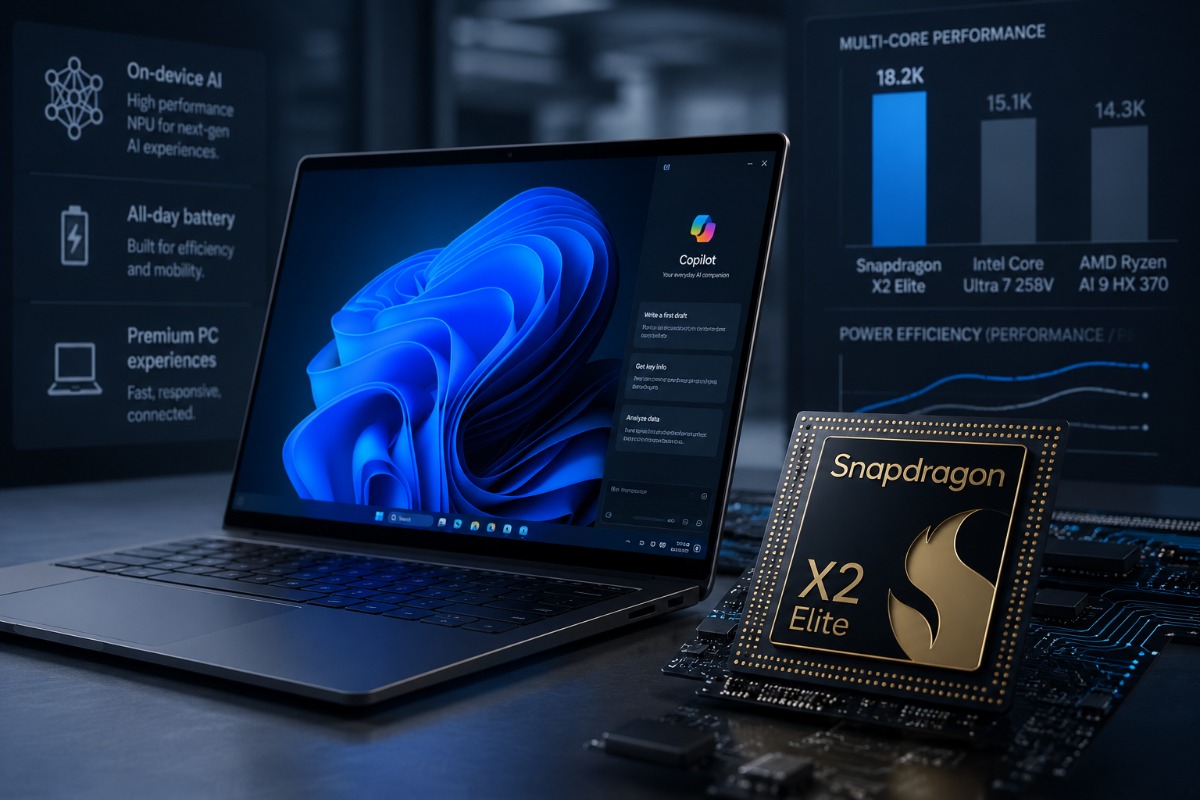
Snapdragon X2 Elite: The X2E 80 100 is not Qualcomm’s flagship laptop chip, but its specs show why the company’s real Windows PC fight may happen in volume machines.
If Windows on Arm is going to move beyond showcase laptops, it will not happen through the most expensive flagship chips alone, but through parts like Qualcomm’s Snapdragon X2 Elite X2E 80 100.
The name is awkward, but the role is clearer. X2E 80 100 appears to be the official SKU identifier for this lower-tier Snapdragon X2 Elite chip. After the first mention, it is easier to think of it as the new entry-level Elite.
That label should not make it sound modest. The chip lists 12 Oryon v3 CPU cores, boost clocks up to 4.7 GHz, 34 MB of cache, Adreno X2 85 graphics and an 80 TOPS neural processor. TOPS means trillion operations per second. Microsoft requires 40 TOPS for Copilot Plus PCs, so Qualcomm is doubling that threshold for local AI tasks.
Qualcomm has not attached this exact SKU to confirmed laptop pricing yet. That matters because the X2E is not supposed to be a halo product. It is built for the machines shoppers actually compare: premium thin laptops, business notebooks and creator-focused systems where speed, battery life and price must land together.
Why This Chip Matters More Than The Flagship
Qualcomm’s fastest X2 Elite Extreme parts will attract the early attention. The X2E may matter more to actual buyers.
Mainstream buyers typically ignore flagship configurations in favor of machines PC brands sell at volume. That means thin premium notebooks, creator-focused ultraportables and higher-end business laptops where price, battery life and compatibility matter as much as raw speed.
If Qualcomm puts strong performance into the lower end of the X2 Elite stack, Windows laptop makers gain more room to build systems that do not depend on the most expensive chip. That gives Qualcomm a better shot at competing in retail categories where buyers usually choose between Intel Core Ultra and AMD Ryzen AI machines.
The architecture also suggests a more mature pitch. The 12-core setup combines 6 prime cores and 6 performance cores. Prime cores handle heavy bursts. Performance cores support lighter and sustained work. Cache, graphics and memory bandwidth then shape how responsive the system feels under real load.
Early Benchmarks Give Qualcomm A Stronger Argument
Geekbench 6 and Cinebench listings give Qualcomm a stronger case than it had with earlier Windows on Arm efforts. The X2E lands in a competitive single-core range, which affects everyday responsiveness. Its multi-core output also looks credible for a lower-tier chip, especially in a lineup where the Extreme models still carry the top performance burden.
Those early numbers do not settle the comparison. Reference hardware, engineering samples, firmware and power limits can all shift before PC makers ship final devices. Cooling will matter too. A thin laptop can make a strong chip look ordinary if it cannot hold speed under sustained work.
Even with that caveat, the workload picture looks encouraging. The X2E should handle heavy Chrome tab loads, large Excel workbooks, common coding tasks and lighter creator workflows without feeling out of place in a premium laptop.
Buyers care little about peak synthetic scores. They want apps to run cleanly. They want the battery to survive heavy workloads. They want performance to hold up away from a charger. Retail machines in 2026 will answer those questions better than any early benchmark table.
The Real Test Is Software, Not Silicon
The claimed performance has sparked curiosity among creators and power users. Some praised the jump in CPU and AI capability. Others focused on a more practical concern: will the platform support the tools they already use?
That concern surfaced directly in replies to Qualcomm’s launch post, where 1 user asked whether Linux support would be available at release. The question matters because many expert users still rely on x86 systems for development work, hardware tools and operating system flexibility.
This is Qualcomm’s harder problem. The company can build efficient silicon, but it still needs the software ecosystem to back it up. Developers need dependable tooling. Creative users need plug-ins, drivers and native app support. Businesses need stable deployment, predictable security updates and clear support windows.
Windows on Arm has improved, but compatibility still decides trust. A laptop can benchmark well and still lose buyers if a key workflow breaks.
Intel And AMD Now Face A Stronger Snapdragon Floor
The X2E gives Qualcomm a credible foundation for the next stage of its Windows PC push. It does not need to beat every Intel or AMD chip in every benchmark to matter. Its job is to make Snapdragon laptops feel fast, quiet and dependable in everyday use.
That is why this lower-tier model deserves attention. It points to a strategy built around scale rather than spectacle. Qualcomm is not only chasing the top of the chart. It is trying to raise the floor.
If retail laptops deliver on the early numbers, Intel and AMD will face a more serious Arm-based rival in the premium Windows market. Should the software experience remain uneven, the benchmarks will matter less than the frustration they fail to solve.
Also Read: Sony’s 2028 PlayStation Disc Cutoff Reignites Digital Ownership Debate

Anup Singh is an independent technology journalist and content writer covering Apple, Android, AI, laptops, gaming, and the consumer tech industry. He focuses on delivering factual, well researched, and easy to understand reporting while explaining how new technologies impact everyday users.
1 thought on “Qualcomm’s Entry-Level Snapdragon X2 Elite Tests The Waters For Next-Gen Windows PCs”