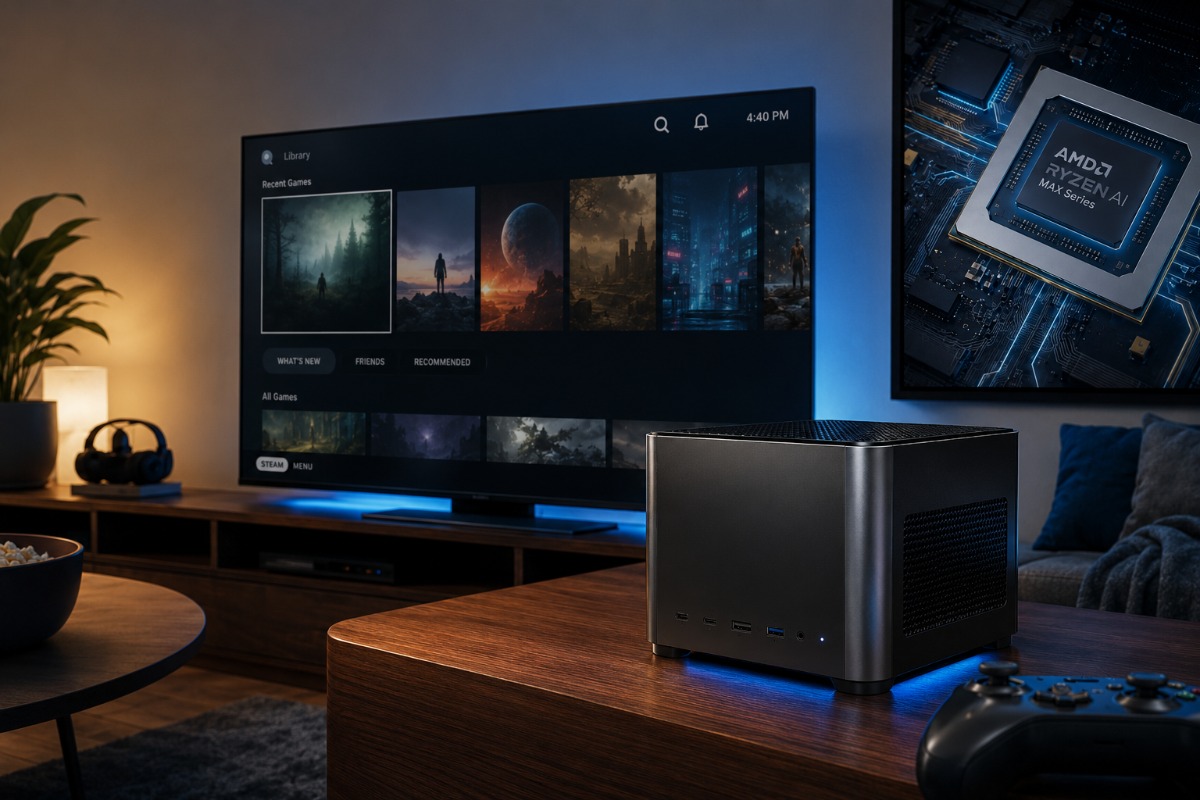
Ryzen AI Halo SteamOS: A wild SteamOS mod shows how powerful AMD’s Ryzen AI Halo silicon can be, while exposing why this kind of performance still needs cheaper hardware.
What happens when you force SteamOS onto a $4,000 workstation built for artificial intelligence? You get a compact gaming box that can outclass Valve’s official Steam Machine in demanding titles, while also proving exactly why this hardware is not ready for normal living rooms yet.
YouTuber ETA Prime loaded SteamOS 3.8.14 onto a $3,999 AMD Ryzen AI Halo MiniAI workstation. AMD packed the system with a Ryzen AI Max+ 395 processor, a 16 core, 32 thread Zen 5 chip, 128GB of LPDDR5X unified memory, and Radeon 8060S integrated graphics with 40 RDNA 3.5 compute units. The key trick was memory allocation. Instead of leaving the system at a normal firmware controlled graphics memory split, ETA Prime pushed the allocation to 96GB for the GPU. That gave the integrated graphics far more breathing room than a typical gaming box would ever have.
The result was not just interesting. It was genuinely impressive for an iGPU. In Cyberpunk 2077 at native 4K Ultra with no upscaling, the Ryzen AI Halo system hit 27 FPS, compared with 18 FPS on Valve’s Steam Machine.
How The SteamOS Experiment Worked
The mod was not magic. ETA Prime used a SteamOS recovery image to get Valve’s Linux based gaming platform running on the Ryzen AI Halo system. That matters because raw hardware power is only half the story. A living room gaming PC also needs a simple interface, reliable controller support, quick resume behavior, and easy game compatibility checks.
Valve’s Verified system makes hardware compatibility a core part of buying games. It tells users whether a game has been tested and should work properly on Steam Deck or Steam Machine hardware. For any compact SteamOS PC, that software layer is just as important as the chip inside.
“The Halo also works with Steam’s wake from sleep function,” one user noted.
That seamless wake from sleep function is exactly why this hardware mod matters. Gamers do not just want higher frame rates. They want the flexibility of a PC paired with the plug and play ease of a console.
Why The Benchmarks Looked Better At 4K
The Ryzen AI Halo box did not simply win everywhere by brute force. At 1080p, the gap was narrower because the system appeared more limited by CPU behavior and platform overhead. At higher resolutions, the huge memory pool and stronger integrated graphics had more room to show their advantage.
That is why the 4K results stood out. Cyberpunk 2077 is brutal on graphics hardware, and 27 FPS at native 4K Ultra is still not a perfect couch gaming experience. But against the Steam Machine’s 18 FPS, it showed a 50 percent lead. Shadow of the Tomb Raider was more playable, reaching 62 FPS at 4K compared with 44 FPS on Valve’s box.
The massive 96GB graphics memory allocation was central to that result. It did not turn the Radeon 8060S into a discrete graphics card, but it helped remove one of the usual constraints on integrated graphics: tiny memory reserves.
The Price Still Breaks The Argument
Nobody is actually going to buy a $4,000 AI workstation just to play Cyberpunk 2077 from their couch. But stacking a $4,000 workstation against a much cheaper console style PC is not a fair fight either.
There is already a more grounded comparison point. Systems such as the GMKtec EVO X2 use the same Ryzen AI Max+ 395 chip for around $1,999. That is still expensive, and models with less memory cannot copy the same 96GB graphics allocation. Even so, it shows how quickly this hardware could move from workstation curiosity to premium gaming mini PC.
The product people seem to want is not this exact machine. It is closer to a $1,000 to $1,500 SteamOS box with 32GB or 64GB of memory, a strong Ryzen AI Halo class APU, fast storage, console style sleep behavior, and enough cooling to stay quiet beside a TV.
AMD Has A Clear Market Signal
This experiment gives the PC industry a clean look at the future of SteamOS desktops. It proves that high performance integrated graphics can make sense in the living room, provided they are packaged for gamers instead of enterprise buyers.
A cheaper SteamOS mini PC with strong integrated graphics is not a silver bullet. AMD and its partners would still have to solve hard engineering problems around memory bandwidth, thermals, driver support, and long term software updates.
Still, the direction is hard to ignore. Ryzen AI Halo was not designed as a console killer. Yet this mod shows that AMD already has the building blocks for a powerful SteamOS gaming machine. The missing piece is not performance. It is price.
Also Read: Black Flag Resynced: The PS5 Pro Finally Gets Its 60 FPS Showcase

Anup Singh is an independent technology journalist and content writer covering Apple, Android, AI, laptops, gaming, and the consumer tech industry. He focuses on delivering factual, well researched, and easy to understand reporting while explaining how new technologies impact everyday users.