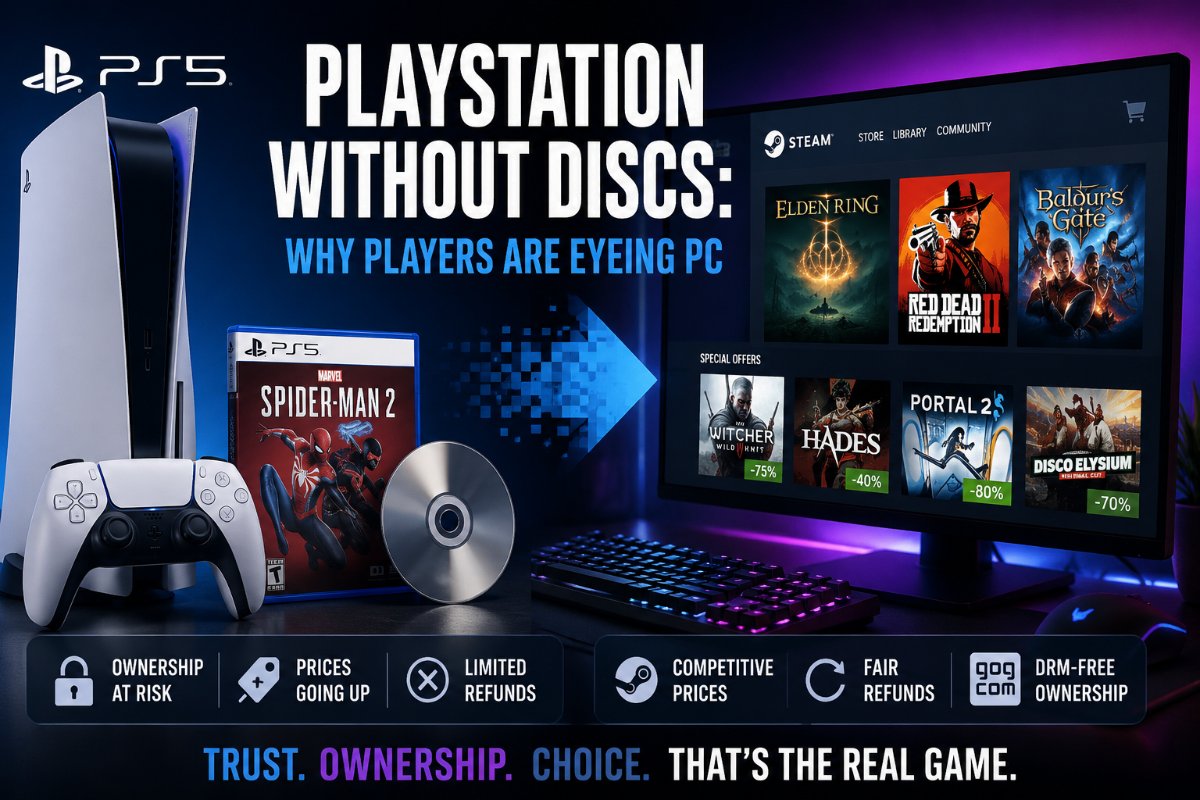
PlayStation Without Discs: Sony’s move toward a download only future has turned a console preference debate into a larger fight over ownership, pricing, and trust.
A simple plastic disc has become the latest stress test for Sony’s relationship with PlayStation fans. Sony says physical game disc production for all new games releasing on PlayStation consoles will end starting January 2028. After that, new releases will be sold on PlayStation Store and at retailers in digital formats only. The company says the change will not affect games already released, or titles that arrive on disc before the cutoff.
The backlash is not theoretical. A Push Square poll voted on by more than 6,500 readers found that 45% of PlayStation enthusiasts were seriously considering moving to PC. Another 15% said they had already made the transition, while 23% said they would stick with PlayStation. We should not mistake this poll for a mass exodus. It is a voluntary survey of highly engaged users. Still, it captures a real pressure point: Sony is asking its most loyal customers to trust an all download future at the same time many of them are questioning platform control.
Why Discs Still Mean Trust
For Sony, the business logic is simple. Downloads reduce packaging, shipping, manufacturing, and retail complexity. They also make the PlayStation Store more central to each purchase.
Players see the trade differently. A physical game can be shared, resold, collected, and preserved. More importantly, it can be bought from competing retailers. A $69.99 first party release may see $10 or $20 discounts at a store like Amazon, Walmart, or Best Buy, while a download version depends on Sony’s own sale calendar. That turns the disc into a price tool as much as an ownership symbol.
This is why the anger has spread beyond collectors. Removing discs without better rights or stronger pricing competition makes PlayStation feel like a walled garden. One longtime PlayStation user summarized that frustration directly, saying, “I will be leaving for PC if they stop producing physical disks. GOG and STEAM are both better environments.” The comparison matters because users are no longer judging PlayStation only against another console. They are judging it against a broader PC market with more storefronts, more price pressure, and more control over how games are bought and stored.
Why PC Stores Look More Attractive
The PC is not a return to physical media. Most PC games are also downloads. The difference is that the PC market has competing storefronts, and that competition gives users more room to choose.
Steam offers a standard refund path for games bought within 2 weeks and played for less than 2 hours. PlayStation Store gives users 14 days too, but games and add ons generally lose refund eligibility once downloading or streaming begins, unless the content is faulty.
GOG adds another contrast because many of its games are DRM free. In plain terms, that means supported titles can be installed and played without the same kind of online authentication limits. GOG also frames its store around the idea that players should own what they buy, which explains why its name keeps appearing in arguments about PlayStation’s future.
Sony Still Has A Large Buffer
Sony is not facing a confirmed customer collapse. The PlayStation business remains huge. Sony lists PS5 hardware sales at more than 93 million units as of March 31, 2026, plus 125 million monthly active PlayStation users.
That scale matters. Casual players may stay because PlayStation remains simple, familiar, and tied to existing libraries, friends lists, subscriptions, controllers, and living room habits. Convenience still has value, especially for users who do not want to build or maintain a gaming PC.
The risk is reputational first. Hardcore users often shape the conversation before the wider market reacts. To survive this transition, Sony has to offer players an actual incentive to give up discs, not just a cost saving measure for itself. Better refunds, stronger library protections, sharper store pricing, and real retailer competition for download codes would help. Without those changes, Sony’s disc less future may look less like progress and more like a narrowing of consumer choice.
Also Read: As PlayStation Discs Die, Sony’s Region Locks Threaten Your Digital Library

Anup Singh is an independent technology journalist and content writer covering Apple, Android, AI, laptops, gaming, and the consumer tech industry. He focuses on delivering factual, well researched, and easy to understand reporting while explaining how new technologies impact everyday users.
1 thought on “PlayStation Without Discs: Why Sony’s Digital Shift Has Players Eyeing PC”