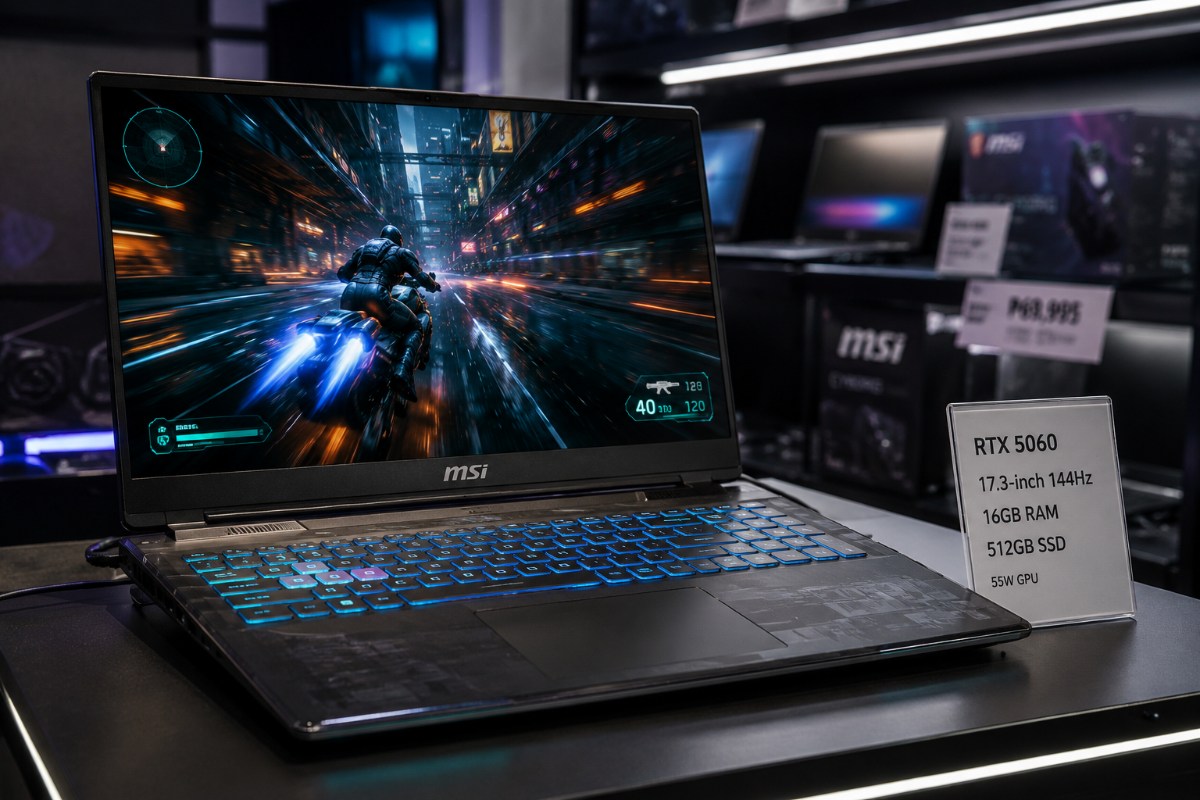
The 17.3-inch gaming laptop brings Nvidia’s Blackwell graphics to mainstream retail, but buyers need to read the fine print.
Nvidia’s RTX 5060 is finally trickling down to mainstream gaming laptop buyers. With the Cyborg 17, MSI is bringing Blackwell graphics and a 17.3-inch screen to retail shelves, but the accessible positioning comes with important limits. The Cyborg 17 B2RWFKG 420PH features a 17.3-inch Full HD 144Hz IPS-level display. Under the hood, it pairs an Intel Core 7 240H processor with Nvidia’s GeForce RTX 5060 Laptop GPU, 16GB of DDR5 memory and a 512GB SSD. MSI positions the machine as a large-screen option for buyers who want a modern GPU and a visible gaming aesthetic without paying flagship prices. Regional pricing changes the value story. In the United States, similar RTX 5060 Cyborg 17 configurations sit near $1,000 to $1,100. In the Philippines, the 420PH configuration lists at ₱110,950. That price does not kill the laptop’s appeal, but it makes the compromises much harder to overlook.
MSI Is Selling Blackwell To Mainstream Shoppers
That pricing context matters because MSI is not only chasing the small crowd that studies power limits and benchmark charts. The bigger story is where MSI is selling this laptop. The Cyborg 17 is built for retail shelves where students, families, casual gamers and first-time gaming laptop buyers make faster decisions.
That changes the pitch. In a specialist PC store, the RTX 5060 badge starts a technical debate about wattage, cooling, memory bandwidth and frame generation. In general retail, it becomes a simpler promise: newer Nvidia graphics, a large screen and smoother gaming than an older entry-level laptop can offer.
Philippine electronics retailer DataBlitz captured that pitch with the line, “Level up your game with Cyborg speed.” It is blunt marketing, but it explains the product’s target well. MSI wants the Cyborg 17 to feel like an easy step into modern PC gaming, not a machine that requires buyers to decode every part number before checkout.
That is also why the spec list looks so familiar. Big screen. 144Hz refresh rate. RTX graphics. 16GB memory. Windows 11. MSI uses that checklist well, but the product becomes more complicated once buyers move past the headline specs.
The 55W Cap Defines The Real RTX 5060 Story
The RTX 5060 Laptop GPU is the main hook, but it is not the whole story. MSI lists this Cyborg 17 configuration at 55W maximum graphics power with Dynamic Boost. That is a conservative limit for a modern gaming GPU.
Such a cap matters because laptop graphics chips do not perform the same across every machine. A GPU with the same RTX 5060 name can run faster in a thicker laptop with more cooling and more power. In a thinner or value-focused system, the same chip may sit much closer to the lower end of its range.
The Cyborg 17 is not weak, but buyers must manage their expectations. A 55W RTX 5060 should still handle 1080p gaming, especially with DLSS 4 in supported titles. DLSS uses AI-assisted upscaling and frame generation to boost perceived smoothness. It can help a laptop like this stretch its performance.
The power limit may also help MSI control heat inside a 17.3-inch chassis, but mainstream buyers should not confuse a bigger laptop with silent fans or long unplugged gaming sessions. Real gaming performance will still depend on cooling, fan behavior and whether the machine is plugged in.
An RTX badge alone cannot replace raw power, cooling and sustained clock speed. In some games, a higher-wattage RTX 4050 or RTX 4060 laptop from the previous generation could challenge a low-watt RTX 5060 machine. That is why the 55W figure matters more than the sticker on the palm rest.
The Big Screen Helps Gaming But Exposes 1080p Limits
The 17.3-inch display gives the Cyborg 17 an obvious appeal. A larger panel makes games, video and school work feel more comfortable than they do on smaller gaming laptops.
A 144Hz refresh rate also makes sense for this hardware. Competitive games benefit from smoother motion, and 1080p keeps the GPU workload realistic. MSI is not pretending this is a 4K machine. It is targeting the most practical gaming resolution for the price class.
Stretching 1080p across 17.3 inches does create a trade-off. The pixel density sits around 127 pixels per inch. Text, icons and fine details will not look as sharp as they would on a smaller 15-inch 1080p laptop or a 1440p panel.
Gamers who care more about frame rate than sharpness may accept that compromise. Buyers who also plan to edit photos, work with text all day or use the laptop as a main productivity screen should look closely before choosing the bigger panel.
The 512GB SSD Is The Ownership Warning
The 512GB SSD may be the biggest practical limitation. On paper, it sounds acceptable for a mainstream gaming laptop. In daily use, it can disappear quickly.
MSI lists 1 M.2 NVMe SSD slot for the Cyborg 17 platform. That means storage expansion is not as simple as adding a second drive. A buyer who wants more internal space may need to replace the boot drive, clone or reinstall Windows, then reinstall games and apps.
That changes the ownership cost. The laptop may look affordable at checkout, but many users will eventually need a larger SSD. That upgrade takes planning, time and extra money.
Even a single major shooter can create pressure. Call of Duty Black Ops 6 asks for 102GB of SSD space at launch on PC. After Windows 11, drivers, launchers, updates and a few more games, a 512GB drive becomes tight very quickly.
Buyers should treat 1TB as the more comfortable target for a gaming laptop in 2026. The Cyborg 17 can still work with 512GB, but it demands more storage discipline than many casual shoppers expect.
16GB RAM Is Now The Baseline
Memory is another area where the Cyborg 17 lands in the safe zone, not the generous one. The listed 16GB of DDR5 RAM is enough for gaming, browsing, chat apps and school work today.
For modern PC use, 16GB is no longer a luxury. It is the baseline. Browsers, game launchers, anti-cheat tools, voice chat, capture apps and background updates can all eat into that memory before a game even starts.
Modern games also keep growing. Players who multitask while gaming may feel the limit sooner than expected. Content creators, streamers and heavy browser users should consider a future move to 32GB.
MSI gives the platform 2 memory slots, which helps. Unlike the storage situation, memory upgrades should be more straightforward. Still, buyers should view 16GB as the starting point rather than a long-term ceiling.
What Buyers Should Take From It
The Cyborg 17 gives mainstream gamers a clear entry point into Nvidia’s newest laptop graphics generation. Its appeal is easy to understand: a large screen, a current RTX GPU, 16GB of DDR5 memory and a familiar gaming design.
Ultimately, the Cyborg 17 proves buyers do not need flagship money to get a taste of Nvidia’s latest architecture, provided they can live with the hardware compromises. The 55W GPU limit, single M.2 storage slot and 512GB SSD all matter.
At the right price, this laptop makes sense for 1080p players who want a big screen and modern Nvidia features. At higher regional prices, shoppers should compare it carefully against laptops with stronger GPU power limits, larger SSDs or sharper displays.
MSI has brought the RTX 5060 badge to a broader audience. Now buyers need to look beyond the badge.
Also Read: ASUS TUF A14 Deal Puts RTX 5060 Power Below $1,500
FAQs
Q. Is the MSI Cyborg 17 good for gaming?
Yes, it should suit 1080p gaming well. Buyers should still watch the 55W GPU limit and 512GB SSD.
Q. Does the MSI Cyborg 17 have an RTX 5060?
Yes. The listed model uses Nvidia’s RTX 5060 Laptop GPU, but its 55W power limit shapes real performance.
Q. Can you upgrade storage on the MSI Cyborg 17?
Yes, but it is not simple expansion. The laptop lists 1 M.2 slot, so users may need to replace the boot drive.
Q. Is 512GB enough for a gaming laptop?
It is enough to start, but it fills quickly. Modern games, Windows and launchers can consume space fast.
Q. Who should buy the MSI Cyborg 17?
It fits buyers who want a big 1080p screen, RTX features and mainstream pricing. Power users should compare stronger alternatives.

Anup Singh is an independent technology journalist and content writer covering Apple, Android, AI, laptops, gaming, and the consumer tech industry. He focuses on delivering factual, well researched, and easy to understand reporting while explaining how new technologies impact everyday users.
1 thought on “MSI’s Cyborg 17 Pairs A Massive Screen With A Heavily Constrained RTX 5060”