The 14 inch gaming laptop now makes more sense for portable gamers, but the soldered 16GB memory remains the key compromise.
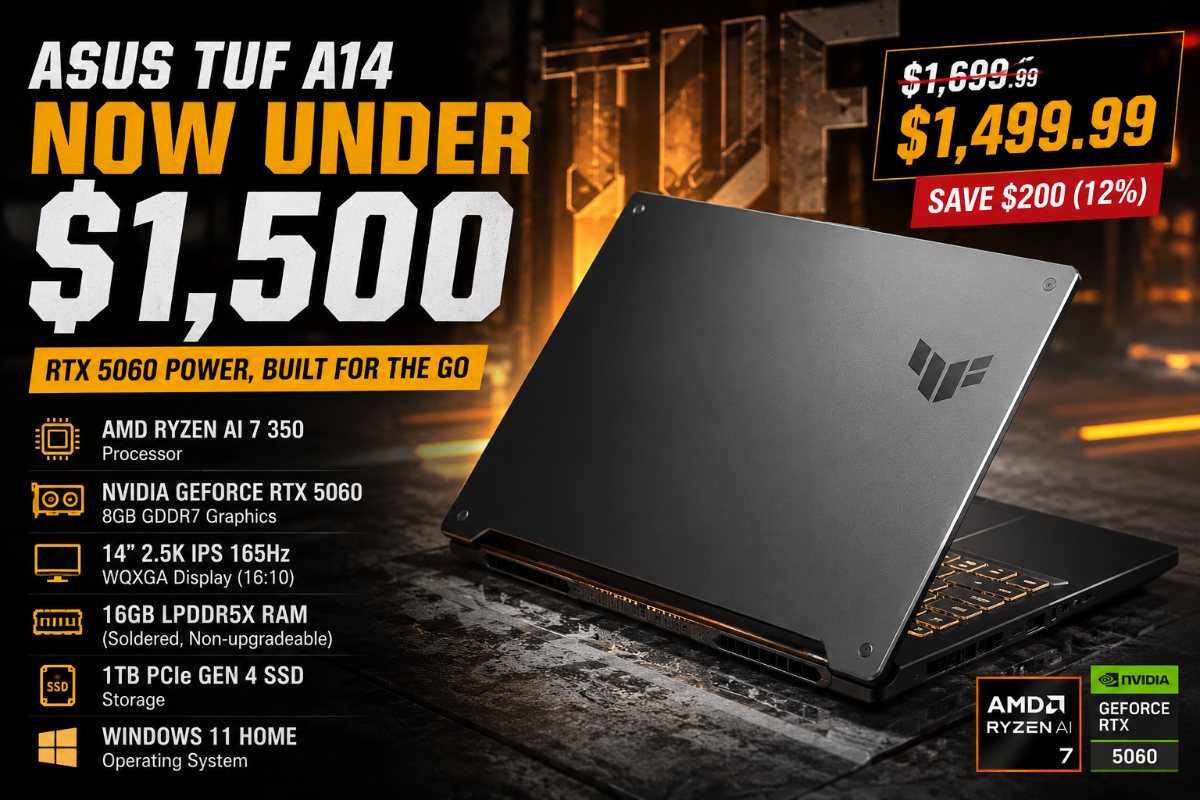
Small gaming laptops usually carry a clear portability tax. You pay more for less bulk, accept tighter thermals, and often give up the upgrade options found in larger machines. That is why the ASUS TUF A14 looks more interesting after a $200 discount brought the RTX 5060 model down to $1,499.99. For that price, buyers get an AMD Ryzen AI 7 350 processor paired with NVIDIA RTX 5060 graphics. ASUS also includes a 1TB PCIe Gen 4 SSD, 16GB of LPDDR5X memory, and a 14 inch WQXGA display with a 165Hz refresh rate. The price cut does not turn the A14 into a budget laptop. It does make the machine easier to take seriously as a compact daily driver that can move from office work to modern games without needing a much heavier chassis.
The Value Case Is Stronger Now
ASUS built the TUF A14 around a clear tradeoff. It gives users gaming hardware in a smaller body, but that smaller body limits thermals, screen space, and memory flexibility. At its original price, those limits were harder to ignore. At $1,499.99, the equation is more balanced.
The RTX 5060 is the biggest part of that shift. It gives the laptop enough graphics power for modern games, Blender rendering, 4K Premiere Pro timelines, and some local AI workloads. Since this is a 50 series GPU, DLSS 4 is also part of the appeal. DLSS 4 can improve frame rates in supported games by using AI based upscaling and Multi Frame Generation. It does not replace raw graphics power, but it helps a compact laptop punch above what its size might suggest.
There is a thermal reality behind that promise. The A14 uses a compact 14 inch chassis, so the RTX 5060 cannot behave exactly like the same chip inside a bulkier 16 inch or 18 inch laptop. Its Total Graphics Power tops out around 110W with Dynamic Boost. That is a strong figure for this size class, but buyers should not expect desktop level performance or the same sustained output as a larger gaming rig with more cooling room.
The Ryzen AI 7 350 also gives the laptop a stronger AI PC foundation. Its NPU can deliver up to 50 TOPS, a measure of how many AI operations it can process each second. That clears Microsoft’s 40 TOPS requirement for Copilot+ PC features. Still, the NPU should not be treated as a magic fix. Today, most buyers will feel the benefit of the GPU, display, battery life, and thermals more clearly than the AI label.
The 16GB Memory Bottleneck
The biggest caution comes from memory. The 16GB LPDDR5X RAM is fast, but it is soldered to the motherboard. Users cannot upgrade it later. That matters far more than a simple spec sheet makes clear.
For mainstream gaming, 16GB can still be enough. Many current titles run well at that level, especially when users keep background apps under control. The problem appears when the laptop needs to handle several heavy tasks at once. A creator editing video, running a browser with dozens of tabs, keeping Discord open, and exporting assets may hit that ceiling sooner than expected.
Local AI work can also raise the pressure. Small models and AI assisted creative tools can run on a machine like this, but memory limits quickly shape what feels smooth and what feels cramped. Buyers who plan to keep the laptop for several years should think carefully before accepting soldered 16GB RAM. The storage can be generous at 1TB, but memory is the part you are stuck with.
Portability Is The Real Selling Point
The Asus tuf a14 makes the most sense for users who want a gaming laptop they can actually carry every day. It weighs about 1.46kg and measures about 1.69cm thick, which puts it closer to a serious daily laptop than a traditional gaming brick. That matters if the same machine has to move between a desk, a classroom, a train, and a home setup.
Battery capacity also supports that role. The 73Wh pack is large for a compact gaming laptop, and fast charging to 50% in about 30 minutes helps when users need a quick top up between sessions. Gaming on battery will still drain power much faster than basic work. That is true for almost every gaming laptop. But the A14 has enough battery headroom to feel more useful away from a wall socket than many heavier performance machines.
Build quality is part of the value question too. A smaller gaming laptop has to resist flex, manage heat, and keep the keyboard comfortable without feeling cramped. The A14’s compact frame gives it a cleaner travel profile, while the TUF branding still points toward durability as a selling point. That does not mean users should treat it carelessly. It means ASUS is positioning this laptop as something built for movement, not just for a fixed desk.
The display helps that case. Its 2560 x 1600 resolution gives more vertical space than a typical 16:9 panel, which is useful for documents, timelines, code, and web work. The 165Hz refresh rate also suits fast games. Even so, a 14 inch screen has natural limits. Staring at it through a long gaming session or a full editing day will feel tighter than using a larger panel. Many buyers will want an external monitor at home.
A Better Deal, Not A Perfect Laptop
At its original price, the A14 was a tougher sell next to larger laptops with more cooling room and stronger upgrade paths. The new $1,499.99 price gives the machine a clearer purpose. It is for buyers who value portability enough to accept the limits that come with it.
That does not make the memory issue disappear. Soldered 16GB RAM is the detail that should slow down creators and heavy multitaskers. The compact chassis also means the RTX 5060 has to work within a tighter thermal envelope than it would in a larger machine.
For the right buyer, though, the deal now makes sense. The A14 is a lightweight Windows laptop that can handle serious gaming, daily productivity, and occasional creative work without feeling oversized. The price cut does not remove every compromise. It simply makes those compromises easier to justify.
Also Read: The $1,000 Alienware 15 Tests How Much Premium DNA Belongs In A Budget Laptop
FAQs
Q. Is the ASUS TUF A14 deal worth it?
It looks stronger at $1,499.99. The main tradeoffs are soldered 16GB RAM and compact laptop thermals.
Q. Can you upgrade the ASUS TUF A14 RAM?
No. The article notes that its 16GB LPDDR5X memory is soldered, so buyers cannot upgrade it later.
Q. Does the ASUS TUF A14 support DLSS 4?
Yes. The RTX 5060 supports DLSS 4, including Multi Frame Generation in supported games.
Q. Is the ASUS TUF A14 good for creators?
It can handle lighter creative work. Heavy creators should think carefully because the 16GB RAM limit may become restrictive.
Q. How portable is the ASUS TUF A14?
The laptop weighs about 1.46kg and uses a 14 inch chassis, making it easier to carry than larger gaming laptops.

Anup Singh is an independent technology journalist and content writer covering Apple, Android, AI, laptops, gaming, and the consumer tech industry. He focuses on delivering factual, well researched, and easy to understand reporting while explaining how new technologies impact everyday users.
1 thought on “ASUS TUF A14 Deal Puts RTX 5060 Power Below $1,500”