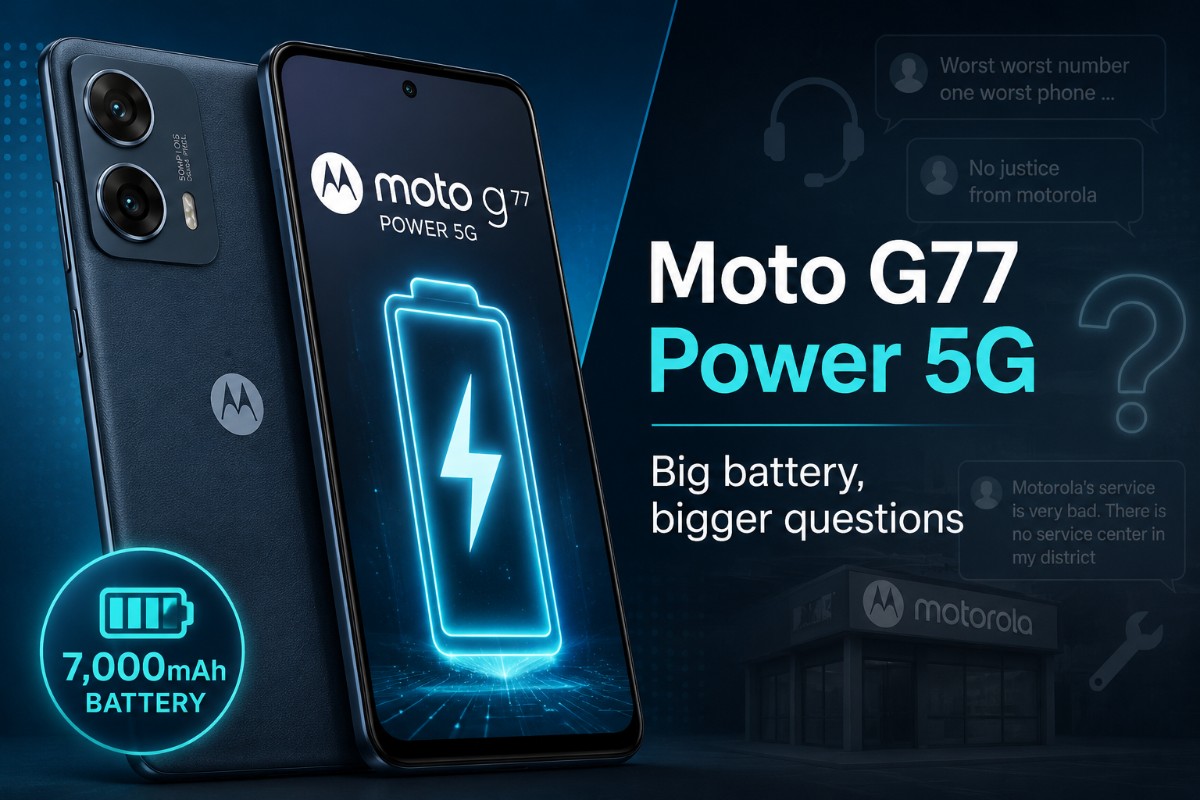
Motorola has built the Moto G77 Power 5G around endurance, but price, storage and after sales support may decide its real value.
With the Moto G77 Power 5G launching on July 8, Motorola is making a direct play for India’s battery first buyers. The phone’s headline feature is a 7,000mAh cell, aimed at users who stream, commute, game and work from their phones all day. That alone gives Motorola a clear hook in a crowded mid range market.
The rest of the phone follows a practical script. It runs on a MediaTek Dimensity 6400 processor with Android 16 and up to 8GB of memory. The display is a 6.72 inch FHD+ LCD panel with a 120Hz refresh rate, while the camera setup includes a 50MP Sony LYTIA 600 main sensor, an 8MP ultra wide lens and a 32MP selfie camera.
Motorola also adds 30W TurboPower charging, IP64 protection, MIL STD 810H durability, Gorilla Glass 7i, stereo speakers, Dolby Atmos, a 3.5mm headphone jack and microSD expansion up to 1TB. The company has nailed the hardware brief for endurance focused users. Now it has to prove the ownership experience can match the spec sheet.
Battery Life Gives Motorola A Clear Identity
The Moto G77 Power 5G does not chase a thin body or a premium glass finish. Its identity starts with endurance. A 7,000mAh battery gives Motorola an easy message in a market where many buyers care more about screen time than benchmark charts.
That approach fits India well. Heavy commuters, gig workers, students and delivery professionals often need a phone that survives long days away from a charger. A larger battery also matters during travel, mobile hotspot use and video heavy routines.
Charging is more modest. The 30W speed will not trouble the fastest phones in the segment, but Motorola is betting that users will accept slower charging if the phone needs the plug less often. The Dimensity 6400 also fits that endurance strategy more than a raw power strategy. If independent tests confirm strong efficiency, the chipset could help Motorola make the most of the larger cell.
The Compromises Sit Below The Headline Spec
Whether these compromises matter depends entirely on where the Moto G77 Power lands on the pricing spectrum. Motorola is expected to keep it under Rs 30,000, where Realme, POCO, Vivo, iQOO, Redmi and Nothing already fight hard on performance, cameras, design and charging speeds.
Storage could become the first pressure point. Early information mainly points to 4GB and 8GB memory options with 128GB storage. MicroSD support helps, but it does not fully replace fast internal storage for apps, games and camera files. UFS 2.2 storage would be acceptable near the lower end of the segment. If the final price climbs closer to Rs 30,000, however, it becomes a much tougher sell against rivals with faster storage and stronger performance tuning.
Memory also matters. The 4GB version may help Motorola lower the starting price, but it risks feeling tight in 2026. Background heavy apps, frequent social media switching, BGMI sessions and Motorola’s Smart Connect features will make the 8GB model the safer pick.
Software support adds another concern. The phone ships with Android 16, but the expected upgrade path points only to Android 17. That is common for many Moto G series phones, yet it weakens the long term pitch for buyers who keep devices for 3 or 4 years. A battery built to last for years deserves software support that lasts beyond 1 major Android update.
Service Questions May Decide Trust
Consumers are looking past the spec sheet. Under Motorola India’s launch post on X, several replies focused on price, storage and after sales service rather than battery size alone. One user wrote, “Motorola’s service is very bad. There is no service center in my district.” Another asked about the tentative price, while a separate reply questioned whether a 256GB variant would be available.
Those comments do not define the entire market, but they point to the real test for Motorola. In Tier 2 and Tier 3 cities, service access can shape buying decisions as much as a chipset or camera sensor. For buyers in hilly areas around Shimla or rural Himachal Pradesh, an authorized repair visit can mean a long road trip, lost work time and extra delays during monsoon season. That is the kind of ownership cost a spec sheet cannot capture.
A phone built for durability still needs reliable repair handling when something goes wrong. Motorola’s social media team routinely funnels public complaints into direct messages. That is standard customer care practice. The bigger issue is whether buyers see enough visible support on the ground.
For users dealing with mountain roads, rain affected travel, field work or daily commuting, durability is useful. Local service confidence is essential. A 7,000mAh battery can reduce charging anxiety, but it cannot fix the frustration of waiting days for basic repair access.
The Verdict Depends On Price And Trust
The Moto G77 Power 5G has a sensible hardware formula. It offers a large battery, a smooth screen, useful durability claims, expandable storage and familiar convenience features. That gives it a real chance with practical buyers.
Still, the phone cannot win on battery size alone. Motorola needs aggressive pricing, a clear 8GB variant, transparent storage options and stronger confidence around service. A competitive price and improved after sales support could turn this strong spec sheet into a daily driver favorite. Without those fixes, the massive battery might not be enough to win buyers’ trust.
Also Read: RedMagic Astra 2 Brings Active Liquid Cooling To Android Gaming Tablets

Anup Singh is an independent technology journalist and content writer covering Apple, Android, AI, laptops, gaming, and the consumer tech industry. He focuses on delivering factual, well researched, and easy to understand reporting while explaining how new technologies impact everyday users.