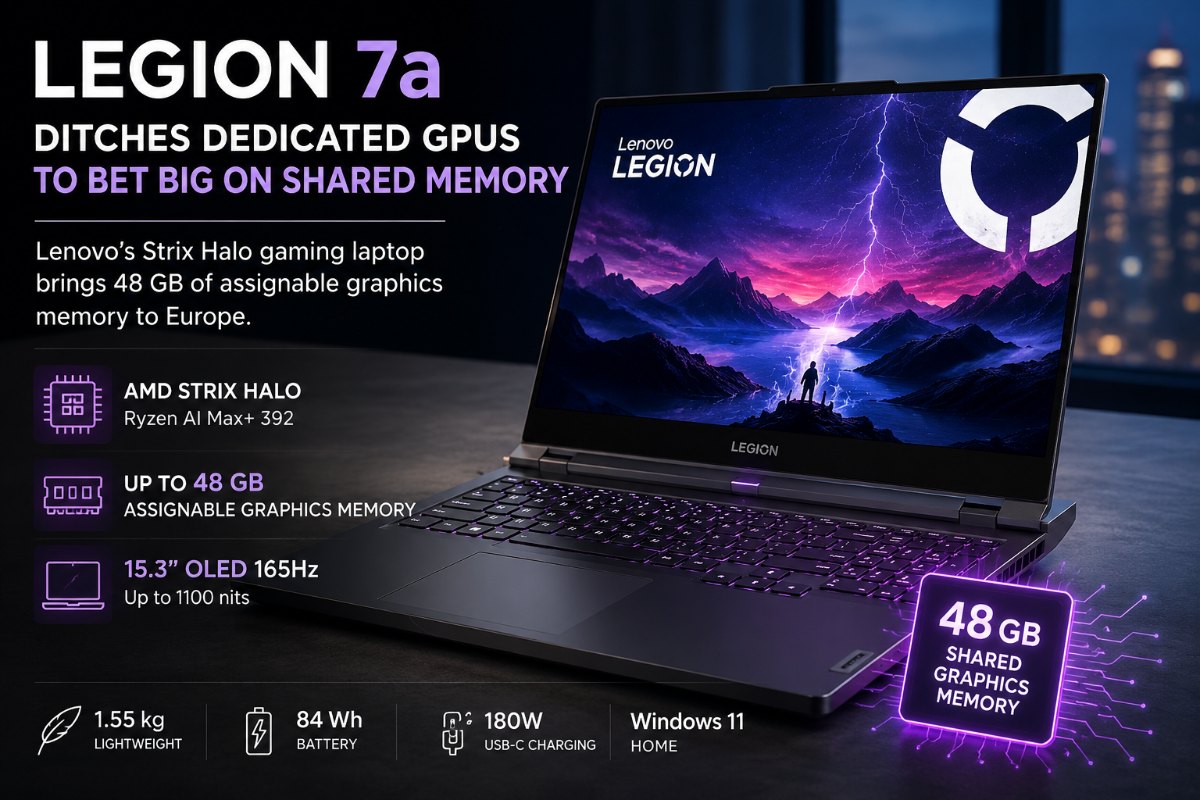
Legion 7a: Lenovo’s Strix Halo gaming laptop brings 48 GB of assignable graphics memory to Europe, but its premium price puts it against serious RTX rivals.
For decades, a £2,100 gaming laptop without a dedicated Nvidia or AMD graphics card would have been a difficult pitch. Lenovo is now testing that idea in Europe with the Legion 7a 15ASH11, a 15.3 inch system built around AMD’s Strix Halo platform instead of a separate GPU.
That price immediately puts it near premium thin gaming laptops with dedicated RTX 5060 and RTX 5070 graphics, including the Asus ROG Zephyrus line and Lenovo’s own Nvidia based Legion systems. Lenovo’s counterargument is memory, portability, and efficiency. The top configuration pairs 64 GB of RAM with a distinctive advantage: users can assign up to 48 GB of that memory directly to the Radeon 8060S graphics unit.
UK pricing starts at £2,100, while European listings sit around €2,419 to €2,470. A North American launch remains unclear.
Strix Halo Changes The Usual Gaming Laptop Equation
Lenovo offers 2 processor tiers: the Ryzen AI Max+ 388 and Ryzen AI Max+ 392. Both are part of AMD’s Strix Halo family, a chip lineup designed to combine high CPU performance, stronger integrated graphics, and AI hardware inside a single package.
That matters because the Legion 7a does not follow the standard premium gaming laptop formula. Most systems in this bracket rely on dedicated RTX 50 series graphics. Lenovo is choosing a cleaner route: a lighter 1.55 kg chassis, a 165 Hz OLED display, an 84 Wh battery, and a graphics system that pulls from shared memory rather than fixed graphics memory.
Its unplugged performance claims are also central to the pitch, but reviewers will need to test them closely. Gaming on battery usually cuts both runtime and performance sharply, and many premium gaming laptops can fall toward the 60 to 90 minute range when pushed hard away from the charger.
Why 48 GB Shared Memory Matters
The 48 GB figure is not just a marketing number. Many laptops with RTX 5060 and RTX 5070 class GPUs commonly ship with 8 GB of dedicated graphics memory, while some higher configurations move to 12 GB. Lenovo’s approach gives the integrated Radeon 8060S access to a far larger shared pool.
That does not automatically make it faster than a dedicated GPU. Shared LPDDR5X memory is not the same as dedicated GDDR7 memory. Bandwidth, drivers, cooling, and game optimization still matter. But capacity can change what the system can attempt.
A developer could run larger local large language models through LLaMA based tools. A creator could work with heavy 8K timelines in DaVinci Resolve. A 3D artist could load larger Blender scenes with massive texture sets. For those workloads, memory headroom can matter more than raw gaming benchmarks alone.
The Price Forces A Hard Comparison
The Legion 7a is interesting because it breaks from the usual template. The difficult part is convincing buyers to pay RTX laptop money for a system without a dedicated GPU.
For pure gamers, an RTX 5060 or RTX 5070 laptop will still look safer. Those machines bring stronger ray tracing support, mature DLSS features, broader game tuning, and more predictable frame rates. At this price, that matters.
Lenovo’s argument is strongest for users who split time between games, creator work, and local AI. Those buyers may care more about the OLED panel, low weight, large shared memory pool, and all AMD design than maximum frames per pound.
The Legion 7a will not kill the discrete GPU. But by leaning hard on AMD’s Strix Halo architecture, Lenovo is proving that ultra thin gaming laptops do not have to depend on a separate graphics card to justify a premium price. Europe will decide whether that tradeoff makes sense.
Also Read: RedMagic Astra 2 Brings Active Liquid Cooling To Android Gaming Tablets

Anup Singh is an independent technology journalist and content writer covering Apple, Android, AI, laptops, gaming, and the consumer tech industry. He focuses on delivering factual, well researched, and easy to understand reporting while explaining how new technologies impact everyday users.
1 thought on “The Legion 7a Ditches Dedicated GPUs To Bet Big On Shared Memory”