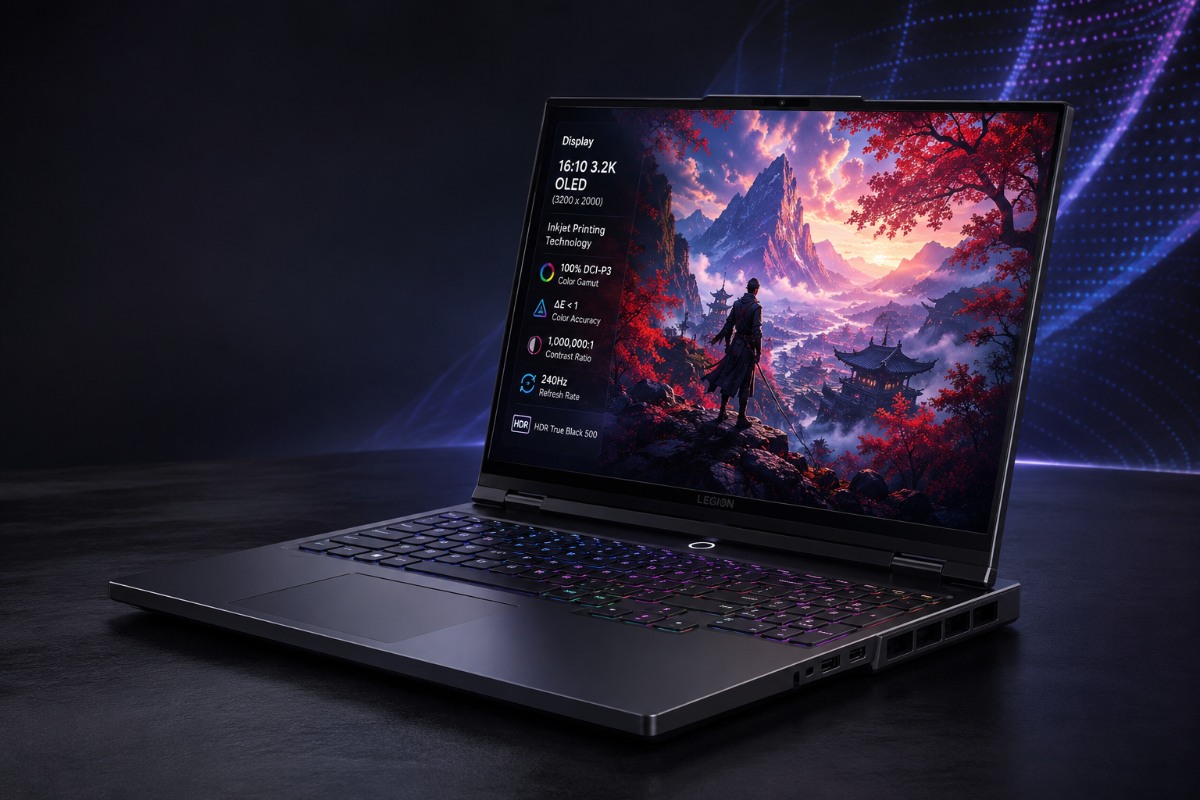
Lenovo Legion R9000P: The new 16 inch gaming notebook brings printed OLED technology into a commercial laptop, but its core hardware remains unknown.
For years, display makers have promised that inkjet printed OLED could simplify production without sacrificing the deep blacks and fast response that make OLED attractive. Lenovo’s Legion R9000P now brings that technology to a commercial gaming laptop with a 240Hz refresh rate, more than 99% DCI P3 color coverage and a Real RGB Stripe subpixel layout.
Those specifications point to a premium gaming display. They also move printed OLED beyond laboratory demonstrations and trade show prototypes. The technology is now inside a consumer product, even though Lenovo has yet to reveal most of the computer surrounding it.
The real story is not the laptop itself. It is the screen technology inside it.
Printing OLED Removes an Expensive Manufacturing Step
Traditional OLED manufacturing uses Vacuum Thermal Evaporation. The process heats organic materials inside a vacuum chamber, then uses Fine Metal Masks to guide those materials into the correct subpixel positions.
Inkjet printing deposits liquid organic material directly onto the panel instead. This removes the Fine Metal Mask stage and reduces reliance on costly vacuum equipment. In theory, the method can simplify production, use materials more efficiently and improve manufacturing yields.
“The result is a streamlined process, more efficient production, and added cost advantages,” TCL CSOT said.
That remains a company claim rather than an independently verified result. New display processes often face low initial production volumes, inconsistent yields and other scaling problems. Independent testing will be needed to show whether TCL CSOT can deliver the efficiency it promises at commercial scale.
A Conventional RGB Stripe Could Sharpen Windows Text
The 240Hz refresh rate will attract gamers, but the Real RGB Stripe layout may matter just as much during everyday use.
Many OLED screens use nonstandard subpixel structures, including triangular PenTile arrangements and WRGB designs. These layouts can produce color fringing or soft edges around fine text. Microsoft designed ClearType around separate red, green and blue components arranged in regular stripes, so unusual layouts can complicate text rendering.
TCL CSOT instead places distinct red, green and blue subpixels side by side within each pixel. The company says this approach reduces blur and color fringing.
That could improve the experience in browsers, productivity software and creative applications. Independent reviews must still test text clarity, brightness, color accuracy and uniformity before the panel’s wider value becomes clear.
The Laptop Around the Screen Is Still a Mystery
Lenovo has not confirmed the panel resolution or peak brightness. Current 16 inch Legion models commonly use 2560 by 1600 displays, making that a reasonable baseline expectation, but it is not a confirmed specification for the R9000P.
The company has also withheld the processor, graphics chip, cooling design, battery capacity, release date and launch markets. Those omissions make the announcement feel more like a display technology demonstration inside a laptop chassis than a complete product launch.
Gaming notebooks offer a logical entry point for the new panel. Enthusiasts already pay more for early technology, premium screens and high refresh rates. That gives manufacturers room to recover development costs before attempting to bring the same process into mainstream machines.
The Legion R9000P proves that printed OLED has escaped the research lab. Until Lenovo puts a price on the laptop, gamers will not know whether cheaper manufacturing produces real savings at checkout.
Also Read: Sony Physical Disc 2028 Phaseout Is Hijacking Indie Game Promotions

Anup Singh is an independent technology journalist and content writer covering Apple, Android, AI, laptops, gaming, and the consumer tech industry. He focuses on delivering factual, well researched, and easy to understand reporting while explaining how new technologies impact everyday users.
1 thought on “Lenovo Legion R9000P Debuts With TCL’s 240Hz Inkjet OLED Screen”