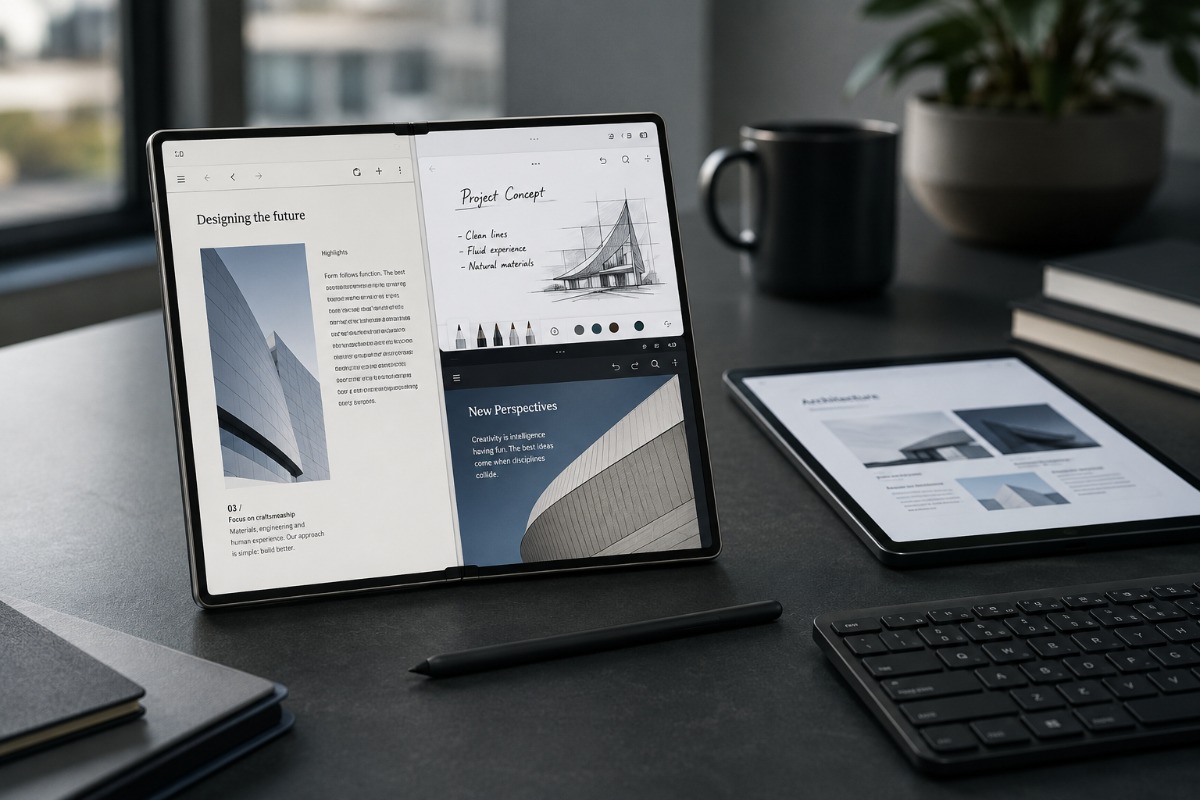
Galaxy Z Fold 8: Samsung’s rumored wider foldable could fix the Fold line’s biggest weakness, but replacing a tablet will take more than a new shape.
When Samsung takes the stage in London on July 22 for Galaxy Unpacked, the biggest news may be a long overdue shape change. The company has teased the event with the line “A New Shape Unfolds,” and recent leaks point to a wider Galaxy Z Fold 8 that moves away from the tall, narrow design that defined earlier Fold models. The Galaxy Z Fold 8 Wide name remains unconfirmed, but the direction looks clear. Samsung appears ready to make its flagship foldable feel less like a stretched phone and more like a compact tablet. That shift matters because the Fold line has always promised 2 devices in 1. In daily use, though, its narrow cover screen and awkward inner aspect ratio have kept many users attached to an iPad Mini or a small Android tablet for reading, video, notes and work.
Samsung Is Finally Chasing A Better Shape
The Galaxy Z Fold line has improved every year, but its basic shape stayed stubbornly narrow. From the Fold 3 through the Fold 6, the outer screen often felt closer to a TV remote than a normal smartphone. It worked for quick messages, calls and notifications, but longer typing sessions never felt natural.
A wider body changes that usability problem. A passport style chassis gives the cover screen more room for typing and browsing. Opened up, it also gives the inner display a more natural canvas for video, documents and web pages. The goal is not simply a bigger panel. It is a screen that shows normal 16:9 and 4:3 content without making everything feel squeezed or surrounded by wasted space.
Samsung is not discovering this idea first. Devices such as the Google Pixel 9 Pro Fold, OnePlus Open and Oppo Find N series already proved that wider foldables can feel more comfortable in daily use. The pressure on Samsung now is not to invent the format. It is to execute it better.
The Fold 8 Lineup Is Starting To Split
Recent leaks suggest Samsung may separate its foldable strategy into 2 lanes. One version, the wider Galaxy Z Fold 8, appears to be the practical redesign aimed at fixing usability. The rumored Galaxy Z Fold 8 Ultra looks more like the premium spec play, with a familiar body and higher end hardware focus.
That split matters for the S Pen. If the Wide model is the version built around tablet replacement, stylus support cannot feel like a bonus feature trapped inside the main display. The S Pen has historically carried limits on Fold devices, including gaps around cover screen support. A wider Fold would need stylus use to feel natural across the places users actually read, mark up documents and take notes.
The Ultra can chase top tier cameras, thinner materials and prestige pricing. The Wide needs to become Samsung’s dedicated productivity engine. It has to prove the company can make a foldable that behaves like a work device, not just a luxury phone with a bigger inner screen.
Performance will matter across both devices. The rumored Snapdragon 8 Elite Gen 5 for Galaxy would carry much of the burden for heat control, app scaling and heavy multitasking. Foldables are not just phones with flexible screens. They ask the processor to handle split screen apps, floating windows, video calls and desktop style output without slowing down or draining the battery too quickly.
Why Replacing A Tablet Is Still Hard
To truly replace a tablet, the Fold 8 Wide must handle long reading sessions, split screen work and heavy document edits. It has to do all of this without feeling like a stretched out smartphone.
Samsung already has useful software pieces. DeX can turn a Galaxy device into a desktop style workspace. Floating windows and split screen tools are mature. A wider chassis would make those features feel less cramped and more practical.
An Instagram user noted, “Can’t be new if Google and Oppo did it already.”
The criticism is fair. Samsung is playing catch up on shape. The real test is whether it can turn that shape into a complete system.
Hardware alone will not be enough. A stable stand, a good folding keyboard and smoother desktop output could decide whether the Fold 8 Wide becomes a real work tool or just another premium smartphone with a larger screen.
Samsung Must Prove The Promise In Daily Use
A wider Fold could be Samsung’s most important foldable shift in years. It would show that the company is no longer just trimming bezels, refining hinges and chasing thinner bodies. More importantly, it would show that Samsung finally understands shape as the core user problem.
Still, a better shape does not guarantee a tablet replacement. Pricing, battery life, durability and software polish will decide whether buyers see the Fold 8 Wide as a serious work device or another expensive showcase for flexible display tech.
Samsung has the ecosystem, brand power and software base to make the idea credible. The next step is proving that a foldable can replace a tablet without making users feel like they gave something up.
Also Read: Samsung’s Z Flip 8 Could Mark the End of the Compact Foldable Era

Anup Singh is an independent technology journalist and content writer covering Apple, Android, AI, laptops, gaming, and the consumer tech industry. He focuses on delivering factual, well researched, and easy to understand reporting while explaining how new technologies impact everyday users.
2 thoughts on “Why The Galaxy Z Fold 8 Wide Could Deliver On The Tablet Killer Promise”