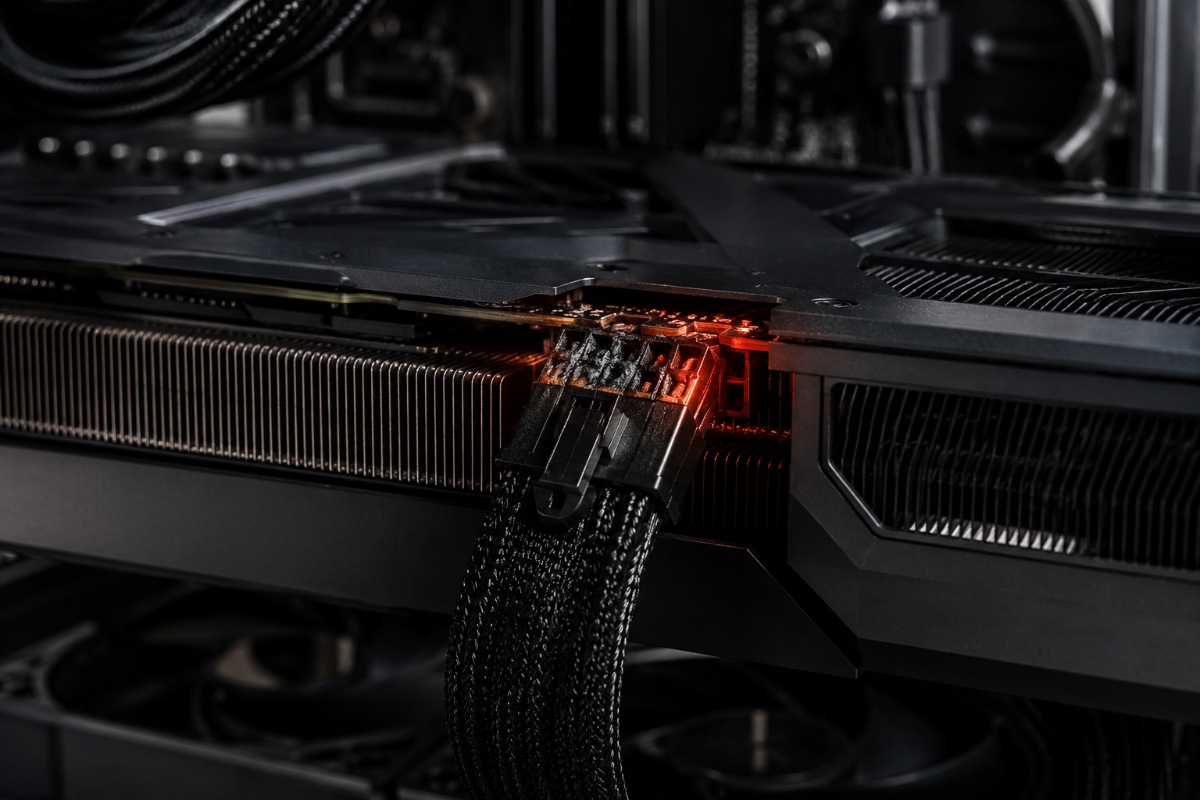
The latest RTX 5090 connector failure raises sharper questions because it happened on a cable built to detect dangerous heat before damage occurs.
When a 12V-2×6 power connector melts, the industry usually looks first at the plug. Was it fully seated? Did the cable bend too close to the socket? Could uneven pressure have left one terminal carrying more current than the others?
The latest reported RTX 5090 failure is harder to file away that neatly. It happened on an ASRock TempGuard cable, a thermal safety design built to monitor connector heat and cut power if temperatures exceed 105°C, or 221°F.
The affected system reportedly used an MSI GeForce RTX 5090 Gaming Trio OC with an ASRock PG1000 PSF power supply. The owner, known online as Riptide, said the cable was fully seated at both ends and not sharply bent. After several weeks of use, the PC began crashing. A later inspection found visible melting around the connector.
That does not prove a broad defect. It does make this case important. A safety cable failed to stop the exact failure mode it was built to catch.
The Technical Mystery Around TempGuard
TempGuard uses an NTC thermistor near the graphics-card connector. In simple terms, that sensor watches temperature and tells the power supply to cut power if the connector area gets too hot.
This is why the incident matters. A standard cable melting can still leave room for debate about installation. A thermal protection cable melting shifts attention toward what the sensor can actually detect.
The leading theory is localized heat. If one pin carries too much current, that contact can heat up faster than the surrounding plastic and sensor area. In that scenario, the connector can start melting before the thermistor reaches its 105°C trigger point.
Fail-safes are not designed to fix every underlying hardware weakness. They exist to stop catastrophic damage. Here, the protection system may have been too far from the hottest point, or the heat may have built up too quickly in too small an area.
A Single Failure, Not A Final Verdict
This remains an isolated report, and that context matters. ASRock’s TempGuard has not failed in every extreme test. In a separate heavy overclocking case, the system reportedly protected a shunt-modded RTX 5090 drawing around 1350W.
That contrast complicates the story. TempGuard can work under brutal loads, but this new case suggests it may not catch every real-world failure pattern.
The user history also adds another wrinkle. Riptide reportedly experienced a similar connector failure earlier while using a Corsair SF1000 power supply. That makes the investigation harder, not easier. It raises questions about the graphics card, the cable path, connector wear, contact pressure, and the exact load behavior of the system.
The user returned the power supply to the retailer, which severely limits deeper forensic inspection. Without the full hardware chain in a lab, no one can definitively assign blame. That uncertainty is why the public debate has turned so quickly toward the connector itself. Under the VideoCardz post, one commenter reduced the concern to a blunt engineering fear:
“It’s a fuse, too much power through too little metal.”
The wording was informal, but the point matches the core question now facing hardware makers: whether the connector has enough margin when current concentrates in the wrong place.
The Bigger Problem Is Current Distribution
Hardware analysts have focused on uneven current distribution in previous RTX 5090 connector incidents. Roman Hartung, known as der8auer, has pointed to cases where one contact carried far more load than the others. That matters because more current through one small contact creates more heat in one small place.
For the 12V-2×6 connector, that is the recurring fear. The plug is compact, the power draw is high, and the system depends on clean contact across multiple terminals. If that balance breaks, the weakest point can heat quickly.
PC builders quickly dissected the latest failure online, shifting the question from ASRock’s sensor to Nvidia’s underlying connector standard. Some users are now asking why multiple vendors need extra safeguards around a single plug. Others argue that the RTX 5090 class of hardware simply pushes too much power through too little physical margin.
Those are not settled conclusions. They are the questions hardware makers now have to answer with better data.
Will Sensors Solve The 12V-2×6 Problem?
ASRock now has two stories around TempGuard. In one extreme overclocking case, the system appeared to do its job. In this reported retail system, the connector still melted.
That split is the point. A thermal cable may reduce risk, but it does not remove the basic dependence on contact quality, current balance, cable routing, and fast enough sensor response.
For Nvidia, ASRock, and other hardware makers, the issue is no longer only whether a user seated a plug correctly. Until companies publish clearer failure data, each melted connector fuels the same debate. Is this a rare user error, or a fundamental design margin problem?
The RTX 5090 remains a flagship graphics card. Its connector story remains far less settled.
Also Read: Why The Galaxy Z Fold 8 Wide Could Deliver On The Tablet Killer Promise

Anup Singh is an independent technology journalist and content writer covering Apple, Android, AI, laptops, gaming, and the consumer tech industry. He focuses on delivering factual, well researched, and easy to understand reporting while explaining how new technologies impact everyday users.