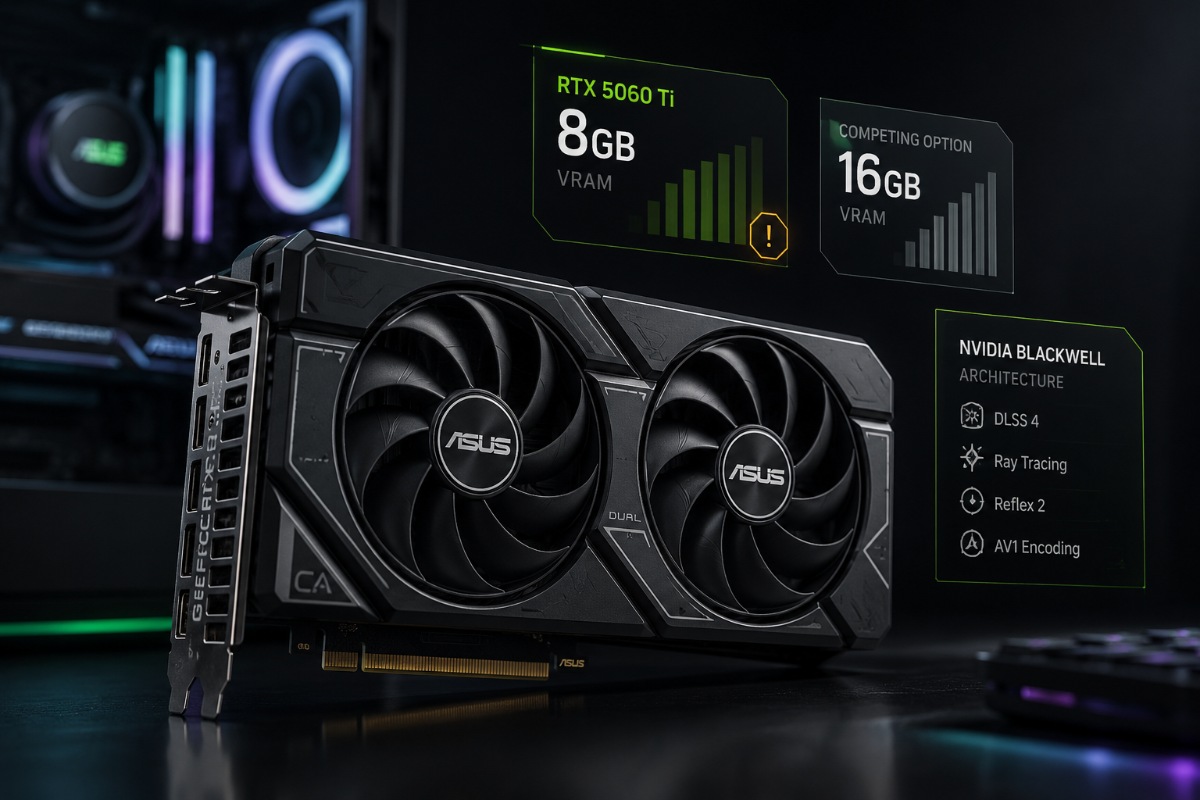
ASUS RTX 5060 Ti: A near record Amazon discount makes Nvidia’s Blackwell card tempting, but AMD’s 16GB competition complicates the value argument.
Amazon’s latest Prime deal has pushed the ASUS Dual RTX 5060 Ti OC to $384.99, putting Nvidia’s Blackwell generation back in front of budget PC builders. The card brings GDDR7 memory, DLSS 4, Multi Frame Generation and a compact dual fan design into a price range that looks far easier to justify than most new graphics hardware.
The problem is not the feature list. It is the 8GB frame buffer. That capacity still works for 1080p gaming and carefully tuned 1440p play, but it limits how much confidence buyers should place in the card over the next few years. Players upgrading from older GTX hardware, RTX 20 series cards or entry level RTX 30 series models may find real value here. Anyone chasing high texture settings in demanding games should look closely at the VRAM ceiling before checkout.
Blackwell Features Make The Discount More Tempting
The ASUS RTX 5060 Ti OC uses Nvidia’s GB206 Blackwell GPU with 4608 CUDA cores, 8GB of GDDR7 memory and a 128 bit memory bus. It also brings 5th gen Tensor cores, newer ray tracing hardware, PCIe 5.0 support, HDMI 2.1b and DisplayPort 2.1b.
Those specs matter because the RTX 50 series advantage is not just raw frame rate. DLSS 4 and Multi Frame Generation can boost smoothness in supported games by creating extra frames through AI assisted rendering. For players with high refresh monitors, that can make a mid range card feel quicker than its base hardware suggests.
The ASUS Dual design also fits the audience it is chasing. Its 2.5 slot footprint and 2 axial fans make it easier to place in cramped older cases or small form factor builds. The cooling setup gives the card enough thermal headroom for mainstream gaming loads without turning it into a bulky flagship board. For budget builders upgrading an existing machine, that practical fit matters almost as much as benchmark charts.
DLSS 4 Helps, But VRAM Still Sets The Ceiling
Nvidia’s software stack gives the RTX 5060 Ti a clear selling point against older cards. DLSS 4 can help stretch performance in supported titles, while Multi Frame Generation can make motion feel smoother when the base frame rate is already stable.
Still, generated frames cannot replace missing VRAM. Games such as Cyberpunk 2077 with path tracing, Alan Wake 2 and large open world titles with heavy asset streaming can pressure 8GB cards when texture settings rise. You can push this GPU to 1440p, but texture settings and ray tracing may need to come down to keep performance consistent.
Creator workloads expose the limit even faster. Local Stable Diffusion generation, Blender scenes and heavy DaVinci Resolve timelines can chew through an 8GB buffer. Buyers who plan to game first and create second should treat those workloads as occasional use cases, not the main reason to buy this card.
AMD Makes The Value Question Harder
The ASUS deal looks stronger when compared with current RTX 5060 Ti 16GB pricing, where several Nvidia models still sit far above the original launch target. From that angle, the discounted ASUS Dual 8GB card is easier to defend for buyers who want Nvidia’s latest feature set without jumping into a much higher bracket.
AMD changes the calculation. Radeon RX 9060 XT 16GB cards can often be found close enough in price to make the memory gap difficult to ignore. That gives buyers double the VRAM for a modest step up, which matters for texture heavy games and longer upgrade cycles.
The AMD alternative also has a stronger argument in pure rasterization workloads. That means traditional game rendering without ray tracing or AI generated frames. In games such as Call of Duty, where many players prioritize high native frame rates over ray tracing effects, Radeon cards can deliver aggressive frames per dollar. That matters for hardware enthusiasts who care more about raw performance than Nvidia’s software stack.
Nvidia still has advantages. DLSS 4 support is stronger than AMD’s equivalent in many games, ray tracing performance is often more consistent, and creator tools tend to favor CUDA support. But buyers who mostly play standard rasterized games should not ignore the RX 9060 XT 16GB just because the ASUS card has a near record discount.
The ASUS RTX 5060 Ti OC is a better fit for players who want Nvidia features, efficient 1080p performance and a compact card. The AMD alternative looks more sensible for buyers worried about texture packs, future games and raw performance without AI assistance.
At $384.99, the ASUS Dual RTX 5060 Ti OC is a good fit for the right system. It is not the automatic budget winner. Spending that much on an 8GB GPU in 2026 means choosing Nvidia’s modern feature set over long term memory breathing room. That trade can make sense, but only if your games, monitor and upgrade cycle match the card’s limits.
Also Read: What A $1,000 GameStop Trade Tells Us About Sony’s Digital Future

Anup Singh is an independent technology journalist and content writer covering Apple, Android, AI, laptops, gaming, and the consumer tech industry. He focuses on delivering factual, well researched, and easy to understand reporting while explaining how new technologies impact everyday users.
1 thought on “ASUS RTX 5060 Ti Prime Deal Tests The 8GB VRAM Compromise”