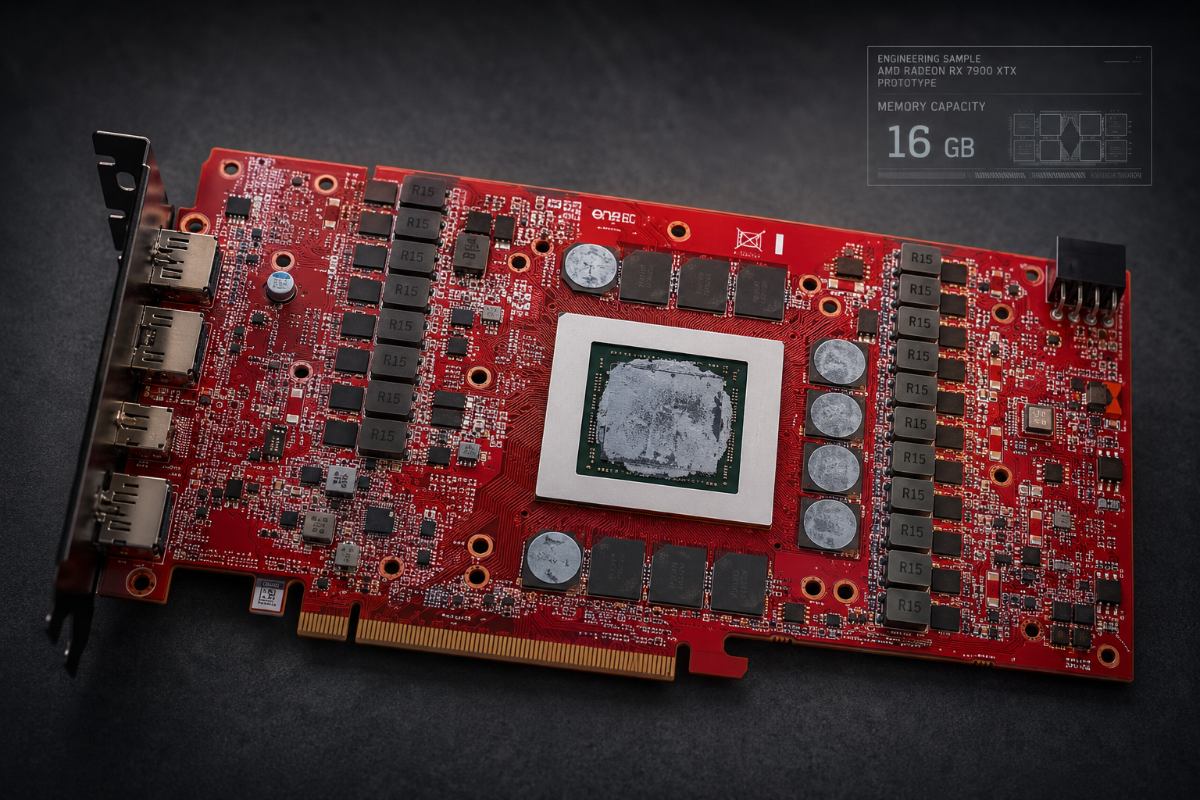
AMD RX 7900 XTX: A strange red PCB Radeon card reveals how early GPU test boards can look familiar in software while behaving nothing like retail hardware.
Engineering samples are rarely meant for public eyes, but a newly discovered AMD Radeon prototype is offering a strange glimpse into the RDNA 3 testing phase. Reddit user Shav_tech surfaced the card after picking it up secondhand and noticing several odd details: a red printed circuit board, no backplate, custom firmware, exposed test hardware and a memory reading that does not line up with a normal RX 7900 XTX.
Software identifies the unit as an RX 7900 XTX. GPU-Z, however, reports only 16 GB of memory instead of the 24 GB found on the retail model. For context, AMD’s standard RX 7900 XTX includes 24 GB of GDDR6 memory, 96 compute units, 192 ROPs and 384 texture units. This card appears to sit somewhere stranger: physically close to AMD’s flagship layout, but functionally closer to a cut down Navi 31 test board.
The Discovery Started With A Secondhand GPU
The original post described a card that looked wrong almost immediately. It carried 12 memory packages, matching what users would expect from a 24 GB RX 7900 XTX layout, but Windows and GPU-Z detected only 16 GB of usable video memory.
That mismatch is the card’s biggest mystery. RDNA 3 uses chiplets, with memory cache dies sitting around the main graphics compute die. On a normal high end Navi 31 card, those memory paths help support the wider bus and larger memory pool. Here, the physical layout suggests more capability than the card actually exposes to the operating system.
The find gained attention because the board includes debugging interfaces such as I2C, PMBus, JTAG headers, logic analyzer connections and dip switches. Engineers typically use these connectors during stress testing, firmware recovery and direct voltage monitoring before a consumer BIOS is finalized.
Why The 16 GB Reading Matters
The 16 GB result points toward disabled memory pathways rather than a simple software label mistake. While all 12 memory chips appear physically installed on the board, the GPU is not using every available memory channel. Shav_tech captured the confusion neatly, saying the card had “12 chips just like a 7900XTX” but only showed “16gb VRAM” in Task Manager or GPU-Z.
That helps explain why the card looks closer to an RX 7900 GRE in some readings. The RX 7900 GRE, short for Golden Rabbit Edition, began as a more limited Navi 31 variant before wider availability. It uses a narrower 256 bit memory bus and 16 GB of GDDR6 memory, unlike the 24 GB RX 7900 XTX.
The owner reportedly tried flashing RX 7900 GRE firmware, likely to see whether the card could correct the mismatch or unlock a cleaner working profile. That attempt failed. This is where the prototype nature matters. Firmware locks, hardware fuses and board level differences can stop an engineering sample from behaving like any retail card, even when the specs appear familiar.
A Fascinating Artifact, Not A Safe Upgrade
Because of those limits, this is not the kind of GPU a normal builder should chase for a gaming rig. Prototype cards can be unstable, difficult to support and unpredictable under driver updates. Custom VBIOS behavior also creates risk if something goes wrong during flashing or troubleshooting.
For hardware preservationists and AMD fans, the red PCB is still a fascinating artifact from the trial and error phase of bringing RDNA 3 to market. It shows that internal test hardware can carry a recognizable product name while running a stripped down configuration that never reached store shelves.
Ultimately, this card is a reminder that early silicon rarely mirrors the final product. Retail GPUs are built for consistency. Engineering samples are built to answer questions before those products are ready for consumers.
Also Read: ASUS RTX 5060 Ti Prime Deal Tests The 8GB VRAM Compromise

Anup Singh is an independent technology journalist and content writer covering Apple, Android, AI, laptops, gaming, and the consumer tech industry. He focuses on delivering factual, well researched, and easy to understand reporting while explaining how new technologies impact everyday users.
I like this design