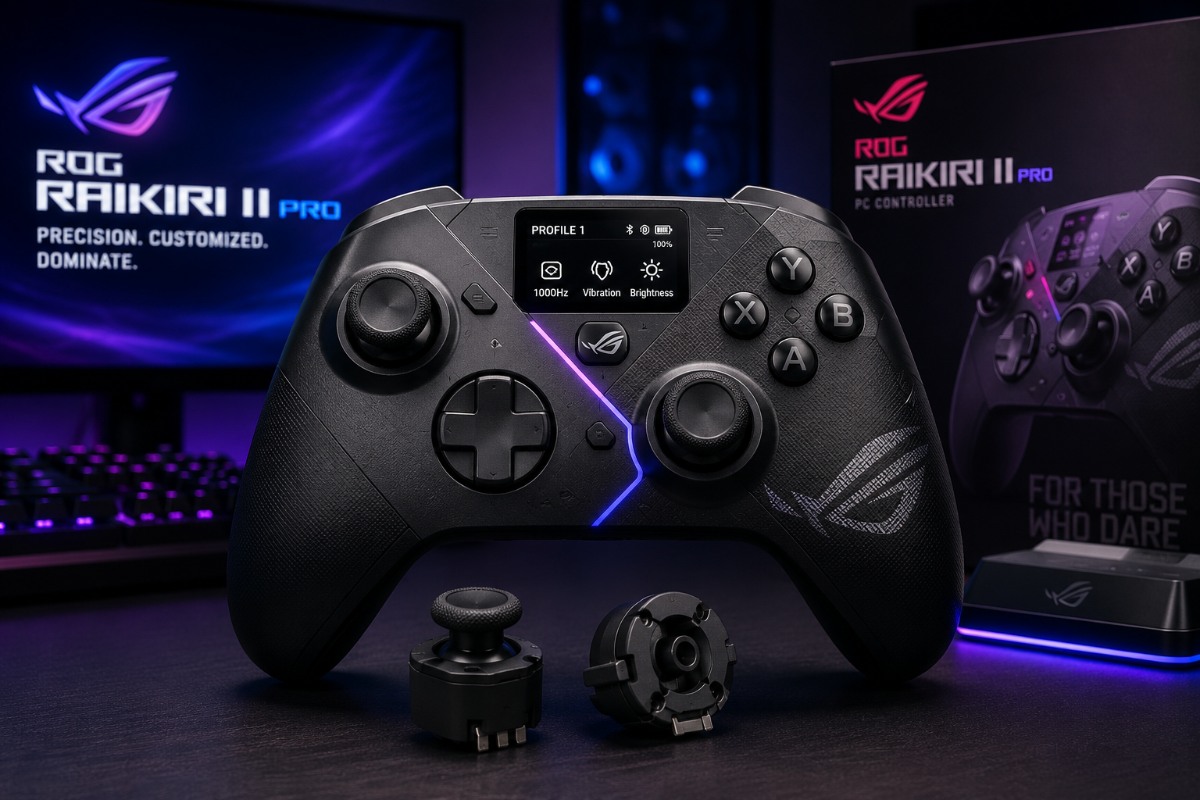
ASUS ROG Raikiri II Pro: ASUS is making a direct play for PC gamers who have grown tired of stick drift and sluggish wireless controllers. The ROG Raikiri II Pro combines hot swappable magnetic joystick modules with an 8000Hz polling rate, giving the company a sharper answer to premium gamepads from Xbox, Scuf, Razer and GameSir.
The pitch is simple: faster input, replaceable sticks and more control without always opening software on a PC. ASUS says the controller supports 8000Hz polling in wired and 2.4GHz wireless PC modes through ROG SpeedNova wireless technology. It also includes dual mode triggers, micro switch buttons, 4 removable rear buttons, 2 extra bumpers and a full color panel for changing key settings. ASUS has not provided final pricing in its announcement, and product availability may vary by country.
8000Hz Is A Big Number, But Not A Guaranteed Advantage
Polling rate measures how often a controller reports input to a PC. A 1000Hz controller sends input data 1000 times per second, while 8000Hz raises that ceiling sharply. The Raikiri II Pro also stands far above ASUS’s own earlier controller lineup, where the Raikiri II Xbox Wireless lists 1000Hz on PC and 250Hz on Xbox.
That does not mean every player will feel a dramatic difference. A higher polling rate technically reduces input delay, but the hardware is only half the battle. Players still need a high refresh display, a fast PC and the raw reflexes to notice the difference on a thumbstick. ASUS describes the Raikiri II Pro as built for “competition grade responsiveness,” which makes its target clear. Independent testing will decide whether 8000Hz delivers a meaningful advantage or mainly gives ASUS a bigger number for the box.
Magnetic Sticks Are The More Practical Upgrade
Stick drift plagues modern controllers, destroying trust and frustrating gamers. ASUS is trying to answer that with TMR joystick modules. TMR stands for Tunnel Magnetoresistance, a magnetic sensing method designed to detect stick movement without relying on the same physical contact points that wear down in many traditional analog sticks. ASUS says the modules are built for anti drift performance and lower power consumption.
For players used to standard analog sticks, the important difference should be consistency rather than a strange new feel. A normal stick can feel tight on day 1, then slowly become looser, less precise or prone to unwanted movement as the sensor parts wear down. A TMR stick should still feel familiar under the thumb, but it is meant to hold its center point and directional response more reliably over time. The 2 included module weights also matter: 120gf gives a firmer push, while 50gf should feel lighter and quicker for players who prefer less resistance.
The modular design may matter even more than the sensor label. By making the joysticks hot swappable, ASUS lets users replace a failing module instead of throwing out the whole controller. That is a practical repair angle in a category where expensive gamepads often become waste once the sticks start drifting.
ASUS Still Has To Prove Durability
Early reaction around the older Raikiri line gives ASUS both opportunity and baggage. Some users praised earlier controllers for their feel and value, while others complained about durability issues, including a previous generation trigger problem after 2 weeks of use.
That does not prove anything about the new Raikiri II Pro. It does explain why long term testing matters. A premium controller cannot survive on polling rate claims alone. Buyers will want to know whether the triggers, rear buttons, wireless connection and stick modules hold up after months of daily play.
The Onboard Panel Could Save Time
ASUS is reading the room here: PC gamers are tired of opening heavy desktop software just to tweak thumbstick dead zones between rounds. The Raikiri II Pro tries to move more of that control onto the device itself. Its full color panel lets users switch profiles, remap buttons, adjust lighting, tune vibration and run calibration from the controller.
The controller also works with ASUS Gear Link, the company’s configuration software for deeper tuning. That matters because the onboard panel is best viewed as a shortcut system, not a total replacement for software. Players who want more detailed profile setup, stick sensitivity changes or advanced button mapping will still need the app.
Battery life needs the same caution. ASUS advertises up to 79 hours over 2.4GHz wireless, but that figure applies at 1000Hz with RGB, vibration, audio and the panel turned off. ASUS’s own battery table lists 63 hours at 8000Hz with those features off and 22 hours at 8000Hz with the panel, vibration and RGB on.
Throwing an 8000Hz polling rate and a screen on a gamepad will not automatically dethrone Xbox Elite or Scuf. Comfort, price, support and Gear Link software will decide whether this becomes a serious premium controller or just a spec heavy curiosity. The next real test comes when ASUS confirms pricing and reviewers can put the Raikiri II Pro through proper hands on latency, battery and durability testing.
Also Read: Apple’s iPhone Air 2 Leaks Point To Critical Battery And Camera Upgrades

Anup Singh is an independent technology journalist and content writer covering Apple, Android, AI, laptops, gaming, and the consumer tech industry. He focuses on delivering factual, well researched, and easy to understand reporting while explaining how new technologies impact everyday users.
1 thought on “ASUS ROG Raikiri II Pro Brings 8000Hz Polling Rates And Modular Sticks To PC”