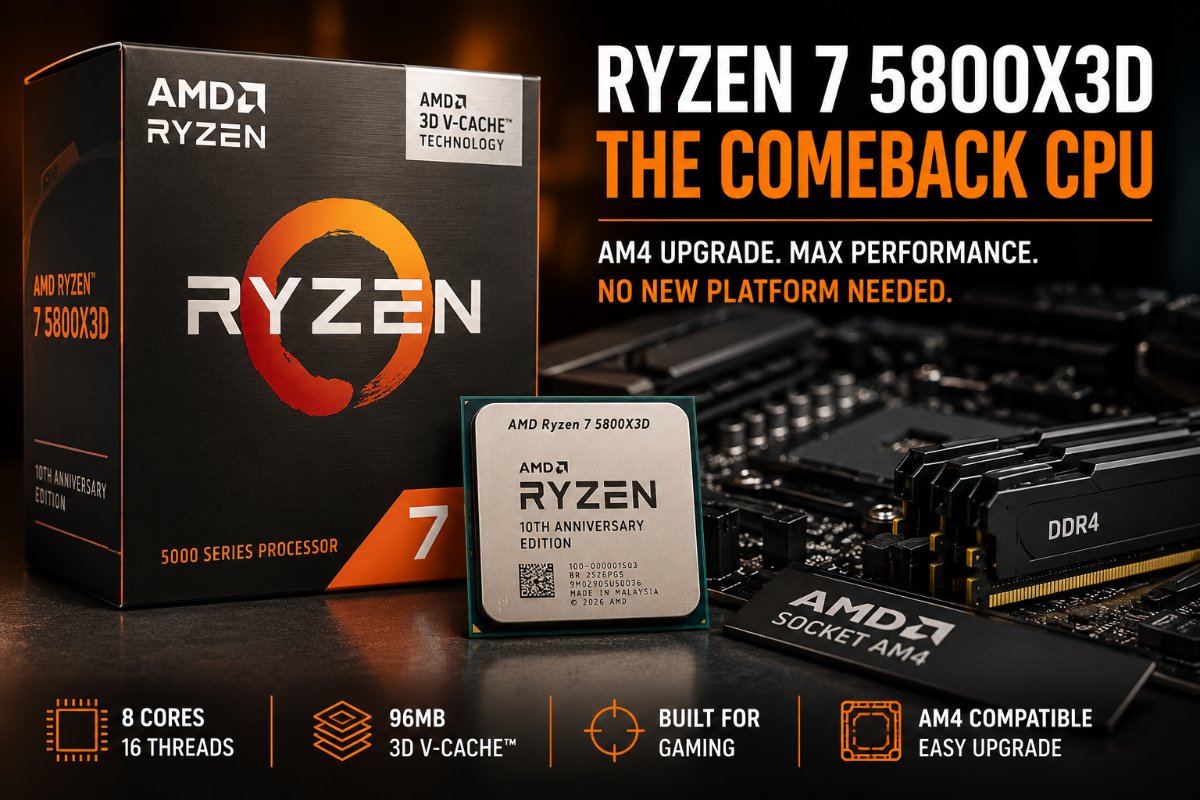
The re engineered anniversary CPU shows why total platform cost can matter more than benchmark performance.
AMD brought the Ryzen 7 5800X3D back to mark the 10th anniversary of its AM4 desktop platform. The company did more than refresh the packaging. Engineers rebuilt the chip around an updated manufacturing process because the technology used to produce the original model was no longer available.
Early retail demand suggests the effort has found an audience. During its first month on Amazon, the $349 Ryzen 7 5800X3D 10th Anniversary Edition sold around 3,000 units. The newer Ryzen 7 7800X3D recorded roughly 2,000 sales during the same period, despite offering stronger gaming performance at a similar street price.
That $349 comparison only tells part of the story. An AM4 owner can spend that amount on the 5800X3D and keep the same motherboard and DDR4 memory. Moving to the 7800X3D requires an AM5 motherboard and DDR5 memory, which can add another $200 to $250. The real choice is therefore closer to a $349 upgrade against a platform switch costing at least $550.
AMD Had To Rebuild More Than The Packaging
The original Ryzen 7 5800X3D arrived in 2022 as AMD’s first desktop CPU with 3D V Cache. The technology places additional cache above the processor silicon, giving games faster access to frequently used data.
Reviving the chip in 2026 created a manufacturing challenge. TSMC had retired the first generation SoIC hybrid bonding process used for the original model. AMD had to adapt the older Zen 3 architecture to a newer bonding method, then test and validate the revised silicon. David McAfee, AMD’s Vice President of Ryzen and Radeon, described the engineering project as “a labor of love.”
The finished CPU retains the familiar specifications. It has 8 cores, 16 threads and 96 MB of L3 cache. Its official $349 price puts it directly against the fluctuating retail price of the newer 7800X3D.
AMD also includes a Carbice Ice Pad thermal interface with the anniversary package. Buyers still need a suitable cooler, but the accessory underlines that this is a newly manufactured product rather than leftover stock from the original release.
AM4 Owners Are Doing Different Upgrade Math
The Ryzen 7 7800X3D is objectively the stronger gaming chip. It uses a newer architecture, supports DDR5 memory and delivers higher frame rates in many CPU limited games.
For a new PC build, AM5 is the obvious route. It offers better performance, modern connectivity and a clearer path to future Ryzen CPUs.
Existing AM4 owners face a different decision. Many already have a capable motherboard, 32 GB or 64 GB of DDR4 memory and a working Windows installation. For them, the 5800X3D upgrade may be as simple as a BIOS update, a CPU swap and a decent cooler.
Skipping the motherboard and memory replacement also leaves more money for components that may produce a more visible improvement. A buyer could put the savings toward a stronger graphics card, a larger solid state drive or additional memory.
Spending $550 or more to move to the 7800X3D may deliver better benchmark results. Spending $349 on the revived 5800X3D can remove a CPU bottleneck while preserving the rest of the rig.
Platform Longevity Is Driving Real Sales
A single Amazon snapshot does not represent global market share. Retail rankings can also shift with stock levels, discounts and short term promotions.
Still, the trend is telling. Buyers are willing to pay for older silicon when it protects the value of hardware they already own. AMD’s decision to re engineer the 5800X3D has given AM4 users one more meaningful upgrade without forcing a complete platform replacement.
The sales gap does not show that gamers prefer slower technology. It shows that CPU value cannot be measured through frame rates and shelf prices alone. Motherboards, memory and installation costs matter too.
Also Read: Newegg Discounts This RTX 5070 And Ryzen 7800X3D Gaming PC Below $1,900

Anup Singh is an independent technology journalist and content writer covering Apple, Android, AI, laptops, gaming, and the consumer tech industry. He focuses on delivering factual, well researched, and easy to understand reporting while explaining how new technologies impact everyday users.
1 thought on “AMD’s Revived Ryzen 7 5800X3D Outsells Newer Chips as Gamers Cling to AM4”