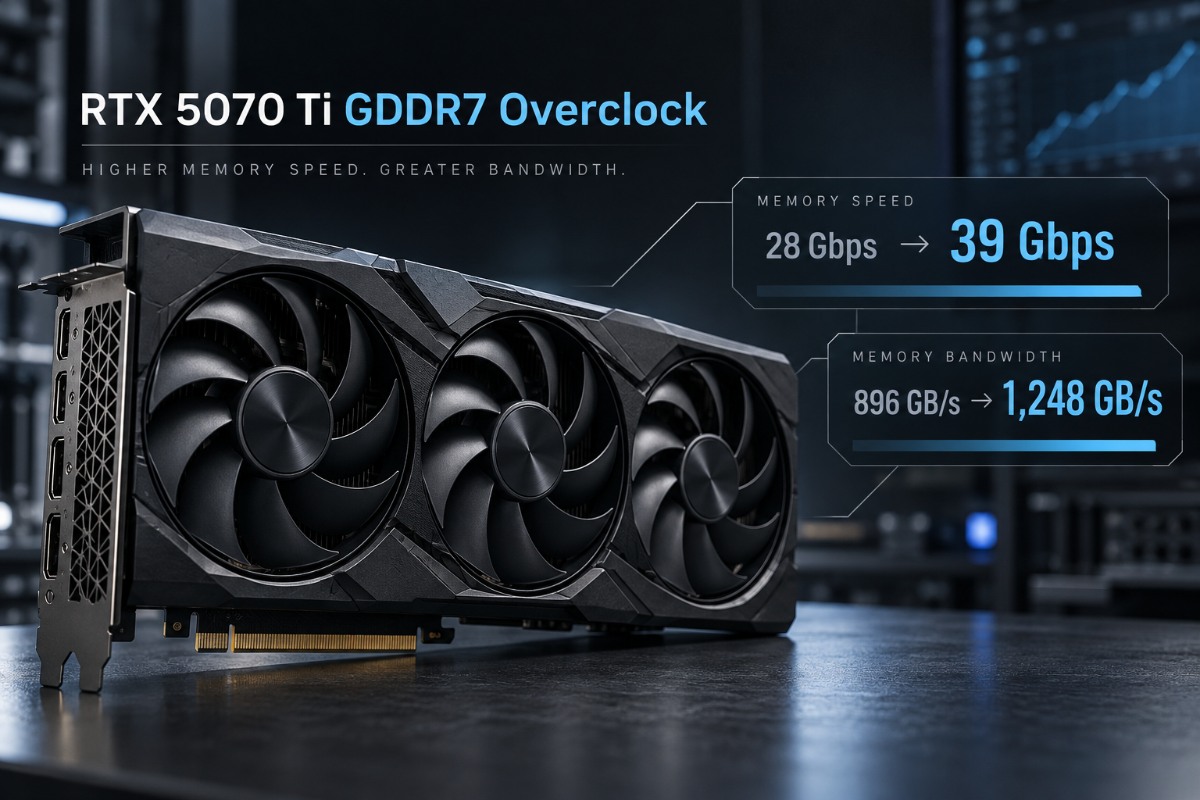
An RTX 5070 Ti has pushed its GDDR7 memory to 39 Gbps, raising theoretical bandwidth by about 39%, but early testing shows that massive memory bandwidth does not automatically deliver equally large gaming gains.
The tester used a Gigabyte Windforce RTX 5070 Ti equipped with Samsung GDDR7 memory. NVIDIA ships the RTX 5070 Ti with 16 GB of GDDR7 connected through a 256-bit memory interface. At its standard 28 Gbps data rate, the card offers 896 GB/s of memory bandwidth.
Applying a +5500 MHz memory offset pushed the effective data rate to 39 Gbps and lifted theoretical bandwidth to 1,248 GB/s. That represents an increase of roughly 39% over the factory specification. Attempting +6000 MHz caused the graphics driver to restart, suggesting that the tested card had reached its practical stability limit.
mVolt+ Extreme Pushes Beyond Normal Memory Limits
The unusually high setting was achieved with mVolt+ Extreme, an independent third party tuning utility built primarily for NVIDIA RTX 50 Series graphics cards rather than an NVIDIA application or a modified version of MSI Afterburner.
Its Extreme version exposes higher memory and power limits than most mainstream overclocking utilities. Common tools generally allow this RTX 5070 Ti to reach around a +3000 MHz memory offset, equivalent to approximately 34 Gbps and 1,088 GB/s of bandwidth.
Moving all the way to 39 Gbps shows that at least some early GDDR7 memory chips have considerably more frequency headroom than standard software normally exposes.
The tester wrote, “I was able to get to +5500 which run stable in Cyberpunk with path tracing enabled for 30 minutes.”
Cyberpunk Gains Remain Difficult To Quantify
Cyberpunk 2077 reportedly gained roughly 1 FPS for every additional +1000 MHz of memory offset. That suggests around 5 to 6 extra FPS between stock memory settings and the +5500 MHz configuration.
Those numbers need important context. The tester did not publish the baseline frame rate or display resolution. Without those figures, it is impossible to calculate the actual percentage improvement.
A gain of 5 FPS from 30 FPS would represent a meaningful uplift. The same increase from 120 FPS would be much less significant.
Another RTX 5070 Ti owner reported around 2.8% higher frame rates at +5500 MHz compared with +3000 MHz. However, the user did not identify the game, resolution, or detailed test conditions, so the result cannot be treated as a controlled comparison.
A separate 3DMark Steel Nomad result showed an improvement of roughly 20%, but that system also used broader GPU tuning. Changes to core clocks and other settings mean the benchmark cannot isolate the effect of the memory overclock alone.
More Bandwidth Cannot Remove Every GPU Bottleneck
Cyberpunk 2077 with path tracing can be limited by far more than memory bandwidth. Shader performance, ray tracing throughput, cache behavior, GPU core frequency, and CPU performance can all affect the final frame rate.
Once memory bandwidth stops being the main bottleneck, pushing GDDR7 faster produces diminishing returns. That explains why a 39% increase in theoretical bandwidth can translate into a much smaller gaming improvement.
The experiment is therefore more interesting as a demonstration of GDDR7 frequency headroom than as evidence of major untapped gaming performance.
The Silicon Lottery Still Decides The Final Limit
Secondary user reports show just how widely RTX 5070 Ti memory results can vary. One ASUS Prime RTX 5070 Ti reportedly reached around +4500 MHz before higher settings produced artifacts or instability. Another card reportedly stopped around +2600 to +2700 MHz, far below the +5500 MHz result achieved on the Gigabyte card.
That spread is the silicon lottery in practice. Even graphics cards carrying the same GPU model can use memory chips with different overclocking margins. Cooling quality, memory temperature, board design, voltage behavior, and the individual chips themselves can all influence the final stable clock.
Reaching 39 Gbps is therefore an impressive result for this particular RTX 5070 Ti, not a realistic expectation for every card. The experiment shows that GDDR7 can have substantial unused frequency headroom, but it also reinforces a familiar rule of GPU overclocking: raw clock speed matters far less than stable performance in the workloads people actually use.
Also Read: KOTIN RX 9070 XT Gaming PC Drops $200 to Its 30 Day Low

Anup Singh is an independent technology journalist and content writer covering Apple, Android, AI, laptops, gaming, and the consumer tech industry. He focuses on delivering factual, well researched, and easy to understand reporting while explaining how new technologies impact everyday users.
1 thought on “RTX 5070 Ti Pushes GDDR7 Memory to 39 Gbps, Showing Only Modest Gaming Gains”