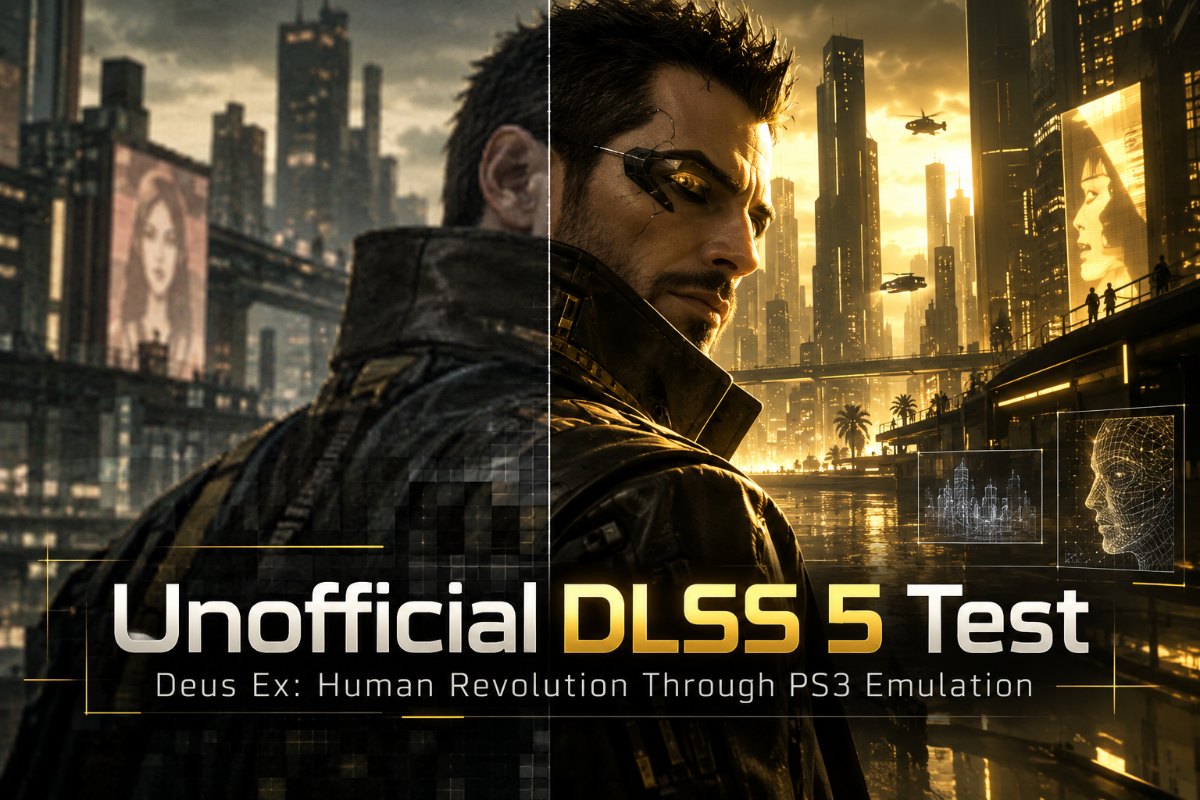
DLSS 5 An experiment with RPCS3 improves character detail and lighting, but says little about performance during actual play.
XDA Developers writer Samarveer Singh had to abandon the native PC version of Deus Ex: Human Revolution before he could try NVIDIA’s DLSS 5. The 2013 Director’s Cut struggled on his Windows 11 system, so he switched to the PlayStation 3 release through RPCS3. An unofficial neural rendering setup, already configured for his other emulated games, let the test proceed.
His experiment made faces look more natural and lighting more convincing. Detroit’s streets, parked vehicles and familiar characters remained recognizable through two neural rendering passes. For an RPG released in 2011, the result suggests an unusual route to improving aged visuals without changing the original game code.
This was a personal visual test, not an official NVIDIA feature or studio remaster. Singh did not provide the system’s CPU, GPU, internal resolution or controlled frame rate measurements, leaving unanswered how the result behaves during combat or camera movement.
Faces Improve Against an Already Changed Art Style
Dialogue scenes delivered the most obvious changes. Closeups of Jensen and other characters showed more realistic facial detail. One comparison features Jensen speaking with pilot Faridah Malik. Singh also found that vehicles, sidewalks and the familiar Detroit setting kept their basic appearance instead of acquiring entirely new designs. As he wrote, “Adam Jensen still looked like Adam Jensen,” even with the added facial detail.
The original 2011 release used a strong black-and-gold palette inspired by Renaissance painting. The 2013 Director’s Cut removed much of that filter and altered its lighting. Singh tested the Director’s Cut, and the DLSS 5 pass was not shown restoring the original color grading. It changed the appearance of an already revised edition.
Why the Native PC Version Failed the Test
Singh first tried the Steam release. Turning off simultaneous multithreading in the BIOS helped it launch on his Windows 11 machine, but enabling DirectX 11 still caused unreliable starts. That stopped him from getting a ReShade-based DLSS 5 hook working in the native PC version.
He then switched to RPCS3, where his existing setup could process the emulator’s output. He did not identify the exact injection layer, graphics backend or motion estimation method used in that run.
Other modders have documented approaches using ReShade, DLSS5 Feeder and motion estimation tools such as Lumenite, although Singh did not confirm using these specific components. Some older games also use DXVK to translate DirectX calls into Vulkan, offering another possible route for graphics modifications.
Motion Stability Still Separates Mods From Native Support
Official DLSS 5 arrived in NBA 2K27 for RTX 50 Series GPUs. Its engine integration uses motion vectors, data that describe movement between frames, to keep images steady. Developers can also limit AI changes so characters and lighting retain their intended style. A PS3 game running through an external graphics hook cannot supply the same native engine data. Some community tools estimate movement, which can cause flickering edges, ghosting or changing background details.
A Reddit discussion about similar Skyrim experiments revealed sharply different experiences. Some players praised the upgraded static image, while others described unstable motion and significant performance losses in their own unofficial setups.
With a planned Deus Ex sequel reportedly canceled in 2024, fans have reason to experiment. For now, the result is a promising visual test, not a verified alternative to a studio remaster.
Also Read: Newegg’s $1,700 RTX 5060 Ti PC Costs $100 More Than October Low

Anup Singh is an independent technology journalist and content writer covering Apple, Android, AI, laptops, gaming, and the consumer tech industry. He focuses on delivering factual, well researched, and easy to understand reporting while explaining how new technologies impact everyday users.