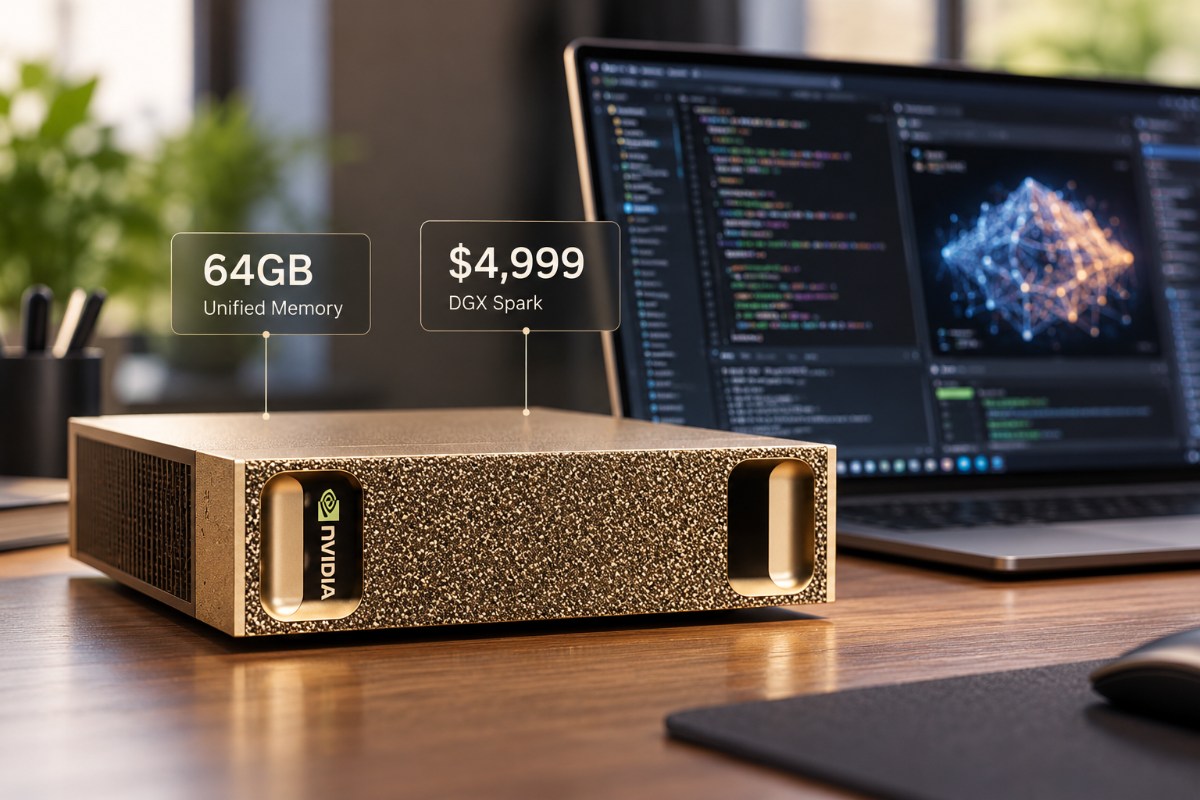
NVIDIA DGX Spark 64GB: NVIDIA’s smaller desktop AI computer keeps the GB10 chip and software stack, but its price shows how quickly local AI hardware economics have changed.
NVIDIA is cutting the memory capacity of its newest DGX Spark configuration to 64GB, but the price is not falling with it. The compact desktop AI computer launches October 23 through hardware partners starting at $4,999. It retains the GB10 Grace Blackwell Superchip, DGX OS, ConnectX 7 networking, and NVIDIA’s AI software stack from the 128GB system.
The comparison with the original model is difficult to ignore. NVIDIA launched the 128GB DGX Spark at $3,999 in October 2025, then raised its official Founders Edition MSRP to $4,699 in February 2026. Current reporting puts the 128GB version at $6,995, although prices can vary as sales channels update inventory.
That jump is happening against a much wider memory squeeze. TrendForce expects conventional DRAM contract prices to climb another 10% to 15% during 4Q26 after forecasting increases of 13% to 18% in 3Q26. Suppliers are prioritizing server DRAM and HBM capacity as cloud companies expand AI infrastructure, leaving the broader market undersupplied.
Memory Pressure Is Already Hitting Spark Pricing
NVIDIA has directly connected memory supply to DGX Spark pricing before. When it raised the Founders Edition MSRP from $3,999 to $4,699 in February, the company said the change reflected “worldwide constraints in memory supply.”
The latest market data makes that pressure easier to see. TrendForce says AI demand is pushing suppliers toward higher value server products while advanced manufacturing capacity remains limited. The firm also expects tight memory conditions to continue into 2027.
That does not prove memory prices are the sole reason NVIDIA created the 64GB configuration. NVIDIA has not made that claim. The safer conclusion is that the new model arrives at a time when adding large amounts of fast unified memory has become substantially more expensive.
What Developers Give Up With 64GB
DGX Spark is designed to run demanding AI workloads locally rather than send every task to a cloud service. Developers can use it for coding assistants, document analysis, research agents, local inference, and retrieval augmented generation systems that work with private data.
The biggest compromise is memory headroom. NVIDIA says the 64GB system can support models as large as 100 billion parameters, but reaching that ceiling requires heavy compression. NVIDIA’s NVFP4 format uses 4 bit precision and reduces memory consumption by roughly 3.5 times compared with FP16.
A 100 billion parameter model requires roughly 200GB for FP16 weights alone. Applying NVIDIA’s stated compression ratio brings that figure to about 57GB. That leaves only around 7GB of the Spark’s 64GB unified memory for context cache, the inference engine, operating system demands, and other runtime data.
That is a narrow margin. Longer context windows or more complex model architectures can quickly consume the remaining capacity.
NVIDIA’s own examples include Qwen3.8 27B, Alibaba’s 27 billion parameter vision and language model. Models in that range leave far more memory available for context and applications than something approaching the 100B limit.
Developers are already questioning the new pricing. In Reddit’s LocalLLaMA community, one user responded to the $4,999 price with, “Just 5k? Oh Nvidia, how gracious of you!” The sarcasm reflects the central concern: buyers now get 64GB for more than the original 128GB Spark cost at launch.
Clustering Adds Capacity at a Cost
NVIDIA’s answer for workloads that exceed 64GB is clustering. Two Spark systems can connect over their 200 Gbps networking and pool 128GB of memory. NVIDIA says its own Qwen3.8 27B testing delivered up to 1.7 times the performance of a single machine.
The company says NVIDIA Sync can detect connected systems and configure the network automatically. Independent testing will be important because distributed inference can introduce additional networking, software, and configuration complexity.
For professional developers, clustering may still be attractive compared with continuously renting cloud accelerators, but buying two systems starts at $9,998. At that price, the setup moves well beyond casual local inference and reinforces the broader shift in AI hardware economics: the 64GB Spark lowers the current entry point into NVIDIA’s GB10 platform, but local high end AI compute is becoming more expensive, not less.
Also Read: RTX 5070 Ti Pushes GDDR7 Memory to 39 Gbps, Showing Only Modest Gaming Gains

Anup Singh is an independent technology journalist and content writer covering Apple, Android, AI, laptops, gaming, and the consumer tech industry. He focuses on delivering factual, well researched, and easy to understand reporting while explaining how new technologies impact everyday users.
1 thought on “NVIDIA Launches 64GB DGX Spark for $4,999 as Memory Prices Continue to Climb”