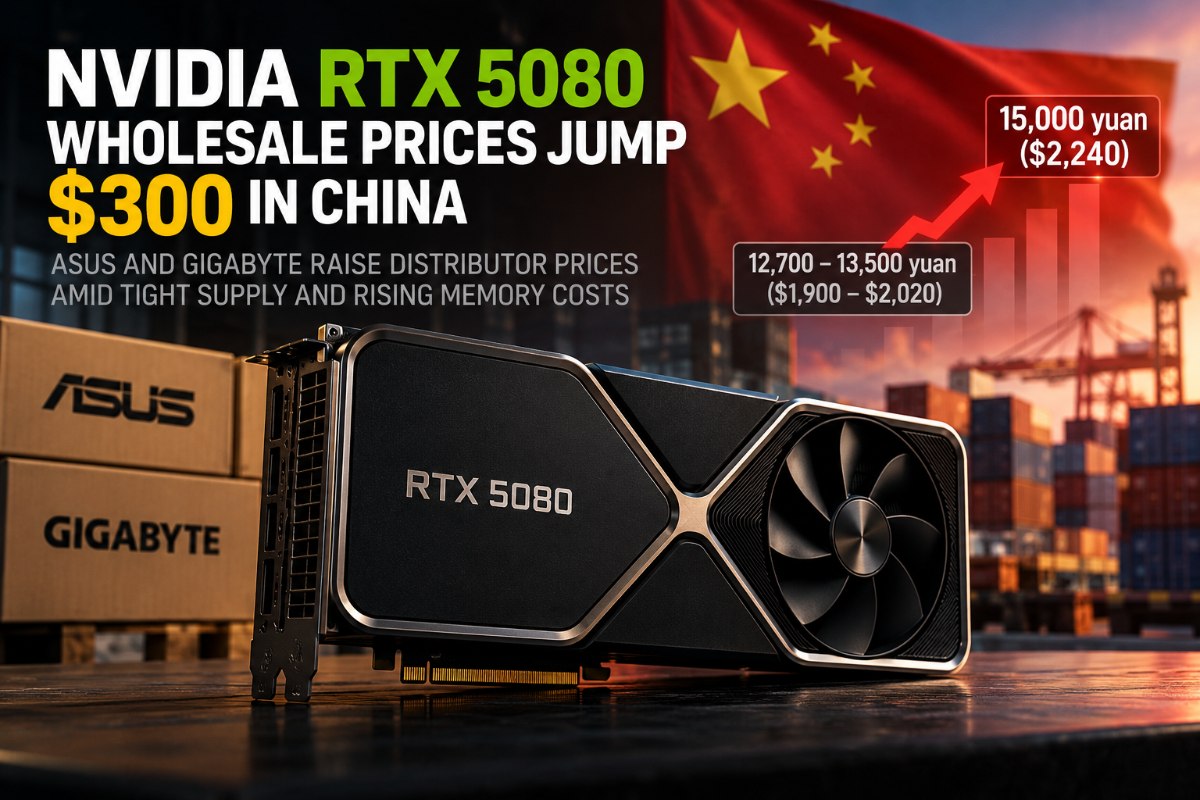
RTX 5080: ASUS and Gigabyte raise RTX 5080 distributor prices by $150 and $180 in China. Tightening GPU supplies and rising memory costs add pressure across the market.
Wholesale traders in China are quoting as much as 15,000 yuan ($2,240) for NVIDIA’s GeForce RTX 5080 16GB, a sharp premium over its official 8,299 yuan launch price.
The latest figures from Board Channels, a Chinese supply chain forum used by graphics card distributors, show an increase of roughly 2,000 yuan ($300). The card previously traded for 12,700 to 13,500 yuan and now commands between 14,500 and 15,000 yuan. At the upper end, that is about 81% above NVIDIA’s original Chinese retail benchmark.
Behind the jump are fresh price adjustments from ASUS and Gigabyte. ASUS raised its factory prices to distributors by 1,000 yuan ($150), while Gigabyte added 1,200 yuan ($180). Those increases differ from the broader wholesale spot market, where distributors negotiate prices for available inventory.
The figures concern China’s distribution network rather than confirmed retail price increases in other countries. Still, they show how limited inventory can push market prices far beyond the initial factory adjustment.
ASUS and Gigabyte Push Price Hikes Across More GPUs
ASUS and Gigabyte are also extending price increases into their midrange and budget graphics card lineups.
ASUS added 200 yuan ($30) to its RTX 5070 Ti, RTX 5070 and RTX 5060 Ti 16GB distributor prices. The RTX 5060 Ti 8GB and RTX 5060 received smaller increases of 100 yuan ($15).
Gigabyte raised its RTX 5070 Ti and RTX 5070 prices by 200 yuan each. Selected RTX 5060 series models received increases ranging from 70 to 200 yuan, while premium RTX 5060 Ti 16GB variants climbed another 100 yuan.
The RTX 5070 Ti faces additional pressure in the secondary wholesale market. Board Channels data shows its prices rising by more than 600 yuan ($90), reaching 9,650 to 9,850 yuan ($1,440 to $1,470). As the RTX 5080 becomes less affordable, some buyers may shift toward the cheaper RTX 5070 Ti, potentially adding to demand for that model.
ASUS also increased prices on some AMD Radeon graphics cards by 100 to 350 yuan ($15 to $52), suggesting that rising component costs are affecting more than NVIDIA products.
Memory Shortages and RTX 5080 Replacement Rumors Add Pressure
Board Channels links the latest increases to tightening GPU availability and rising graphics memory costs. Major memory manufacturers, including Samsung, SK Hynix and Micron, are directing more investment and production capacity toward high bandwidth memory (HBM) and enterprise DRAM used in AI data centers.
This shift could constrain graphics memory supply as both the RTX 5080 and RTX 5070 Ti rely on 16GB of GDDR7, leaving manufacturing costs exposed to pressure in the memory market.
Separate supply chain rumors suggest NVIDIA could discontinue the RTX 5080 16GB in favor of a 24GB replacement using denser 3GB GDDR7 memory modules. Channel speculation places the potential replacement at approximately 19,999 yuan ($2,990) wholesale.
Taiwanese hardware outlet BenchLife has also discussed a possible launch in early 2027, although board partners reportedly have not received complete development documentation. NVIDIA has not confirmed the replacement, its pricing or any discontinuation plans, but uncertainty about future supply could encourage distributors to retain existing RTX 5080 inventory.
What Rising RTX 5080 Prices Mean for PC Gamers
High RTX 5080 prices are already affecting buyers outside China. US hardware price tracker Pangoly recorded an average RTX 5080 price of approximately $1,852 on October 24, 2026, roughly 85% above NVIDIA’s official US launch MSRP of $999. That figure reflects existing American listings, not a confirmed transfer of China’s latest distributor increases.
The rising cost of high performance graphics cards has also renewed discussions about whether building a gaming PC still offers better value than purchasing a console. In a Reddit discussion about the price increases, some users questioned the cost of entering PC gaming, while others argued that cheaper games and free online multiplayer still provide long term value.
A user in Reddit’s GamingLeaksAndRumours community advised, “I feel like the better advice is to hold onto what device you have and treat it well.”
Retailers now face a choice between absorbing higher inventory costs, raising shelf prices or selling through existing stock. For PC builders, the immediate concern is how long elevated prices will persist, particularly as China’s latest wholesale increases add pressure to an already expensive GPU market.
Also Read: Dell Expands RTX Spark XPS 16 Sales Globally as High Pricing Draws Criticism

Anup Singh is an independent technology journalist and content writer covering Apple, Android, AI, laptops, gaming, and the consumer tech industry. He focuses on delivering factual, well researched, and easy to understand reporting while explaining how new technologies impact everyday users.
1 thought on “Chinese Wholesale Prices for NVIDIA RTX 5080 Jump $300 Toward $2,240 Mark”