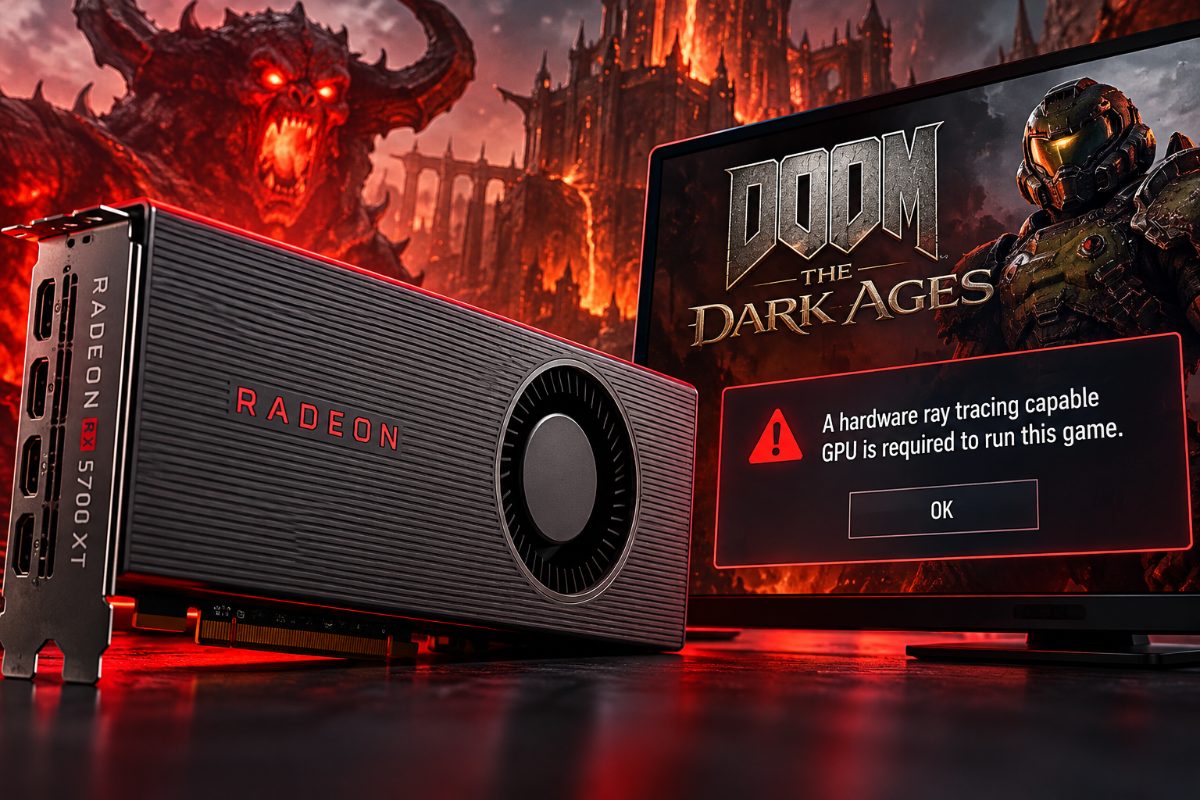
Radeon RX 5000: AMD’s older RDNA1 graphics cards still handle many modern games, but mandatory hardware ray tracing is creating a compatibility barrier that some users want AMD to remove.
An AMD Radeon RX 5700 XT can still run plenty of PC games, yet it cannot meet the minimum requirements for DOOM: The Dark Ages. The problem is not its 8GB of video memory or simply a lack of graphics performance. The game requires hardware ray tracing, a feature AMD’s 2019 Radeon RX 5000 series never included.
Now, owners are pushing AMD to introduce software ray tracing through future drivers. The proposed solution would let older GPUs attempt ray tracing calculations using their existing shader cores, potentially opening access to games that currently reject them.
The request exposes a growing problem for aging graphics cards. Some newer games depend on hardware features rather than traditional rendering performance alone. That means a GPU can remain useful for older titles while failing to launch newer releases.
AMD has not announced plans to add software ray tracing to RDNA1, and there is no guarantee such support would make demanding games playable.
Reddit Users Ask AMD to Remove the Ray Tracing Barrier
The demand comes from a discussion in the r/radeon community on Reddit, where a user named SnooSuggestions5859 started a thread requesting software ray tracing support for the RX 5000 series in future drivers.
The author specifically requested support for Vulkan and DirectX ray tracing functions through software, even if performance suffers. The discussion represents an individual request with mixed community reactions, not an official AMD petition.
Bethesda’s official PC requirements confirm that DOOM: The Dark Ages needs hardware ray tracing even at minimum settings. The company lists the Radeon RX 6600 as an example of supported AMD hardware.
For RX 5700 XT owners, the restriction is immediate. During startup, the game requires Vulkan ray tracing features that RDNA1 cannot provide. Tests have shown the game displaying a graphics compatibility error instead of reaching the main menu.
The thread’s author explained the tradeoff:
“I would rather have playable games at 15 fps than be locked out of a title entirely.”
However, 15 FPS means a new frame appears only about every 67 milliseconds. That slow visual feedback increases perceived input latency, making aiming, dodging, and reacting to enemies extremely difficult in a fast shooter like DOOM.
Linux Already Offers Experimental Ray Tracing Emulation
While Windows users lack an official AMD software fallback, Linux developers have already explored the idea.
The open source Mesa project includes experimental ray tracing emulation through its RADV Vulkan driver, allowing older AMD GPUs to attempt ray tracing without dedicated acceleration.
There are working examples. In 2023, a Linux user reported running Quake II RTX on an RX 5700 XT with software ray tracing enabled, achieving a locked 60 FPS using 540p internal rendering resolution.
That result demonstrates the workaround’s potential, although it is a user reported test rather than an independently verified benchmark. It also does not establish compatibility with demanding modern games.
The main obstacle is performance. Ray tracing requires extensive Bounding Volume Hierarchy (BVH) traversal, which determines where simulated light rays intersect objects in a scene.
Dedicated ray tracing hardware handles these calculations efficiently. RDNA1 must rely on general shader cores, consuming resources normally reserved for rendering graphics.
AMD Faces a Difficult Decision Over 7 Year Old Hardware
The debate has divided Radeon users. Supporters want the freedom to experiment, while critics question whether AMD should dedicate engineering resources to graphics cards introduced 7 years ago.
That is a considerable period in GPU development, particularly when newer architectures include hardware features absent from earlier generations.
AMD would need to justify developing and maintaining a fallback that might deliver little practical gaming performance. Even successful emulation would not necessarily bypass every game’s hardware checks.
The Radeon dispute highlights a growing compatibility problem in PC gaming. Older GPUs can lose access to new releases before their conventional rendering performance becomes inadequate.
Software ray tracing might give RX 5000 owners more options. AMD must now decide whether those limited benefits justify continued engineering investment in aging hardware.
Also Read: How A Custom DirectX 12 Port Brought Neural Rendering To DOOM 1993

Anup Singh is an independent technology journalist and content writer covering Apple, Android, AI, laptops, gaming, and the consumer tech industry. He focuses on delivering factual, well researched, and easy to understand reporting while explaining how new technologies impact everyday users.
1 thought on “Radeon RX 5000 Owners Push for Software Ray Tracing as Games Lock Them Out”