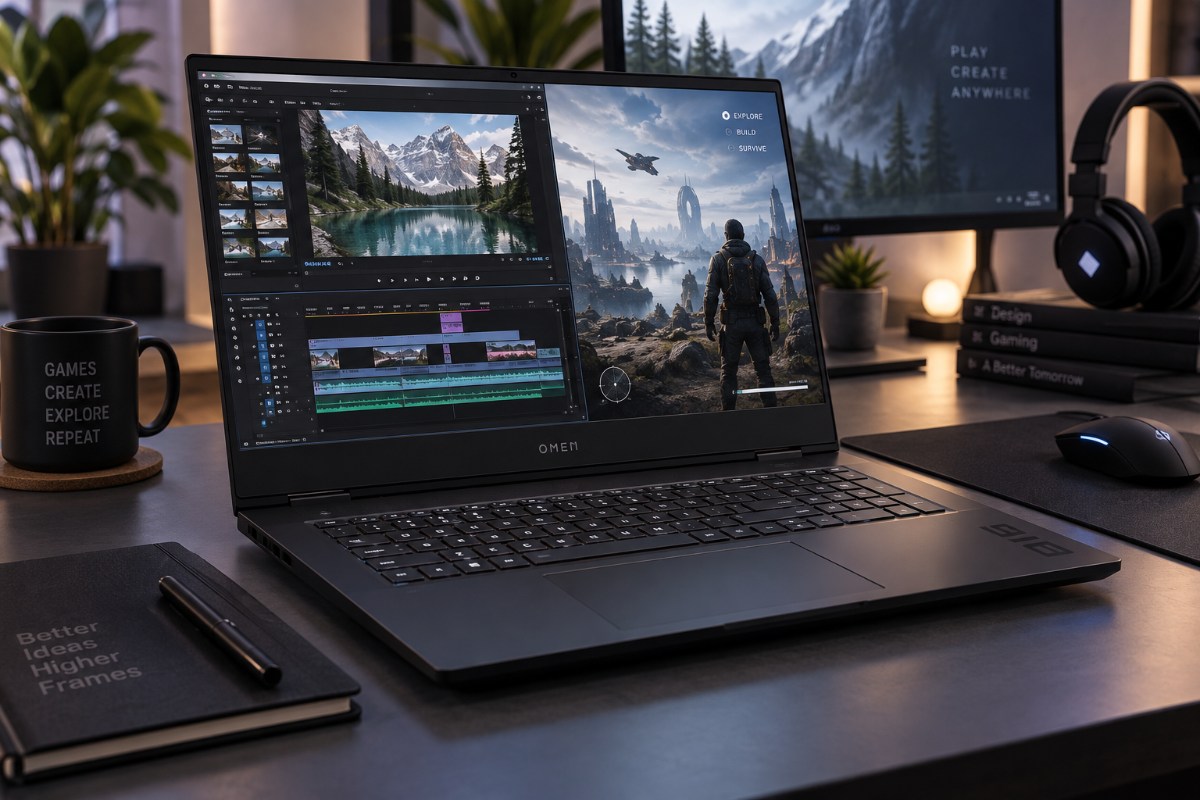
HP Omen 16: The $2,049 Omen 16 Slim spends heavily on processor power, memory, and display quality while leaving gaming performance firmly in the midrange.
Most $2,000 gaming laptops try to justify their price with a faster GPU. HP has taken an unusual route with the Omen 16 Slim. Its $2,049 Amazon configuration pairs an 8GB RTX 5060 Laptop GPU with Intel’s far more ambitious Core Ultra 9 285H, 32GB of DDR5 memory, a 1TB SSD, and a 240Hz QHD+ display. The current price is its lowest on Amazon in 30 days.
The processor brings 16 cores, 16 threads, and boost speeds up to 5.4GHz. That is considerably more CPU muscle than a gaming focused RTX 5060 machine really needs. The specification makes more sense for someone compiling large projects in Visual Studio, exporting 4K footage in Adobe Premiere Pro, or working on Blender projects before opening Steam at night. Gaming feels almost like the secondary job here.
Slim Is Doing Some Heavy Lifting
HP calls the machine Slim, but its 5.35 pound weight deserves scrutiny. The chassis is noticeably thinner than the standard Omen 16, yet it is not especially light for a modern 16 inch gaming laptop. Rivals such as the Asus ROG Zephyrus G16 sit much closer to the 4 pound mark.
The physical package makes more sense as a restrained desktop replacement than an ultraportable. Buyers still get useful connectivity, including USB C, 2 USB A ports, HDMI 2.1, Ethernet, and a headphone jack.
HP also kept the laptop upgradeable with 2 accessible memory slots. Up top, the 2560×1600 IPS display can reach 240Hz, 500 nits of brightness, and full sRGB coverage on the higher specification panel.
Cooling forms another part of HP’s pitch. The company says its revised Tempest Cooling design improves temperatures and noise compared with the previous generation. That remains a manufacturer claim rather than proof of how every configuration will perform under sustained workloads.
The 80W RTX 5060 Is The Real Constraint
The most revealing number is not 240Hz or 5.4GHz. It is 80W.
HP allows up to 110W of total platform power in its maximum performance mode. That figure is not the GPU power limit. The company breaks the budget into roughly 30W for the processor and 80W for the RTX 5060 under that combined ceiling.
An 80W RTX 5060 immediately puts a cap on how aggressively this Omen can chase frame rates. The GPU already sits in Nvidia’s mainstream Blackwell tier, and HP is not giving it an especially large power budget to compensate.
The QHD+ display makes that compromise easier to spot. Rendering games natively at 2560×1600 puts considerable pressure on an 8GB RTX 5060. DLSS can lift performance in supported games, but buyers expecting uncompromised native resolution gaming from a $2,049 laptop should lower those expectations.
The gap becomes clearer in synthetic testing. An Omen 16 Slim using an 80W RTX 5060 has scored around 10,454 points in 3DMark Time Spy, while an Omen Max 16 equipped with an RTX 5080 reached roughly 21,330. These results came from separate systems and should not be treated as a controlled comparison, but the RTX 5080 machine scored about 104% higher. It also carries 16GB of graphics memory instead of 8GB.
PC Guide editor Ramzi Musa described the Omen as “a great laptop for more than just gaming,” which neatly captures the logic behind this unusual specification. The Core Ultra 9, 32GB of memory, and sharper display matter far more if the machine spends its day running creative or development workloads rather than chasing maximum frame rates.
That observation also provides a useful buying test. If your daily workload cannot exploit the processor, memory, and display, much of the premium becomes difficult to defend.
The RTX 5080 Deal Makes The Price Harder To Ignore
Nvidia introduced RTX 5060 laptops with starting prices around $1,099. At $2,049, this Omen costs roughly $950 more. That premium buys a stronger processor, additional memory, a higher quality screen, and a more ambitious overall configuration. It does not move the machine into a higher GPU class.
The current market makes that distinction uncomfortable. Discounted systems such as the Lenovo Legion Pro 5 can reach RTX 5070 territory around this price bracket. More strikingly, an HP Omen Max 16 with an RTX 5080 and 32GB of memory has recently appeared around $2,000.
Deal pricing changes quickly, so that comparison will not always hold. While it does, though, gamers have an obvious reason to hesitate. Spending similar money on an RTX 5080 class machine can deliver dramatically more graphics performance.
The Omen 16 Slim therefore targets a much narrower buyer. Creators and developers who want strong CPU performance, plenty of memory, a sharp display, and capable gaming in a single machine can make a case for it.
Anyone shopping primarily for frame rates should look elsewhere. At $2,049, the 80W RTX 5060 is not a minor compromise. It is the defining tradeoff of the entire laptop.
Also Read: A Clever Driver Hack Brings Nvidia’s RTX 4060 to Windows 11 on Arm

Anup Singh is an independent technology journalist and content writer covering Apple, Android, AI, laptops, gaming, and the consumer tech industry. He focuses on delivering factual, well researched, and easy to understand reporting while explaining how new technologies impact everyday users.
1 thought on “Why HP Paired A Heavyweight Core Ultra 9 CPU With A Mainstream RTX 5060”