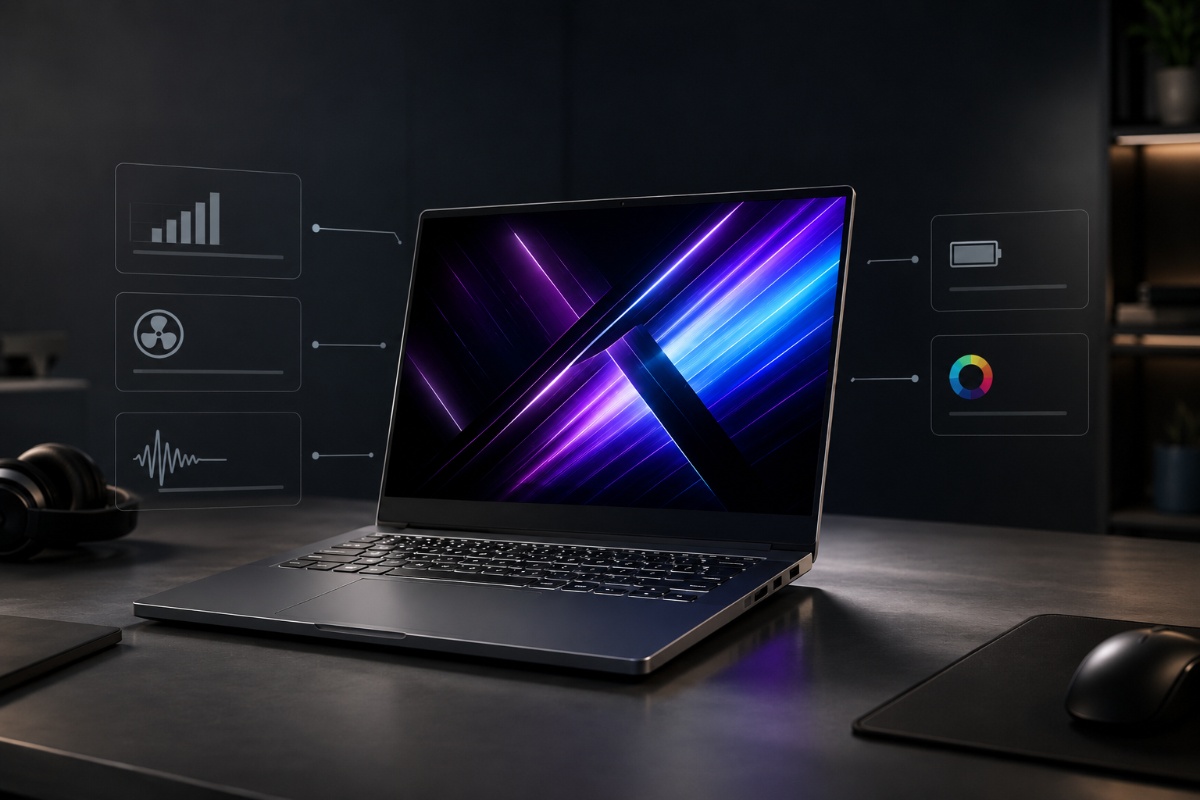
Gaming Laptops: Asus ROG’s new message reflects a maturing laptop market: speed still matters, but daily usability is now just as critical.
If you are spending premium money on a gaming laptop in 2026, Asus wants you to look past the benchmark chart. The company’s latest push, led by machines such as the ROG Zephyrus G16, argues that raw speed means little if a laptop runs too hot, gets too loud, or loses most of its power the moment it is unplugged.
That is a sensible shift for a market where buyers expect more from expensive gaming notebooks. Today’s high end systems often need to handle gaming, editing, school work, office tasks, and travel. A powerful CPU and GPU still matter, but they are no longer enough by themselves. Cooling, fan noise, screen quality, battery behavior, keyboard feel, port selection, and repair options now shape the real ownership experience. Asus frames this as a move away from short synthetic tests and toward real world performance, including thermals, acoustics, portability, display quality, battery life, and upgradeability.
Why Peak Scores Can Mislead Buyers
Benchmarks offer a standardized way to compare chips, but they usually capture short performance bursts. Real laptops are less tidy. A machine can post a strong synthetic score, then drop performance after 20 minutes of gaming if the cooling system cannot keep up.
That is why Asus is putting more emphasis on sustained thermals and acoustic behavior. In the Zephyrus G16, the company is trying to fit serious hardware into a slim aluminum body. The configuration can include an Intel Core Ultra 9 386H alongside an NVIDIA GeForce RTX 5080 Laptop GPU running at up to 160W in manual mode. Doing that inside a 1.49cm chassis makes cooling the real story, not just the chip names.
This is where independent testing becomes essential. Buyers should look for long gaming runs, surface temperature checks, and fan noise readings, not just short benchmark charts. A laptop that stays near or below 45dB in a performance mode will be far easier to live with than one that delivers higher peak numbers while sounding strained.
Rivals Are Solving The Same Problem Differently
This is not only an Asus argument. Razer is making a similar case with the 2026 Blade 16, which also uses Intel’s Core Ultra 9 386H, fixed LPDDR5X 9600MHz memory, a 240Hz OLED display, and NVIDIA RTX 50 Series graphics inside a thinner premium chassis. Razer lists graphics power at up to 165W TGP, with 140W plus 25W Dynamic Boost, giving it slightly more headline GPU power than the Zephyrus G16 while still chasing an ultra portable design.
Lenovo’s Legion Pro line approaches the same market from a more performance focused direction. Its larger gaming designs usually give cooling systems more physical room, which can help with sustained wattage and ports. The contrast matters for buyers. Thin machines must prove they can stay controlled under load, while larger machines must justify their size with steadier performance and better thermals.
The Zephyrus G16 Shows The Tradeoff Clearly
The Zephyrus G16 also shows how premium gaming laptops are now being sold beyond frame rates. Its 2.5K OLED display with a 240Hz refresh rate, 0.2ms response time, and 1100 nits peak brightness matters for games, but it also matters for creators who edit video, work with color, or spend long hours in front of the same screen.
That makes the display a useful baseline for judging any 2026 gaming laptop. Buyers should look beyond refresh rate and check panel quality, HDR support such as VESA DisplayHDR True Black 1000, brightness, color coverage, and power behavior. A weak display can make an expensive GPU feel less impressive every day.
Cooling deserves the same scrutiny. Asus highlights vapor chambers, liquid metal, Tri Fan systems, and tuned exhaust paths across its gaming laptop range. Those details matter because a thin premium laptop has less room to manage heat than a larger desktop replacement. The question is not whether the machine can be fast for a few minutes. The question is whether it can stay fast without becoming loud, hot, or uncomfortable.
Upgradeability And Battery Limits Are Part Of The Same Buying Decision
Storage access remains one of the more practical long term features in a gaming laptop. Game installs keep growing, and an accessible SSD slot can extend the useful life of a machine. Asus says its Strix, Zephyrus, and Flow machines support SSD upgrades, while Strix models add upgradeable memory.
The memory story needs more caution. The Zephyrus G16 uses LPDDR5X memory, which means buyers should not treat RAM as a later upgrade path. That is common in thin premium laptops because fixed memory can help with space, efficiency, and board design. It also makes the initial configuration more important. For heavy creative work, multitasking, or long term use, buying too little RAM is a mistake that cannot be fixed later.
Battery life follows the same logic. The Zephyrus G16 has a 90Wh battery and supports USB Type C Power Delivery, which helps for travel, charging flexibility, and lighter productivity work. It does not turn a powerful gaming laptop into an unplugged gaming machine. With a GPU in this class, serious gaming on battery will usually mean heavy performance limits and roughly 1 hour of play, sometimes less depending on the game and settings.
The 2026 Laptop Race Is About Balance
The broader market now gives buyers 2 clear choices. Thin premium systems such as the Zephyrus G16 and Blade 16 chase portability, OLED quality, strong materials, and enough graphics power for demanding work. Larger performance focused systems such as Lenovo’s Legion Pro models can lean harder into cooling headroom, ports, and sustained wattage.
Neither approach is automatically better. The right choice depends on whether the buyer values mobility or maximum consistency under load. Benchmarks still matter, but relying on them alone gives an incomplete view of daily use. Frame rates may get buyers interested, but thermals, fan noise, screen quality, battery limits, and memory choices will decide whether the laptop still feels worth the money after the first week.
Also Read: GameSir G7 Pro Controller Adds Amber Flame And Plum Purple For $80

Anup Singh is an independent technology journalist and content writer covering Apple, Android, AI, laptops, gaming, and the consumer tech industry. He focuses on delivering factual, well researched, and easy to understand reporting while explaining how new technologies impact everyday users.
1 thought on “Asus Wants You To Stop Buying Gaming Laptops Just For Benchmark Scores”