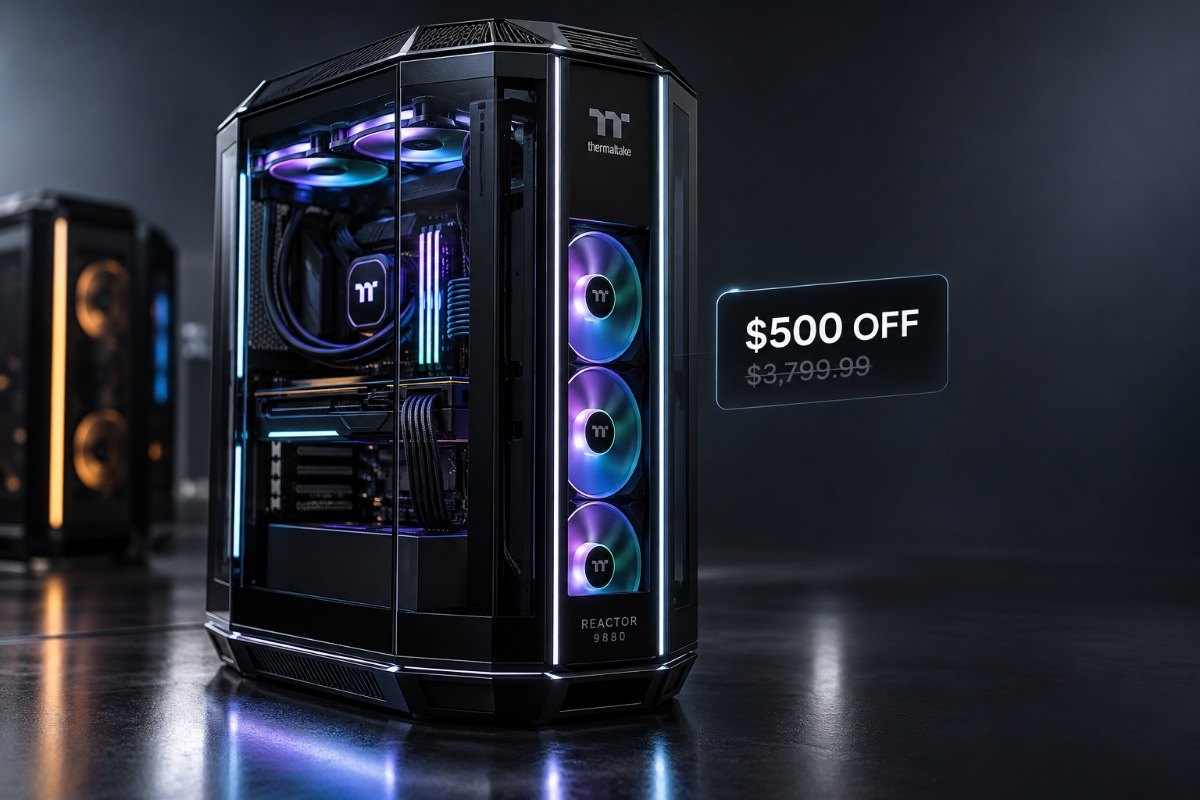
Thermaltake RTX 5080 : The Reactor 9880 now costs $3,799.99, but a recent HP Omen 35L deal raises questions about whether its premium design is worth the extra money.
Thermaltake has cut $500 from the advertised price of its Reactor 9880 gaming desktop, bringing the RTX 5080 powered system to $3,799.99 from $4,299.99. The roughly 12% discount arrives during the fall shopping season, following Amazon’s Prime Big Deal Days on October 6 and 7.
However, Thermaltake faces serious competition from manufacturers offering similar hardware for considerably less. HP’s Omen 35L, equipped with the same AMD Ryzen 7 9800X3D processor and Nvidia GeForce RTX 5080 graphics card, was advertised for $2,799.99 in early October. That created a $1,000 price gap, although HP’s price was a temporary promotion rather than a confirmed current offer.
Both desktops feature 32GB of DDR5 memory and 2TB of SSD storage. Thermaltake instead relies on its unusual vertical chassis, larger liquid cooler, and distinctive design to justify the premium. For buyers focused primarily on gaming performance, those differences make the decision more complicated.
What Thermaltake Includes For $3,799.99
The Reactor 9880 runs AMD’s Ryzen 7 9800X3D, an 8 core processor with additional cache memory designed to improve gaming performance. Nvidia’s RTX 5080 adds 16GB of GDDR7 graphics memory, delivering up to 960GB/s of memory bandwidth compared with 717GB/s on the RTX 4080. That represents roughly 34% more bandwidth, although actual gaming improvements depend on the workload.
Thermaltake replaces the conventional rectangular tower with an octagonal vertical case. Inside, a 360mm sealed liquid cooler manages processor temperatures, while an 850W 80 Plus Gold power supply handles power delivery.
The larger radiator offers additional cooling surface, but this is a conventional liquid cooling solution rather than a custom loop. Whether it delivers noticeably lower temperatures or quieter operation than competing desktops remains unclear without independent testing.
Exact Component Details Matter
Thermaltake confirms an AMD X870 chipset but does not identify the motherboard’s specific brand or model in its published specifications. That missing information matters for buyers considering future storage upgrades, expansion cards, or processor compatibility.
Component transparency has also become a concern among prospective buyers. In Reddit’s r/Prebuilts community, a shopper raised the issue directly by asking, “Are all the parts customizable on this one and are they good quality like psu?” The question reflects a practical concern with expensive prebuilts: customers want to know exactly what they are paying for beyond the headline CPU and GPU specifications.
At this price, buyers should verify the motherboard, graphics card model, power supply, warranty coverage, and available upgrade options before ordering.
Why The HP Deal Changes The Calculation
The HP Omen 35L comparison highlights how much pricing can vary between gaming desktops built around identical processors and graphics cards.
HP’s configuration included a 240mm liquid cooler and a 1000W Gold rated power supply. Thermaltake offers a larger 360mm cooler and its distinctive upright enclosure, but neither feature guarantees better gaming performance.
The Reactor’s vertical design may appeal to buyers seeking a different desk layout. However, they should check graphics card clearance, accessibility, and thermal performance before assuming the compact footprint is an advantage.
For gamers prioritizing performance and value, the Reactor 9880 is difficult to recommend at a $1,000 premium over a comparably equipped competitor. Its unusual case and larger cooler are appealing extras, not convincing reasons to spend that much more without proven cooling or performance advantages. Unless buyers specifically want Thermaltake’s design, a significantly cheaper RTX 5080 desktop with verified components and warranty coverage makes more financial sense.
Also Read: AnyPS5 Decodes All PS5 Shader Instructions, but Native PC Playability Remains Far Off

Anup Singh is an independent technology journalist and content writer covering Apple, Android, AI, laptops, gaming, and the consumer tech industry. He focuses on delivering factual, well researched, and easy to understand reporting while explaining how new technologies impact everyday users.