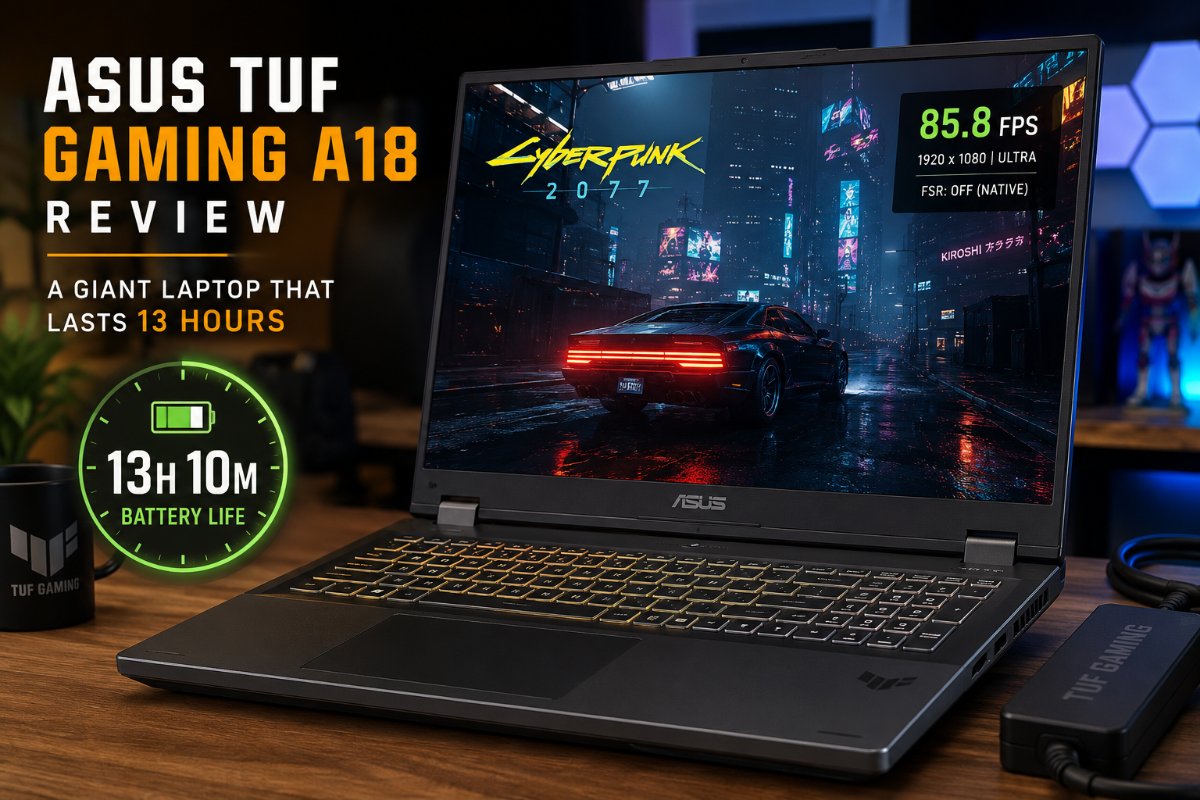
Asus TUF Gaming A18 review: The 18 inch desktop replacement pairs steady RTX 5060 gaming with battery life that its size and hardware should make unlikely.
Nobody buys an 18 inch gaming laptop expecting all day battery life. Yet the Asus TUF Gaming A18 lasted 13 hours and 10 minutes in Notebookcheck’s WiFi 1.3 browsing test. The benchmark used a display brightness of about 150 nits, activated power saving measures and loaded a new web page every 30 seconds.
That result becomes more impressive once you consider the hardware drawing from its 90 Wh battery. Asus pairs a power hungry Nvidia RTX 5060 laptop GPU with an AMD Ryzen 7 260 processor. The tested model also carries 16 GB of dual channel DDR5 memory and a 1 TB solid state drive.
At 2.68 kg, the A18 is not a travel laptop. Still, its endurance removes the constant outlet anxiety that usually follows large gaming machines.
Battery Life Changes The Desktop Replacement Formula
The 90 Wh battery deserves part of the credit, but intelligent hardware switching also matters. Nvidia Optimus allows routine tasks to run through the Ryzen processor’s integrated Radeon graphics. That lets the laptop shut down the RTX 5060 when its extra power is unnecessary.
With more than 13 hours available, owners can browse, stream and work from the couch without dragging the 700 gram charger between rooms. Its large chassis still limits genuine portability, but the machine no longer needs to remain tethered to a desk.
“It’s a bit of a beast, but that 18 inch screen is glorious,” an A18 owner wrote in an Asus TUF community discussion.
That assessment gets to the heart of the product. Asus makes no attempt to disguise the A18 as an ultrabook. Instead, the long battery life makes its size far easier to accept.
RTX 5060 Gaming Finds A Quieter Sweet Spot
Notebookcheck recorded 85.8 frames per second in Cyberpunk 2077 at 1920 × 1080 using the Ultra preset. FSR remained disabled, so the result came from native rendering without upscaling.
Performance mode kept fan noise at 43 dB while allowing the GPU to draw 80 W. Turbo mode increased the result to 95.6 frames per second, but noise climbed sharply to 55 dB.
That is a steep acoustic cost for 9.8 additional frames. Competitive players may accept it, though most owners will find Performance mode more comfortable for everyday gaming.
The strong graphics results were matched by steady processor output. The Ryzen 7 260 scored 17,146 points in the Cinebench R23 multicore test and 1,777 points in the single core run. Those results placed it close to the processor’s broader benchmark average.
Meanwhile, the RTX 5060 includes 8 GB of GDDR7 video memory. Faster bandwidth helps offset the limited capacity, especially at the laptop’s native resolution. However, 8 GB remains a fixed ceiling that could force lower texture settings in demanding Unreal Engine 5 games.
The Screen Is The Clear Compromise
A resolution of 1920 × 1200 feels modest when stretched across an 18 inch display. The 144 Hz panel covers 96.6 percent of sRGB, but its 126 pixels per inch cannot match sharper 2560 × 1600 rivals.
Average brightness of about 323 nits is adequate indoors rather than impressive. Even so, the lower resolution helps the RTX 5060 maintain smoother frame rates without relying on upscaling.
Buyers therefore face a clear tradeoff. The A18 delivers size, speed and exceptional battery life, but it does not offer premium image sharpness.
Look past the average panel and loud Turbo mode, and the appeal becomes obvious. Asus has built a massive gaming laptop with demanding hardware that can finally spend meaningful time away from the wall.
Also Read: Gainward’s New RTX 3060 Proves 12GB Video Memory Still Matters

Anup Singh is an independent technology journalist and content writer covering Apple, Android, AI, laptops, gaming, and the consumer tech industry. He focuses on delivering factual, well researched, and easy to understand reporting while explaining how new technologies impact everyday users.
1 thought on “Asus TUF Gaming A18 Review: A Giant Laptop That Lasts 13 Hours”