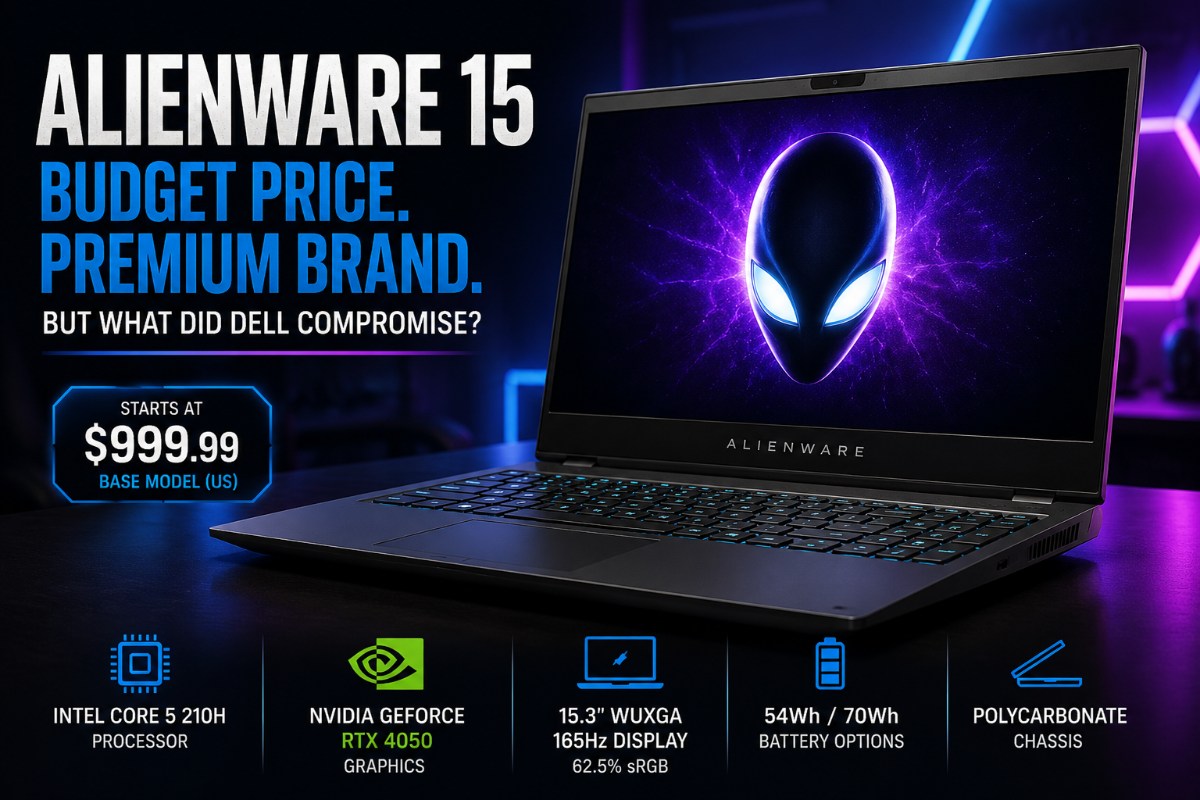
Dell has lowered the price of entry for Alienware, but the new 15 asks buyers to accept a plastic body, a weak color display, and careful battery and performance compromises.
For years, the Alienware badge has been a status symbol for gamers willing to pay for bold design, strong cooling, and premium build quality. The new Alienware 15 drops that brand into a far more aggressive price bracket. Dell’s current US listing shows the $999.99 base model with an Intel Core 5 210H processor, Nvidia GeForce RTX 4050 graphics, 16 GB of DDR5 memory, 512 GB of SSD storage, and a 15.3 inch WUXGA display running at 165Hz. That makes it far easier to enter the Alienware ecosystem, but the discount is not free. Dell is using a plastic chassis, a narrow color display, and smaller battery options than some higher tier gaming laptops. This is not just a cheaper Alienware. It is a test of how much Dell can cut before the brand starts to feel ordinary.
Dell Cut The Price, And The Parts Show It
The base configuration defines the real pitch. At $999.99 in the US, the Alienware 15 starts with Intel Core 5 210H and RTX 4050 graphics, not RTX 5050 or RTX 5060. Dell also lists higher configurations with Core 7 240H, RTX 5050, RTX 5060, 32 GB of memory, and 1 TB of storage. Those versions may look stronger on paper, but they quickly move away from the entry price that makes the product interesting.
Dell also saves money on the shell. The Alienware 15 uses polycarbonate resin for its lid and base. That is a clear step below premium Alienware x series laptops, where higher end models have used anodized aluminum and magnesium alloy construction. Plastic is not automatically fragile, but it changes what buyers should expect. At $1,000 and above, the laptop has to justify why shoppers should pick it over less expensive gaming machines with similar chips.
Regional pricing and configurations may shift the value equation further. Some markets list AMD based Alienware 15 models with different memory, storage, and GPU combinations. That matters for buyers comparing local prices, but the central question remains the same: does the cheaper Alienware still feel premium enough?
The Display Is The Weakest Link
The screen is the hardest compromise to defend. Dell lists a 15.3 inch WUXGA panel with a 165Hz refresh rate, 300 nits of brightness, and 62.5 percent sRGB color coverage. The refresh rate helps motion look smoother in fast games, but the color coverage is weak for a modern gaming laptop near $1,000.
A 62.5 percent sRGB panel can make colors look muted or washed out next to laptops that cover close to the full sRGB range. That matters for games, video, streaming, and basic creative work. A fast panel is useful, but it does not make a dull panel look rich.
Competition makes the issue sharper. Lenovo LOQ, HP Victus, Acer Nitro, and Asus TUF machines already fight aggressively in this price range. Some configurations from those lines offer 100 percent sRGB display options. Not every budget gaming laptop has a good screen, and shoppers still need to check the exact model. Even so, Alienware carries a premium name, so a weak color panel feels more noticeable.
Battery Capacity Adds Another Caution Flag
Battery life is another area where budget gaming laptops often reveal their compromises. Dell lists the Alienware 15 with 54Wh and 70Wh integrated battery options, depending on configuration. Those capacities are not unusual for this class, but they deserve attention because gaming laptops already drain quickly when the GPU is active.
The 70Wh option is the one buyers should watch if they plan to use the laptop away from a desk. The smaller 54Wh battery may feel limiting for students, commuters, or anyone who wants to move between classwork, browsing, video calls, and light gaming without staying close to a charger.
Capacity alone does not decide battery life. Processor choice, screen brightness, GPU switching, fan behavior, and background software can all change real use. Still, battery size gives buyers an early warning. Dell is selling this as a more accessible all purpose gaming laptop, so weak unplugged endurance would hurt the pitch.
Power Limits Will Shape Real Game Performance
Dell says the Alienware 15 uses 2 fans, 3 copper heat pipes, and a rear exhaust. RTX 5050 and RTX 5060 versions also get a Cryo Chamber structure that directs airflow toward core components. That is a sensible setup for a lower cost gaming laptop, but it is still not the kind of heavier thermal design found in Alienware’s most expensive machines.
Alienware described the laptop as offering “real performance, proven quality, and a design engineered to last.”
The key issue is sustained performance. Comparison data places the Alienware 15 at 65W for RTX 4050 and 80W for RTX 5050 and RTX 5060 configurations. Those numbers matter because laptop GPUs with the same name can perform very differently depending on power limits and cooling.
In demanding modern games, a lower wattage GPU may run at lower sustained clock speeds. That can mean fewer frames per second at native 1920 x 1200 resolution, especially with high textures, heavy lighting effects, or ray tracing enabled. An RTX 5060 at 80W may still be a strong upgrade over the base RTX 4050, but it may not match the same chip in a thicker laptop with a higher power limit. Buyers may need to lean on DLSS, lower settings, or frame generation to keep newer games smooth.
Dell Has To Beat Budget Rivals, Not Just Sell The Logo
The Alienware 15 still has a clear audience. It gives students and first time gaming laptop buyers access to modern Nvidia graphics, upgradable memory, upgradable storage, Alienware Command Center software, a 165Hz screen, Ethernet, HDMI, USB C, and a full number pad. For someone who wants 1 laptop for classwork, streaming, and gaming, the product is easy to understand.
That does not make it an easy sell. Shoppers will compare it with Asus TUF, Lenovo LOQ, HP Victus, and Acer Nitro systems, forcing Dell to justify every compromised component. The Alienware logo may carry weight, but buyers in this price bracket tend to be practical. They will look at frame rates, screen quality, fan noise, battery life, repair access, and sale pricing.
A processor and graphics chip do not determine a gaming laptop’s true value. The Alienware 15 has to feel better tuned, better supported, or better built than its cheaper rivals. Otherwise, the famous logo becomes harder to defend.
User Reaction Shows The Risk
Early reaction on Instagram captured the same tension. Some users welcomed the idea of a more accessible Alienware. Others focused on price and similarity to existing budget machines. One user wrote, “i can’t afford you. Ur price is too high”. Another said it “Looks almost like hp victus”.
Those comments are not reviews, but they point to Dell’s main challenge. If buyers see the Alienware 15 as a dressed up budget laptop, the brand premium becomes harder to defend. If they see it as a carefully tuned entry into the Alienware lineup, the price becomes more persuasive.
The $999.99 starting price gets Dell into a market it has not usually owned. Now the Alienware 15 has to prove that Dell did not cut too deeply into the things that made the badge valuable. Its 62.5 percent sRGB screen, 54Wh battery option, plastic chassis, and modest GPU power limits are not small footnotes. They are the compromises that will decide whether this is a smart entry point into Alienware or simply a budget laptop wearing a premium badge.
Also Read: Lenovo’s $1,599 Legion 5i Deal Brings OLED And RTX 5070 To The Midrange
FAQs
1. Is the Alienware 15 really a budget laptop?
It is budget by Alienware standards. Its $999.99 starting price is lower, but rivals may offer stronger value.
2. What GPU comes in the base Alienware 15?
The US base model lists an Nvidia GeForce RTX 4050 with an Intel Core 5 210H processor.
3. Is the Alienware 15 display good?
The 165Hz refresh rate helps gaming, but 62.5 percent sRGB color coverage is weak for this price.
4. Why do GPU power limits matter?
Lower wattage can reduce sustained frame rates. Two laptops with the same GPU name can perform differently.
5. Who should consider the Alienware 15?
It suits first time buyers who want the Alienware brand, modern Nvidia graphics, and upgradeable storage and memory.

Anup Singh is an independent technology journalist and content writer covering Apple, Android, AI, laptops, gaming, and the consumer tech industry. He focuses on delivering factual, well researched, and easy to understand reporting while explaining how new technologies impact everyday users.
1 thought on “The $1,000 Alienware 15 Tests How Much Premium DNA Belongs In A Budget Laptop”