RX 9070 XT vs RTX 5070: The Radeon card reports higher memory figures in several demanding games, but allocation alone cannot reveal efficiency, performance or future limits.
Two 16GB graphics cards can run the same game and still report wildly different memory use. That is exactly what happened in a recent comparison between AMD’s Radeon RX 9070 XT and Nvidia’s GeForce RTX 5070 Ti.
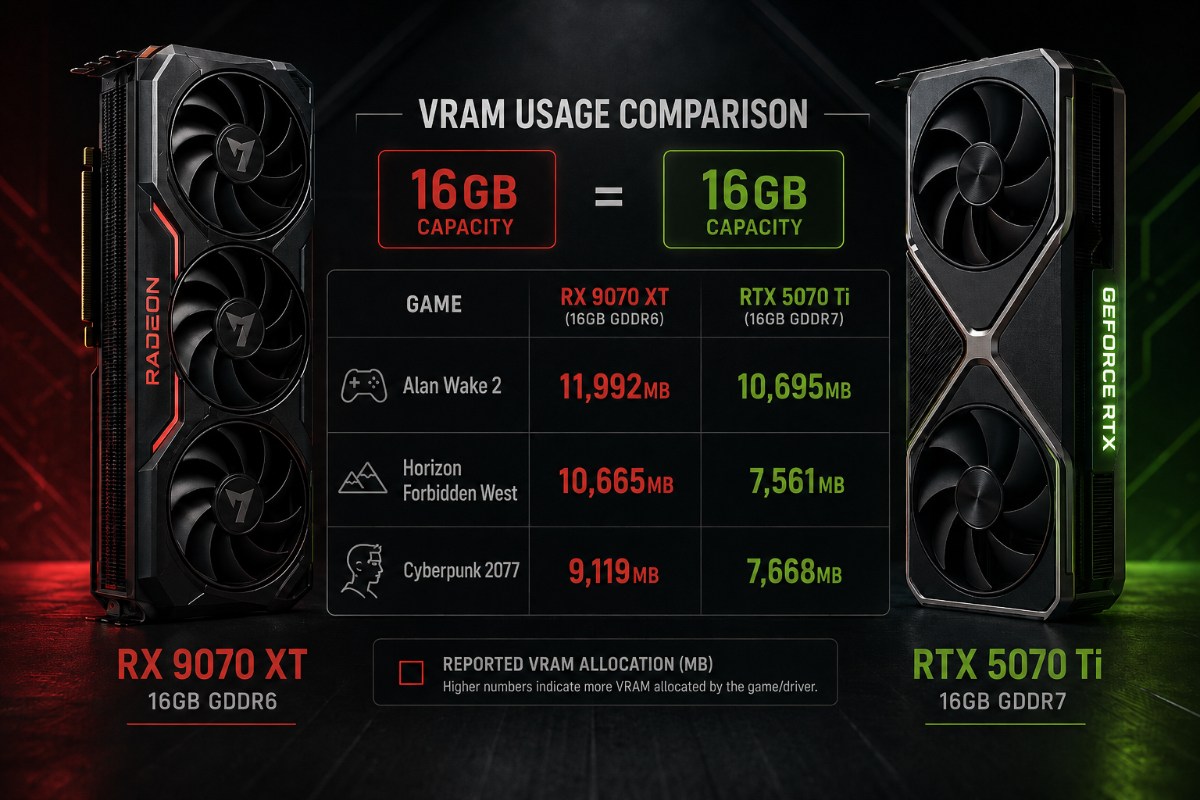
GameGPU published community supplied test captures recorded at 1440p. The RX 9070 XT reached 11,992MB in Alan Wake 2, compared with 10,695MB on the RTX 5070 Ti. Horizon Forbidden West produced the widest gap, with 10,665MB on Radeon and 7,561MB on GeForce. Cyberpunk 2077 showed 9,119MB against 7,668MB.
Those figures may suggest that AMD needs more memory to complete the same work. The evidence does not support that conclusion yet. The comparison did not use a fully controlled laboratory setup with confirmed matching drivers, graphics settings, background processes and benchmark routes. It establishes a difference in reported memory allocation, but not the cause or performance cost.
Different Memory Hardware Sets The Baseline
Capacity is identical, but the memory systems are not. AMD equips the RX 9070 XT with 16GB of GDDR6 on a 256 bit interface, delivering up to 640GB per second.
Nvidia uses 16GB of GDDR7 on the RTX 5070 Ti, also across a 256 bit interface. Its newer memory technology raises bandwidth to 896GB per second.
Bandwidth does not directly determine how much memory a game reserves. It does show why equal capacity does not mean equal behaviour. Each GPU also uses a different cache structure, compression system, driver stack and method for moving resources between the processor, system memory and VRAM.
Allocation Is Not The Same As Consumption
Games often reserve memory for textures, shaders, geometry and other assets before every resource becomes active. Keeping that data ready can reduce loading delays and improve asset streaming through large environments.
A monitoring overlay may combine memory requested by the game with resources that are resident, cached or waiting for later use. Windows treats those categories differently, which is why one displayed number cannot explain the full workload.
Steve Pronovost, the Microsoft engineer responsible for the Windows GPU scheduler and memory manager, made that limitation clear while explaining how graphics memory appears in system monitoring tools.
“Many existing utilities show the memory requested by a process,” Steve Pronovost said.
That distinction applies directly to these results. A higher Radeon reading may reflect more aggressive caching or reservation rather than an extra 3GB required to render every frame.
Professional analysis tools separate memory budget, commitment, residency and active use. Reviewers need those measurements before declaring one architecture more efficient.
Resizable BAR And Drivers May Affect The Reading
Resizable BAR allows the processor to address a much larger section of graphics memory at once. AMD calls its implementation Smart Access Memory, while Nvidia also supports the feature on the RTX 5070 Ti.
Driver profiles can influence how each vendor uses the technology in individual games. Compression methods may also affect the amount of memory reserved, but the published figures cannot isolate either factor.
Texture quality, ray tracing, resolution scaling, driver versions and background applications can all move the displayed total. Even a different route through the same game may load another set of assets.
Buyers Should Watch Frame Delivery
The current readings do not prove that the RX 9070 XT manages memory less efficiently. They also do not show that it will reach its 16GB limit sooner.
A genuine VRAM bottleneck usually produces visible symptoms. Frame times become unstable, textures load incorrectly, performance drops sharply or the game begins transferring data into slower system memory.
Average frame rate tells only part of that story. A stronger comparison would include frame time graphs, 1% lows, shared memory activity and repeated runs through identical scenes.
For buyers, the verdict is simple. Higher allocation alone is not a warning sign. Until it causes stutter, texture problems or slower frame delivery, it should not decide which graphics card you buy.
Also Read: Gigabyte Aorus Master 16 Gen 2 Review: Can RTX 5090 Really Go Portable?

Anup Singh is an independent technology journalist and content writer covering Apple, Android, AI, laptops, gaming, and the consumer tech industry. He focuses on delivering factual, well researched, and easy to understand reporting while explaining how new technologies impact everyday users.
1 thought on “RX 9070 XT Uses More VRAM Than RTX 5070 Ti, But Why?”