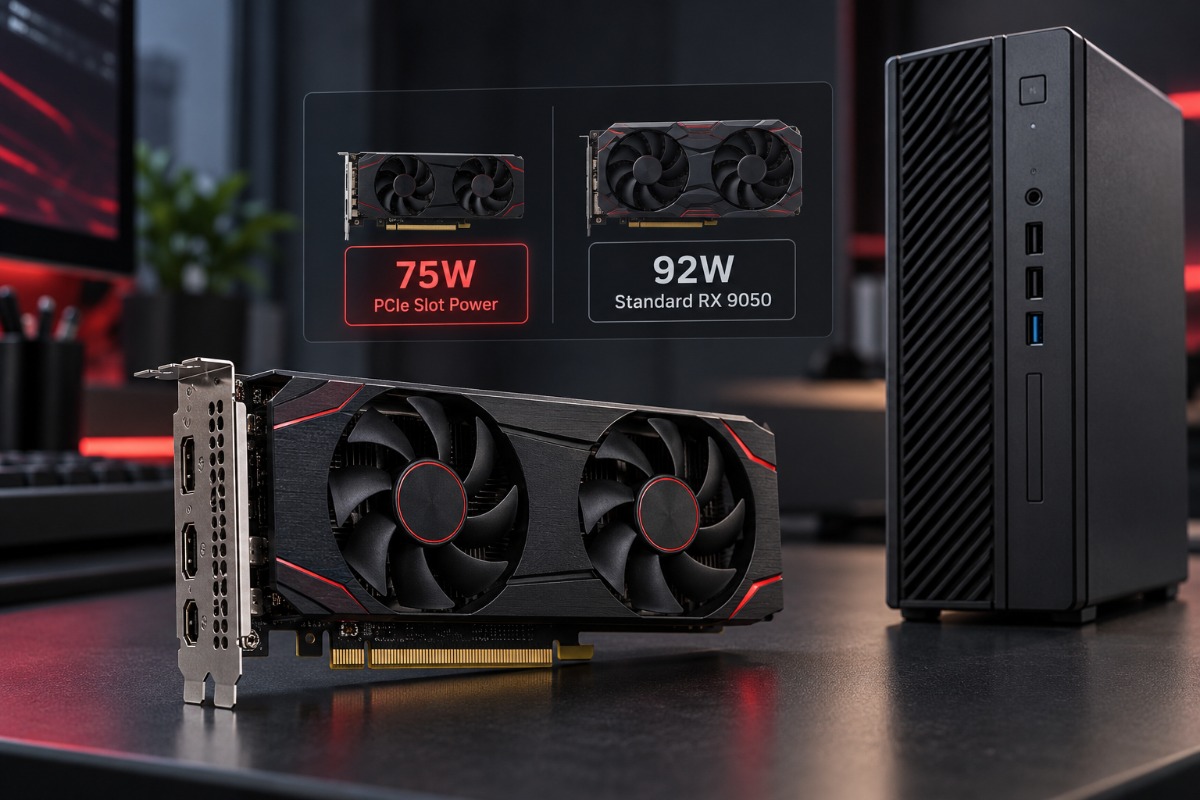
Radeon RX 9050 : PowerColor’s rumored half-height Radeon could bring RDNA 4 to slim desktops, but an 8-pin power connector may limit its appeal.
Just 17W separates AMD’s standard Radeon RX 9050 from the 75W that a PCIe slot can supply. That gap could decide whether PowerColor’s leaked low-profile RX 9050 8GB becomes a practical upgrade for slim desktop PCs. If the smaller card retains the standard GPU’s 92W board power and 8-pin connector, many office systems will have no straightforward way to use it.
Hardware leaker @momomo_us shared the model code “RX9050 8GB LP” on X on October 15, pointing to an unannounced half-height version of PowerColor’s entry-level RDNA 4 graphics card. The company has not confirmed its specifications, physical dimensions, pricing, or release date.
For owners of refurbished Dell OptiPlex, HP EliteDesk, ProDesk, and Lenovo ThinkCentre desktops, a modern slot-powered Radeon would fill a genuine hardware gap. However, PowerColor would need to reduce power consumption without sacrificing too much gaming performance to reach that market.
PowerColor’s Low-Profile RX 9050 Targets a Different Market
PowerColor already sells the RX 9050 8GB Reaper, measuring 200 × 100 × 39 mm without its bracket and 220 × 120 × 40 mm with it. Despite its compact length, the full-height design cannot fit slimline expansion slots. A standard low-profile mounting bracket measures about 79 mm tall, compared with 120 mm for a full-height bracket.
RDNA 4 alternatives remain limited. Vastarmor demonstrated a triple-fan low-profile RX 9060 XT 16GB at CES 2026 but never added it to its public retail catalog. The card resurfaced in August when YouTuber ETA Prime tested a working 140W model inside MINISFORUM’s 8.47-liter 895D7 gaming PC.
The 75W PCIe Power Limit Could Decide Compatibility
The standard RX 9050 draws 92W, requires an external 8-pin PCIe connector, and carries a 450W recommended system power supply rating.
Many refurbished office desktops use proprietary power supplies rated around 180W to 260W, often without spare GPU power cables. Even a physically compatible graphics card may not work safely unless the system has enough available power.
Custom small-form-factor gaming builds can accommodate additional GPU power connections. Refurbished office PCs are more restrictive. A properly engineered 75W version without an external connector would remove a major upgrade barrier, although its cooling capacity and sustained performance would still need testing.
The 8GB Memory Configuration Adds Another Advantage
The standard RX 9050 uses Navi 44 silicon with 1,024 stream processors, a 1,920 MHz game clock, and boost speeds reaching 2,600 MHz. Its 8GB GDDR6 memory runs at 18 Gbps across a 128-bit interface with 32MB of Infinity Cache.
AMD also offers an OEM-only 4GB variant with a narrower 64-bit interface and 16MB cache. Hardware Unboxed found the 8GB model averaged 37% higher frame rates across 18 games at 1080p Low settings.
The standard RX 9050 also supports PCIe 5.0 x16, avoiding the narrow x4 connection that limits older RX 6400 cards in PCIe 3.0 systems. Display connectivity includes two DisplayPort 2.1a outputs and HDMI 2.1b. RDNA 4 features include FSR 4 machine-learning upscaling, HYPR-RX, and Radeon Anti-Lag 2.
Reducing power to 75W could require lower GPU clocks, affecting gaming results. If PowerColor achieves that target, it would compete with slot-powered low-profile options such as Nvidia’s RTX 3050 6GB, AMD’s RX 6400, and Intel’s Arc A310 and A380.
PowerColor has yet to reveal whether its smaller RX 9050 will eliminate the 8-pin connector. That decision, alongside pricing and measured performance, will determine whether it becomes a worthwhile upgrade for existing slim desktops.
Also Read: NVIDIA DLSS 5 Neural Rendering Model Runs 2X Faster With 20% Less VRAM At 4K

Anup Singh is an independent technology journalist and content writer covering Apple, Android, AI, laptops, gaming, and the consumer tech industry. He focuses on delivering factual, well researched, and easy to understand reporting while explaining how new technologies impact everyday users.