Sony ending PlayStation discs: Sony has the sales data. Players still have the trust problem.
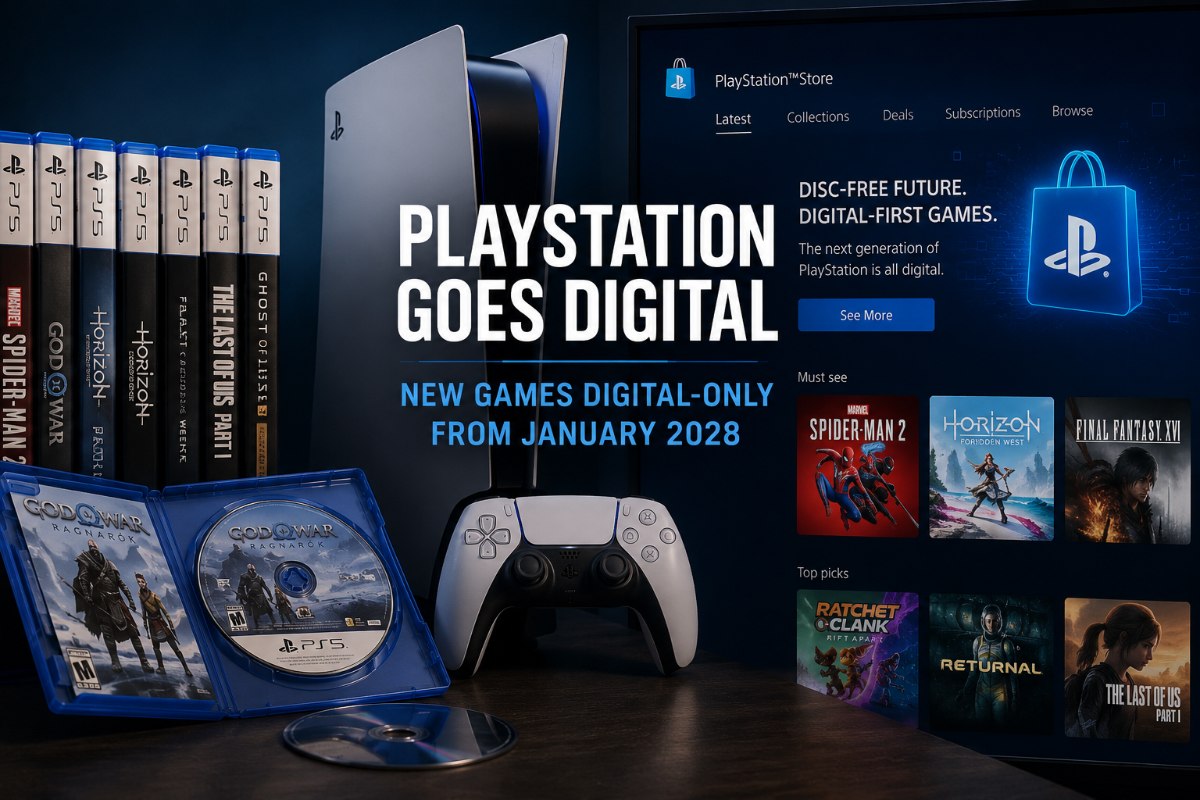
Sony is putting an end date on the PlayStation game disc. Starting in January 2028, all new PlayStation releases will be sold in digital formats only through the PlayStation Store and through retailers offering digital versions. The cutoff does not affect previously released games or titles already scheduled for a physical launch. Sony says the move reflects how people already buy games. Its own investor materials show digital downloads accounted for 78% of full game software unit sales in FY2025 and 85% in the March quarter. The business case is clear. The consumer case is harder to settle. A disc can be traded, resold, lent, or archived. A digital purchase depends on an account, licensing terms, and a store that stays online. Sony is not just following habits. It is removing one of the last simple forms of control that console buyers still had.
Why Sony Wants An All Digital Future
Sony points to changing consumer behavior, but the economics matter just as much. Robin Zhu of Bernstein has argued that digital sales carry near pure incremental margin because Sony avoids the cost of packaging, shipping, and retailer cuts. Piers Harding Rolls of Ampere Analysis has made a similar point, saying the shift should improve profitability and simplify inventory planning. Once a sale happens inside Sony’s own storefront, Sony keeps tighter control over pricing, promotion, and customer relationships.
That is why this decision matters beyond format preference. Sony has not quietly reduced shelf space or limited discs to a few special editions. It has set a firm cutoff for all new PlayStation games. That makes it the first major console maker to draw such a clear line. The change also moves more leverage away from retailers and toward the company that controls the platform.
“This doesn’t have as much of an impact as you might expect,” Frank Cifaldi, director of the Video Game History Foundation, said in a public statement.
Cifaldi’s point adds useful nuance. Modern games often rely on updates, server checks, and fixes that arrive long after launch. A disc no longer guarantees a complete or final version of a game. Even so, his caution does not erase the consumer issue at the center of Sony’s move. The more the industry relies on licenses instead of discs, the more power shifts to the platform holder. That affects resale, lending, pricing, and long term access.
The Vanishing Library Problem
Players have reason to be skeptical because Sony has spent the past week reminding them how fragile digital libraries can be. On the same day it announced the disc cutoff, the company said it will begin closing the PlayStation Store on PS3 in some markets in August 2026, then close the PS3 and PS Vita stores more broadly in July 2027. Sony says previously purchased content will remain downloadable for the foreseeable future, but new purchases will end once those stores shut.
The timing matters because this is the second time Sony has tried to close those legacy stores. In 2021, then PlayStation chief Jim Ryan reversed an earlier shutdown plan after backlash from players and said the company had made the wrong decision. That history makes the new closure plan feel less like routine housekeeping and more like a renewed test of how much shrinking access users will accept.
Sony has also given players a more immediate example of what digital ownership can mean in practice. In several European markets, the company recently warned users that previously purchased StudioCanal titles will disappear from their libraries on September 1 because of licensing agreements. Public reporting says the affected catalog includes 551 films and shows, with no refunds or compensation. That is not a PlayStation game story in the narrow sense. It still lands directly inside the same debate. When paid content can vanish because a licensing deal ends, ownership starts to look more like temporary access than a lasting right.
What Players Actually Lose
The most immediate casualty is the used game market. Without discs, players lose one of the easiest ways to sell a finished game, borrow from a friend, or wait for a cheaper second hand copy. Retailers lose leverage at the same time, because Sony gains more direct control over how games are sold and surfaced.
The preservation issue is narrower, but still real. Physical media no longer guarantees a complete archive of a modern game. Some releases ship in a state that still depends on online updates. Star Wars Jedi: Survivor is a good example. Players who bought the physical edition still needed an internet connection to install a day 1 patch before they could play. That limits what a disc can preserve. Still, a disc remains a stronger starting point for collectors, libraries, and archives than a purchase tied entirely to a live account and a working store.
That distinction matters in an industry where the Video Game History Foundation has found that 87% of classic games released in the United States are already out of print. Sony is betting that convenience will outweigh those concerns. The harder question is whether players will keep accepting a market where paying full price buys less control every year.
Also Read: The Origimagic N2 Pro Proves Budget Mini PCs Aren’t Just For Web Browsing Anymore

Anup Singh is an independent technology journalist and content writer covering Apple, Android, AI, laptops, gaming, and the consumer tech industry. He focuses on delivering factual, well researched, and easy to understand reporting while explaining how new technologies impact everyday users.
1 thought on “Sony Is Ending PlayStation Discs By 2028, But Players Still Want Control”