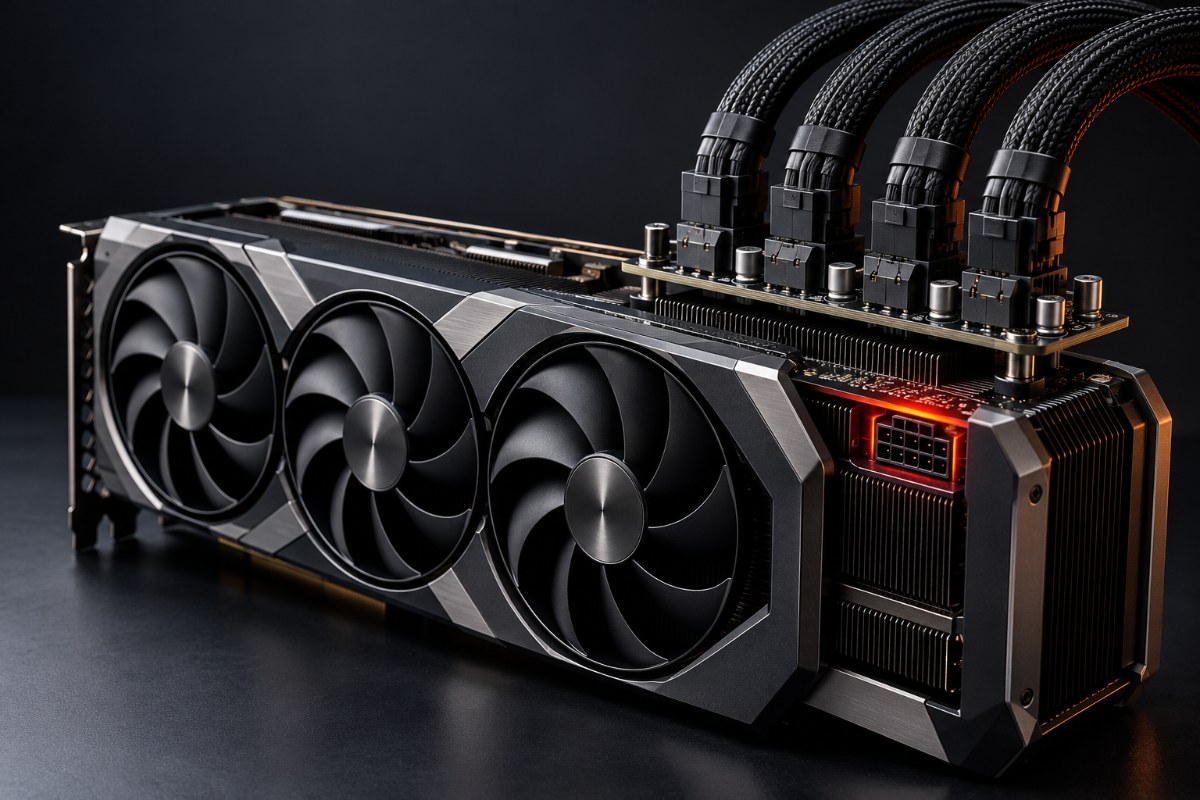
RTX 5090: A custom power board takes the load off Nvidia’s compact GPU socket, but fitting it requires permanent work on an expensive graphics card.
The RTX 5090 launched at $1,999, yet its 575W power draw still travels through a compact connector that some PC builders distrust. The card uses the revised 12V-2×6 standard, introduced after overheating complaints involving the older 12VHPWR connector on the RTX 4090. That revision improved plug insertion detection, but reports of damaged connections have continued.
Hardware modder DallasGrave has developed a board with four traditional 8-pin PCIe sockets that can power an RTX 5090 without using its stock 16-pin input. Unlike Nvidia’s bundled adapter, which funnels four 8-pin cables into a single compact socket, this modification creates another route into the GPU.
The demonstrated prototype is mounted on a Gigabyte-branded RTX 5090, although its exact model has not been identified. It follows an earlier two-connector design that supplemented the original connection. The prospect of permanently modifying such an expensive card shows how seriously some owners take the connector issue.
How the Four-Connector Board Works
Each PCIe 8-pin power connector has a standard rating of 150W, so four provide a combined 600W budget. They also distribute the incoming load across 12 positive power conductors, compared with 6 in a 12V-2×6 connection. Traditional 8-pin connectors use larger contacts and spread the wiring across more plug housings.
This is not a plug-in adapter. The custom circuit board is soldered directly to the GPU’s power contacts. The existing socket can remain available, allowing both connections to operate together, or the new board can supply the card alone.
In an October 15 Reddit discussion on r/pcmasterrace, DallasGrave said equal-length board traces kept current balanced “between 4.1 and 4.4A at 600W.” The design also includes fused connections.
What the Tests Actually Show
DallasGrave reports nearly 50% less current per wire and a roughly 20°C reduction in wire and nearby board temperatures. The module reportedly reached 45°C during an 800W run on a shunt-modded GPU. That modification changes power sensing to permit loads above the RTX 5090’s normal 575W specification. It is not a stock operating condition.
For now, these figures come from the creator’s own tests. Independent reviewers have not verified them across multiple cards. DallasGrave plans to release installation footage, demonstrate live electrical measurements and conduct a 24-hour sustained load test.
Soldering an aftermarket power board onto the GPU voids the standard factory warranty for the modified card, leaving owners dependent on the protection offered by the installer. DallasGrave says customers who use the installation service will receive a separate warranty, but its terms have not been published.
Wider GPU Support and Commercial Availability
The pictured module fits a Gigabyte card, but Asus, MSI and other board partners use different layouts. DallasGrave is developing additional designs, including a remotely mounted version for Nvidia’s compact Founders Edition cards. The creator also plans optional active monitoring and custom backplates designed to give the modification a factory-like finish.
DallasGrave aims to launch a mail-in installation service and open a Las Vegas storefront in December 2026. Installation could add a couple hundred dollars, though final module pricing remains unsettled. Interested owners have already asked about compatibility and warranty protection.
The important difference is physical: four conventional connectors bypass the compact socket that Nvidia’s own adapter still relies on. With RTX 5090 replacement costs running well above launch pricing in some markets, that approach has clear appeal. Whether it delivers lasting reliability will depend on testing outside the creator’s workshop.
Also Read: PlayStation Store Lists GTA 6 as PS5 Pro Enhanced Without Confirming 60 FPS

Anup Singh is an independent technology journalist and content writer covering Apple, Android, AI, laptops, gaming, and the consumer tech industry. He focuses on delivering factual, well researched, and easy to understand reporting while explaining how new technologies impact everyday users.
1 thought on “Modder Bypasses RTX 5090’s Melting-Prone 16-Pin Connector With Four 8-Pin Ports”