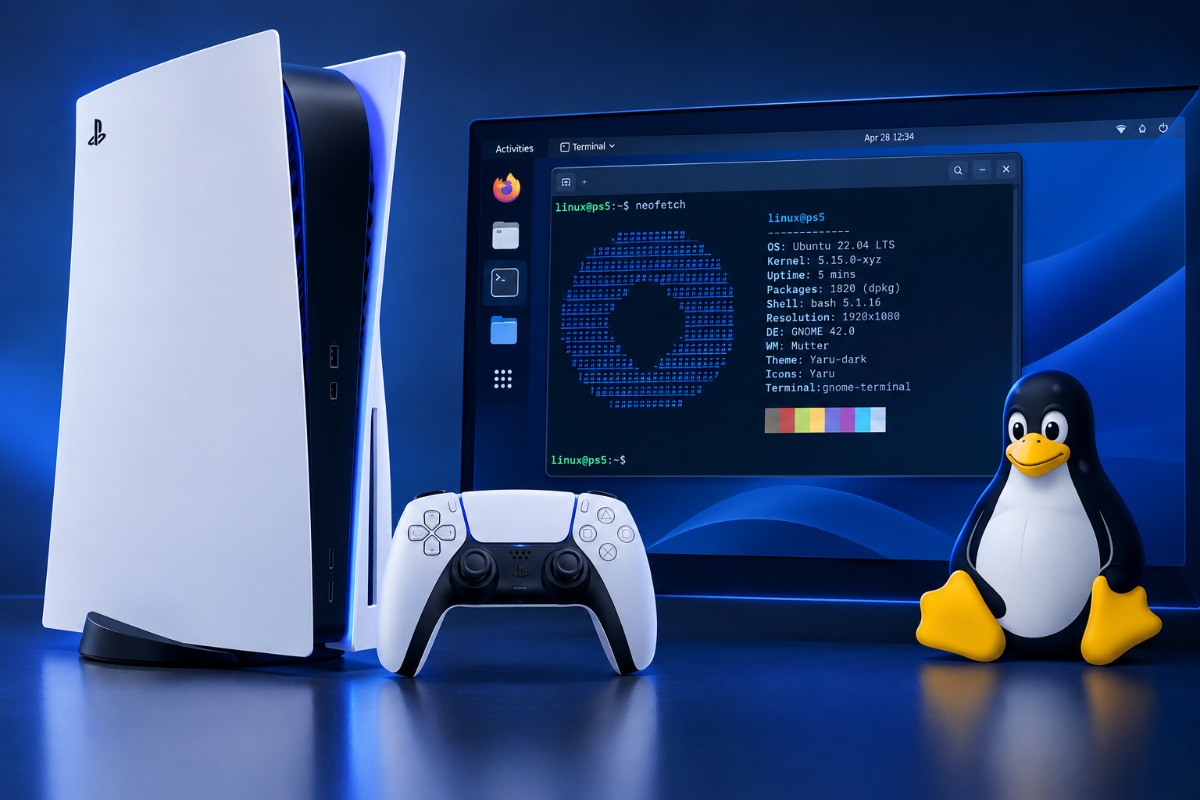
PS5 Linux loader: The project aims to reach consoles updated as recently as July 2026. Its first public build still struggles to start Linux reliably.
For years, turning a PlayStation 5 into a Linux computer meant finding a console left on old system software. A new community project could widen that window dramatically, although its first release is far from finished.
Developer niko86c, working under the pLabs5 name, has published a Linux loader designed for PS5 firmware 8.xx through 13.60. The upper limit matters: version 13.60 arrived in July 2026, while the previous loader stopped at 7.61, released in August 2023. But the pLabs5 project on GitHub currently includes firmware offsets only for version 13.20, released in April 2026.
Even on that version, testers have reported crashes before reaching a usable desktop. The project offers a new route into the PS5’s protected hardware, but it has not yet produced a reliable Linux installation. Its appeal is clear: beneath Sony’s software restrictions sits an AMD processor capable of running familiar PC software.
A New Route Past Sony’s Security
The PS5 uses a custom AMD chip with an 8-core Zen 2 CPU, RDNA 2 graphics and 16GB of shared GDDR6 memory. Its x86 architecture allows Linux to run PC applications without emulating a different processor. Games built for Windows can also work through Valve’s Proton compatibility layer, provided graphics drivers cooperate.
The new loader relies on two security components. Relapse establishes the initial foothold needed to run code in the console’s kernel. Byepervisor Reborn then attacks the hypervisor, a deeper protective layer, and defeats restrictions including Execute-Only Memory, which limits access to protected code.
Adding another firmware version requires its own kernel and hypervisor offsets, the memory addresses used to locate important functions. The developer, niko86c, says the necessary data is still missing for other releases.
The October 14 test reports reveal a more immediate problem. Some consoles crash while waking from rest mode, and a contributor could not confirm that execution had reached the Linux kernel. The initial release remains unstable, with full hardware functionality still unverified.
PC Gaming Is Possible, but the New Loader Has Not Proved It
Security researcher Andy Nguyen showed what a modified PS5 can achieve in March 2026. His older firmware setup ran Grand Theft Auto V Enhanced through Steam at roughly 60 FPS in 1440p with ray tracing enabled. Nguyen described the achievement by saying he had “turned it into a Steam Machine,” demonstrating that Sony’s console hardware could handle demanding PC games under Linux.
More recently, modder Sonic_Iso demonstrated Ubuntu starting on firmware 13.60. Another enthusiast, Simpleziel, reported running CachyOS on the same version using Sonic’s separate loader. CachyOS is an Arch-based Linux distribution tuned for responsive desktop and gaming workloads.
Both demonstrations used a different loader, so they do not establish how well pLabs5 performs. That project still needs reliable booting, working GPU acceleration and tested Mesa graphics drivers before meaningful game benchmarks are possible.
The Cost of Staying on Older Firmware
Sony released firmware 14.00 in September 2026 and 14.10 in October. Neither is covered by the publicly documented Relapse and Byepervisor Reborn exploit chain. Owners remaining on 13.60 also lose normal PlayStation Network access because online services require newer system software.
For now, the significant change is the firmware range researchers can investigate. The next milestone is less glamorous but more useful: making the public loader reach a stable Linux desktop before anyone calls it a replacement for a gaming PC.
Also Read: PowerColor Radeon RX 9050 8GB Low-Profile Leak Hinges on 75W Slot Power

Anup Singh is an independent technology journalist and content writer covering Apple, Android, AI, laptops, gaming, and the consumer tech industry. He focuses on delivering factual, well researched, and easy to understand reporting while explaining how new technologies impact everyday users.