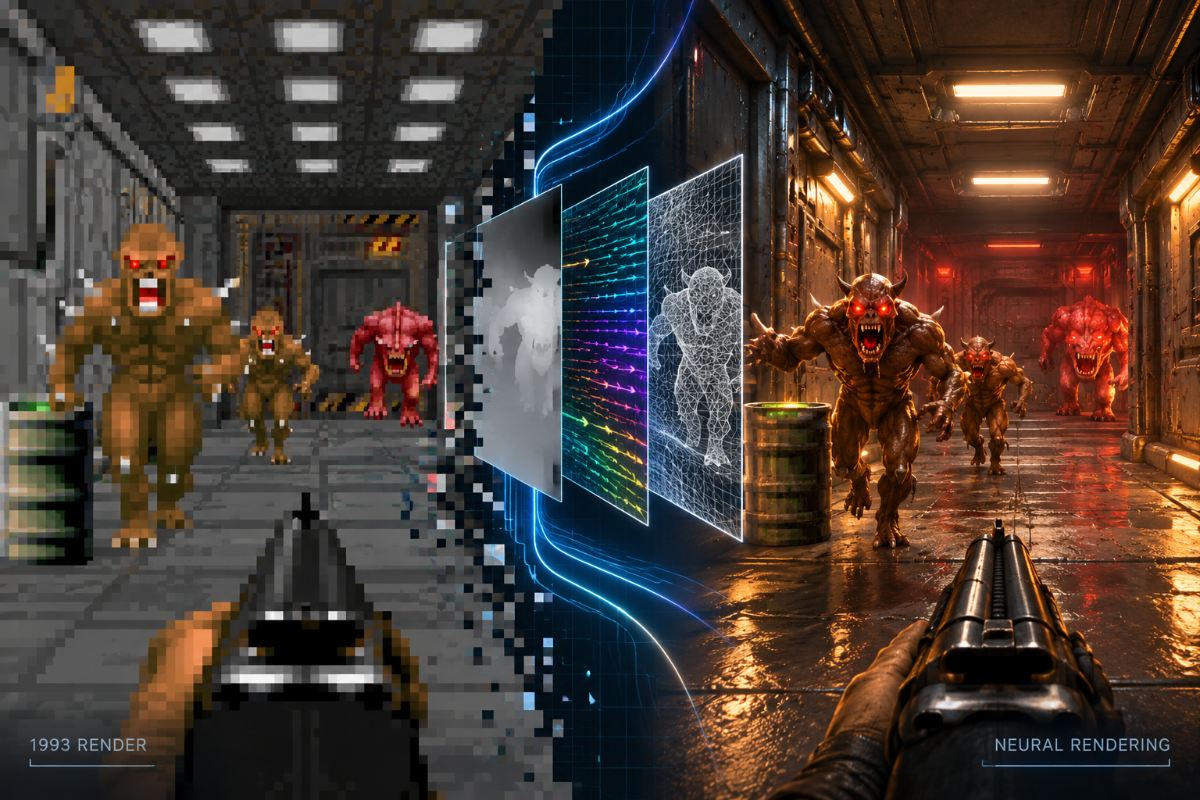
DLSS 5: The 33 year old shooter now feeds modern NVIDIA graphics technology data its renderer was never designed to produce.
DOOM has spent decades proving that old software can survive on almost any hardware. In 2026, software engineer Nikolai Zhivotenko pushed that tradition in a stranger direction by rebuilding the classic shooter so it can work with NVIDIA DLSS 5 Neural Rendering.
Zhivotenko based the project on Linux DOOM 1.10 and converted it into a 64 bit Windows application with a DirectX 12 presentation path. The project’s public GitHub repository explains that the engine still renders its core image at 320×200 before presenting the output inside a 1280×800 window.
But swapping the graphics API is only half the story. Zhivotenko also modified the renderer to produce depth, surface normal, and motion information for every frame. Modern reconstruction systems use those signals to understand where objects sit in a scene and how they change over time. Motion vectors, for example, tell the neural model where pixels are moving between frames, which helps reconstructed details remain stable during movement.
Giving A 1993 Renderer Modern Graphics Data
The modified engine now exposes information expected by graphics technology created more than 3 decades later. Depth tells the renderer how far surfaces are from the camera. Normals describe which direction those surfaces face. Motion data tracks movement from one frame to the next.
The build also works as an unusual comparison tool. It includes DLSS Ray Reconstruction, DLSS 4, DLSS 4.5, AMD FSR 2.2, Anime4K, and nearest neighbor scaling. In its technical coverage of the project, VideoCardz notes that the DLSS 5 mode first processes the image through the DLSS 4.5 path before applying Neural Rendering.
These version names are official technologies rather than labels created by the modder. NVIDIA’s DLSS documentation describes DLSS 4.5 as an update built around its second generation transformer model for Super Resolution and Ray Reconstruction. DLSS 5 goes further with 3D Guided Neural Rendering, which applies neural processing to lighting and material appearance while using the rendered scene as its foundation.
Putting that technology on top of 1993 pixel art can produce some strange interpretations. Tiny faces and HUD graphics contain far less visual information than modern game assets, leaving the neural renderer more room to reinterpret details.
“Doomguy’s face seems like Trent Reznor,” one user joked after seeing the experiment.
The comment is amusing, but it also highlights a real limitation. Modern neural rendering was designed around detailed contemporary game scenes, not tiny sprites created for hardware from the early 1990s.
You Cannot Simply Inject DLSS 5 Into DOS DOOM
To be clear, DLSS 5 is not running directly inside the classic DOS executable.
Zhivotenko’s Windows port matters because it creates the graphics data that Neural Rendering expects. Regular releases of DOOM and DOOM 64 did not produce the same result through a simple injection method. The modified DirectX 12 renderer is therefore a core part of the experiment rather than a wrapper around the old game.
DLSS 5 also differs from conventional image upscaling. In its official explanation of DLSS 5, NVIDIA says the technology uses 3D Guided Neural Rendering to improve lighting and material detail rather than simply turning a low resolution image into a sharper one.
Classic Game Modding Gets A New Graphics Playground
Nobody needs Neural Rendering to make DOOM playable in 2026. Players who value the classic release may even prefer untouched pixels to a neural interpretation.
The interesting work is happening underneath. Zhivotenko has made code rooted in 1993 produce scene information expected by a modern graphics pipeline.
For retro developers, that creates a useful example to study. Age alone is not the main barrier to bringing neural reconstruction into older games. Developers first need a way to expose depth, movement, and scene structure from engines that were never designed to provide them.
DOOM now shows one way to build that bridge. For the modding community, the next question is how many other classic engines can be taught to speak the same modern graphics language.
Also Read: Steam Hardware Survey Shift: 32GB RAM Replaces 16GB at the Top

Anup Singh is an independent technology journalist and content writer covering Apple, Android, AI, laptops, gaming, and the consumer tech industry. He focuses on delivering factual, well researched, and easy to understand reporting while explaining how new technologies impact everyday users.