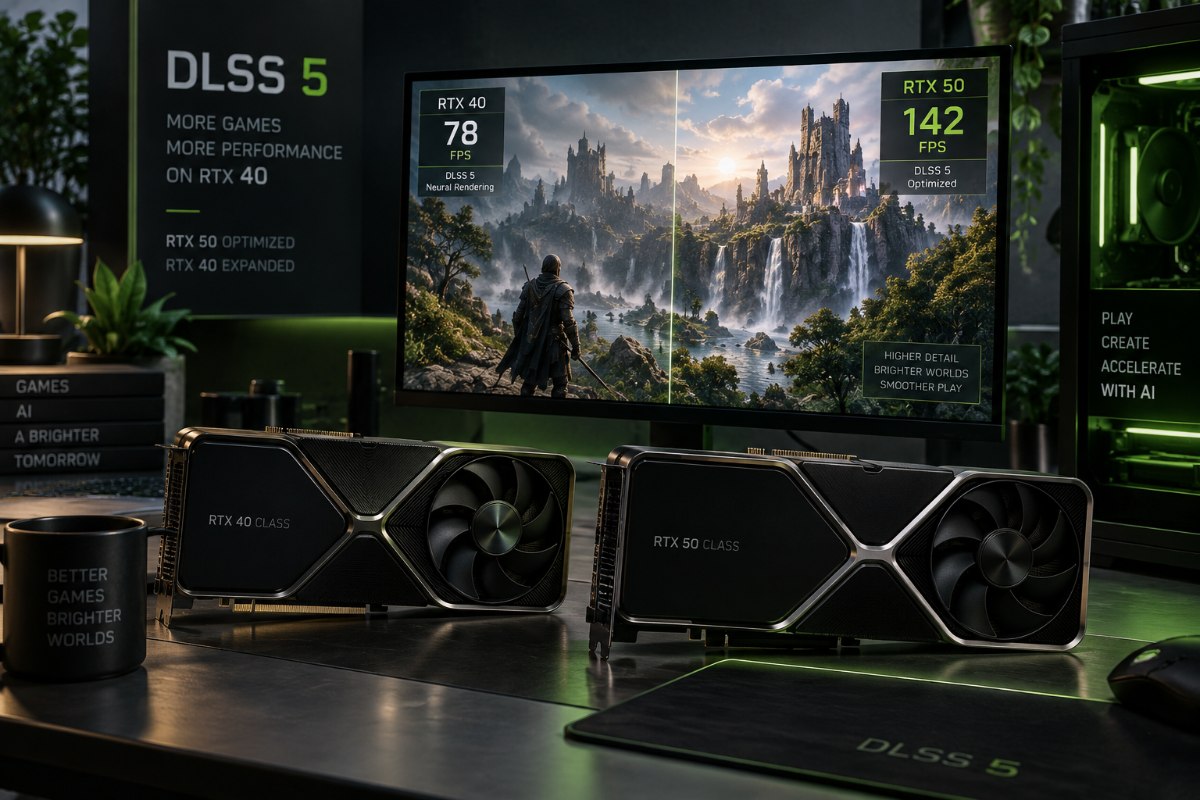
Community experiments show Nvidia’s neural rendering can reach Ada Lovelace, but usable performance remains the real hurdle.
RTX 40 GPUs: Nvidia has confirmed that DLSS 5 will eventually reach GeForce RTX 40 graphics cards, ending concerns that its newest neural rendering technology would remain restricted to RTX 50 hardware. The timing is notable because community developers had already started pushing the technology onto older GPUs before Nvidia outlined its official plans.
Those experiments became possible after an early access build of NBA 2K27 included Nvidia’s nvngx_dlssnr.dll Neural Rendering library ahead of the game’s September 3 release. Modders from the RenoDX community extracted the file and began adapting it for other games and GPU architectures.
DLSS 5 uses 3D Guided Neural Rendering to improve details such as lighting, skin, materials, and shadows after a game creates its underlying scene. That additional AI processing can improve visual quality, but it also consumes considerably more GPU resources than conventional DLSS upscaling.
The question for Nvidia is no longer whether Ada Lovelace can execute the technology. It is whether RTX 40 cards can run it fast enough to make the feature worthwhile.
DLSS 5 Still Carries A Heavy Performance Cost
Nvidia says DLSS 5 has already become significantly more efficient. An internal research demonstration in March required 2 RTX 5090 GPUs, while the current implementation can operate on a single RTX 50 series card. Nvidia describes the improvement as roughly 5X over 6 months.
Independent testing still exposes the workload. Tom’s Hardware measured an RTX 5090 at roughly 61 rendered FPS at 4K with DLSS 5 enabled, compared with around 240 FPS without it in the same test. Much higher displayed frame rates rely on Nvidia’s frame generation technology.
RTX 40 GPUs already support DLSS 3 Frame Generation. RTX 50 hardware adds Dynamic Multi Frame Generation with up to 6X output, allowing the GPU to generate as many as 5 additional frames for each traditionally rendered frame. That capability can help mask the cost of the neural rendering pass.
“Once RTX 50 Series performance is more fully tuned, we plan to work on expanding official support to the GeForce RTX 40 Series,” said Ben Berraondo, Nvidia’s Senior Director of Global PR for GeForce.
Nvidia plans additional model updates this fall, but the company has not announced a public timetable for RTX 40 support.
The NBA 2K27 Leak Gave Modders An Early Look
The community experiments did not rely on the standard DLSS Super Resolution upscaler. Modders used the Neural Rendering library taken from the early access build of NBA 2K27, then patched Blackwell specific CUDA components so the code could execute on older architectures.
Modder Uncle Burrito demonstrated the patched library on RTX 40 hardware, while other developers pushed the same neural rendering workload onto RTX 30 cards. Those Ampere experiments produced brutal results. An RTX 3080 Ti managed roughly 20 to 30 FPS at 1440p in one Grand Theft Auto V test, while separate demonstrations dropped to about 7 FPS in Cyberpunk 2077 and 2 FPS on an RTX 3070 in Hogwarts Legacy.
Those numbers matter because they show how quickly the neural workload overwhelms older hardware. Ampere can execute parts of the system, but compatibility alone does not make DLSS 5 practical.
Ada Lovelace is the more relevant test for Nvidia’s official plans. On an RTX 4090, one patched Control demonstration reportedly dropped from roughly 135 FPS to 82 FPS when Neural Rendering was enabled. That is far healthier than the RTX 30 results, but it still represents a performance loss of about 39 percent.
The RTX 4090 result therefore captures Nvidia’s challenge clearly. DLSS 5 works on Ada. Nvidia now has to make it efficient enough that RTX 40 owners will actually want to leave it enabled.
What RTX 40 Owners Should Expect
For anyone using an RTX 4090, RTX 4080, or another RTX 40 card, Nvidia’s confirmation removes one reason to upgrade immediately. DLSS 5 will not remain exclusive to Blackwell.
Performance remains the unanswered question. Nvidia must reduce the cost of its neural model before the official Ada rollout can offer a convincing balance between visual improvement and frame rate.
RTX 30 and RTX 20 support remains unconfirmed. RTX 40 owners now know DLSS 5 is coming. The next question is how much performance they will have to give up when it arrives.
Also Read: A Clever Driver Hack Brings Nvidia’s RTX 4060 to Windows 11 on Arm

Anup Singh is an independent technology journalist and content writer covering Apple, Android, AI, laptops, gaming, and the consumer tech industry. He focuses on delivering factual, well researched, and easy to understand reporting while explaining how new technologies impact everyday users.