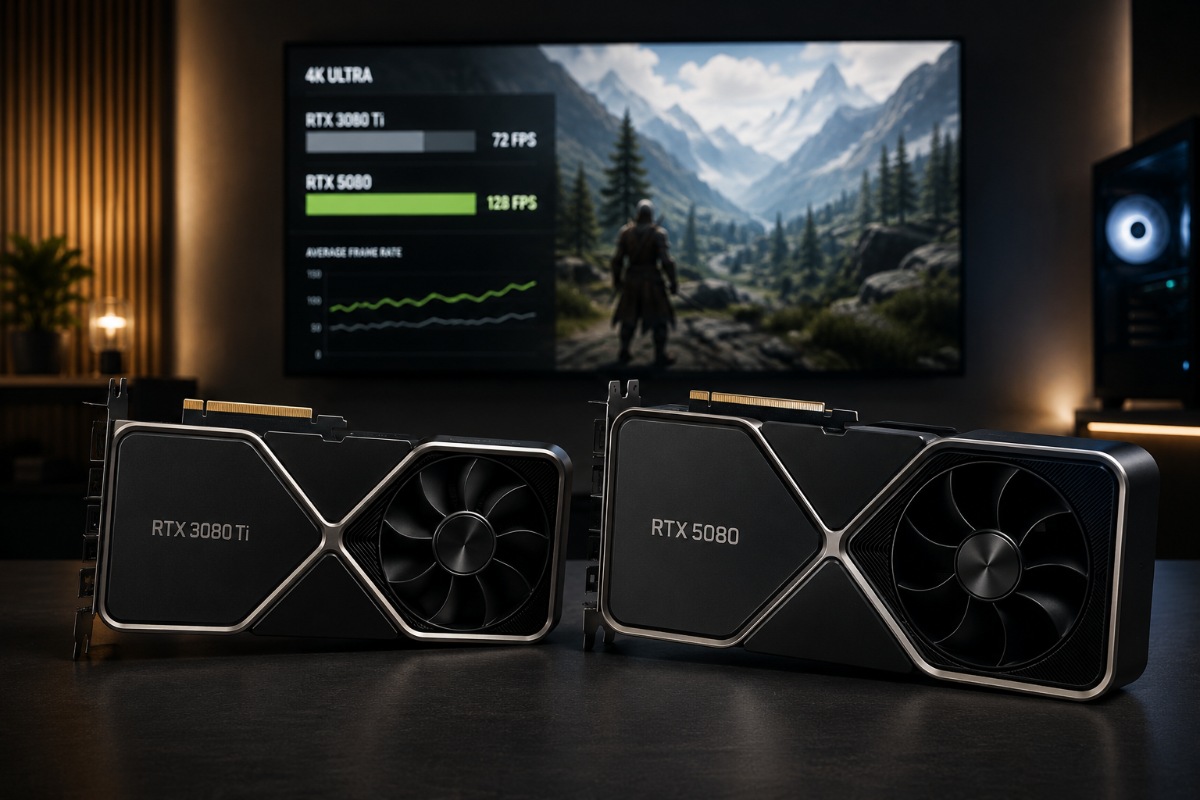
RTX 5080 vs RTX 3080 Ti: Fresh testing shows where Nvidia’s Blackwell card pulls away, and why many RTX 3080 Ti owners should still wait.
Gamers holding onto an RTX 3080 Ti have spent years waiting for a convincing reason to upgrade. Nvidia’s RTX 5080 finally provides one at 4K, but the financial case remains uncomfortable.
PC builder Richy59 tested a PNY RTX 5080 Slim OC against his RTX 3080 Ti using a Ryzen 7 5800X3D system with 32GB of DDR4 memory. He ran built in benchmarks at 3440 by 1440 and 3840 by 2160, generally using the highest available graphics settings.
The goal was simple: achieve a stable 4K60 experience on a television without relying on aggressive image scaling. That reflects the needs of players using living room displays such as LG C series OLED televisions, where consistent frame delivery can matter more than chasing the highest possible benchmark result.
The RTX 5080 reached that target more reliably. Still, this was one owner’s test across a limited group of games, not a controlled laboratory review.
The 4K Performance
In Forza Horizon 6 at 4K Extreme settings with ray tracing disabled, the RTX 5080 produced 80 FPS. The RTX 3080 Ti managed 61 FPS.
F1 25 reached 143 FPS on the newer card and 98 FPS on the older model. Both results came at 4K Ultra settings without ray tracing, making this a direct comparison of traditional rendering performance.
Cyberpunk 2077 created a wider gap. At 4K High settings with Ultra ray tracing and DLSS Quality, the RTX 5080 reached 60 FPS, compared with 40 FPS for the RTX 3080 Ti. Red Dead Redemption 2 at 4K Ultra with DLSS Quality returned 104 FPS and 82 FPS respectively.
Those gains are substantial, particularly in games with demanding ray tracing effects. Raw frames, though, do not automatically justify a £1,000 purchase.
Blackwell And The DLSS Advantage
The RTX 5080 uses Nvidia’s Blackwell architecture, 4th generation RT cores, 5th generation Tensor cores, 16GB of GDDR7 memory, and DLSS 4. The RTX 3080 Ti is based on the older Ampere architecture and carries 12GB of GDDR6X memory.
Richy59 also found that DLSS Quality produced a cleaner image on the RTX 5080. Frame Generation was disabled during testing, which removed one of the newer card’s largest potential advantages. The RTX 3080 Ti cannot run Nvidia’s native DLSS Frame Generation or Multi Frame Generation features because it lacks the required hardware support.
That distinction matters in demanding titles using heavy ray tracing or path tracing. The RTX 5080 can combine stronger hardware with newer AI rendering tools, while the RTX 3080 Ti must rely on older scaling technology and traditionally rendered frames.
“Overall I found the 5080 to be good, but not sure it is £1000 good compared to the 3080 Ti,” Richy59 wrote.
That verdict matches the wider discussion among PC builders in Reddit’s r/PcBuild community. Enthusiasts generally recognise the RTX 5080 as a strong 4K card, but many question whether the improvement is large enough to justify replacing an RTX 3080 Ti that still performs well.
Is The £600 Net Cost Actually Worth It?
Richy59 estimated that selling his RTX 3080 Ti for £400 would reduce the effective upgrade cost to roughly £600.
A £400 resale is far from guaranteed. The final price will depend on the exact model, its condition, remaining warranty, original packaging, selling fees, and local demand.
For players staying at 1440p, the answer is straightforward. Keep the RTX 3080 Ti. It remains fast enough that a £1,000 replacement is difficult to defend.
Owners targeting 4K60 with ray tracing have a stronger case, especially if they can buy the RTX 5080 near its intended retail price and recover a reasonable amount from their old card.
The RTX 5080 easily wins the performance battle. The purchase decision comes down to the display, the game library, and whether a smoother 4K experience is worth an effective cost of around £600.
Also Read: ASUS Slashes $400 Off Its Premium 4K 240Hz QD-OLED Gaming Monitor

Anup Singh is an independent technology journalist and content writer covering Apple, Android, AI, laptops, gaming, and the consumer tech industry. He focuses on delivering factual, well researched, and easy to understand reporting while explaining how new technologies impact everyday users.
1 thought on “The RTX 5080 Aces 4K60 Gaming, But The £1,000 Upgrade Remains A Tough Sell”