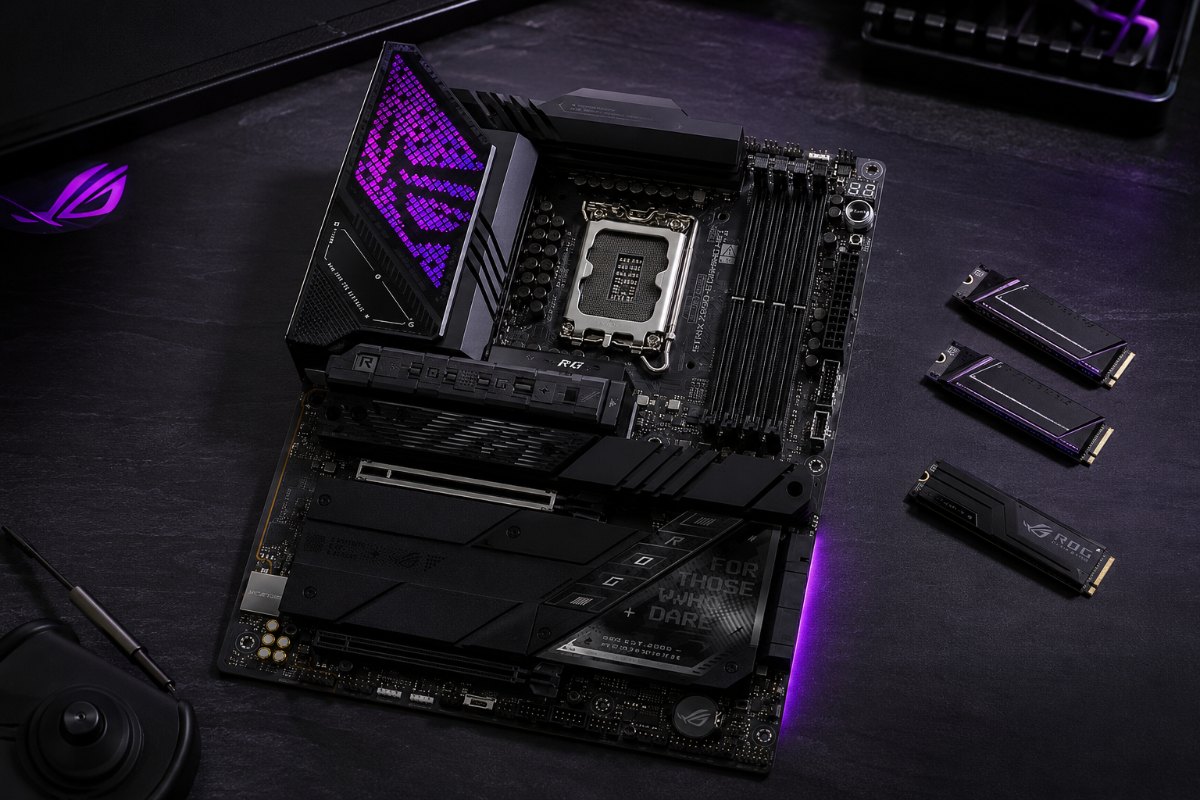
ASUS ROG Strix Z890E: The ROG Strix Z890E Gaming WiFi gives Intel builders a serious storage board, but the $499 price makes it a premium fix rather than an easy value play.
Intel’s new Core Ultra processors may be the reason many users start looking at a fresh PC build, but the ASUS ROG Strix Z890E Gaming WiFi makes a different case for upgrading. It focuses on a problem that modern desktops keep running into: storage space.
Between large game installs, 4K video scratch disks, photo libraries, virtual machines, and local AI models, a single 2TB drive does not stretch as far as it used to. ASUS is targeting that pressure point with a Z890 motherboard built around 7 M.2 slots, 4 SATA ports, WiFi 7, 5Gb Ethernet, Thunderbolt 4, DDR5 support, and a strong power design for Intel Core Ultra Series 2 chips.
That does not make the board cheap. At roughly $499, the Strix Z890E sits firmly in premium territory. Its appeal depends on whether buyers see storage expansion as a core need, not a luxury feature.
Storage Is The Main Event
ASUS gives builders enough internal expansion to load up on NVMe SSDs without immediately turning to add-in cards or external enclosures.
That matters for PC users who keep everything local. Call of Duty titles, Microsoft Flight Simulator 2024, Adobe Premiere Pro projects, Blender assets, and local development environments can chew through drive space quickly. Content creators also need fast scratch disks. Gamers want more installed at once. Developers may keep multiple virtual machines on hand.
For digital hoarders and content creators, the Strix Z890E acts almost like an internal storage rack. It helps keep a desk from turning into a pile of USB drives, docks, and short cables. ASUS frames the board around “seven onboard M.2 slots,” and that line captures the real sales pitch better than any benchmark chart.
The board also includes 3 PCIe Gen 5 M.2 slots. Gen 5 SSDs can move data extremely fast, though they also need good cooling. ASUS pairs the layout with large M.2 heatsinks and its M.2 PowerBoost feature, which is meant to help several SSDs run reliably at the same time.
The Lane Sharing Catch Is Real
The storage layout comes with a tradeoff. M.2_3 and M.2_4 share bandwidth with the main PCIe Gen 5 graphics slot. Populate those Gen 5 SSD slots and the graphics card drops from x16 to x8.
That sounds alarming, but it needs context. This is not simply an ASUS design mistake. It reflects the lane limits of Intel’s consumer platform. The CPU has a finite number of direct PCIe lanes, and motherboard makers must choose how to split them between the graphics slot and fast SSD storage.
For most high-end graphics cards, PCIe Gen 5 x8 should not be a major gaming bottleneck. It provides the same theoretical bandwidth as PCIe Gen 4 x16, which is still plenty for cards such as an RTX 4090 in normal gaming workloads.
Still, buyers should plan the build. Use M.2_1 for a primary Gen 5 SSD if needed. Treat M.2_3 and M.2_4 as the slots that trigger the graphics bandwidth drop. Anyone filling 5 or more drives should read the slot layout before installing hardware.
A Premium Board For Planners
The Strix Z890E also carries an 18+1+2+2 power stage design rated up to 110A per main stage. In plain English, that means the board has a strong voltage delivery system for demanding chips such as Intel Core Ultra 9 models, especially under boost or overclocking loads.
Manufacturers struggle to sell motherboard upgrades based purely on raw performance. The CPU and GPU still decide most frame rates. A motherboard earns its price through connectivity, storage, stability, cooling, and build convenience.
That is where ASUS has a clear argument, but not a cheap one. The Strix Z890E gives storage-heavy users a serious platform with modern networking and strong power delivery. At $499, though, it asks buyers to pay a steep price for that convenience.
For users with 1 or 2 drives, this board is probably more than necessary. For creators, game collectors, and builders who know they will keep adding SSDs, the Z890E makes more sense. It does not make storage anxiety disappear for free. It makes it solvable inside the case.
Also Read: Xbox Disc To Digital Rumour Tests Trust As Sony Ends New Game Discs

Anup Singh is an independent technology journalist and content writer covering Apple, Android, AI, laptops, gaming, and the consumer tech industry. He focuses on delivering factual, well researched, and easy to understand reporting while explaining how new technologies impact everyday users.