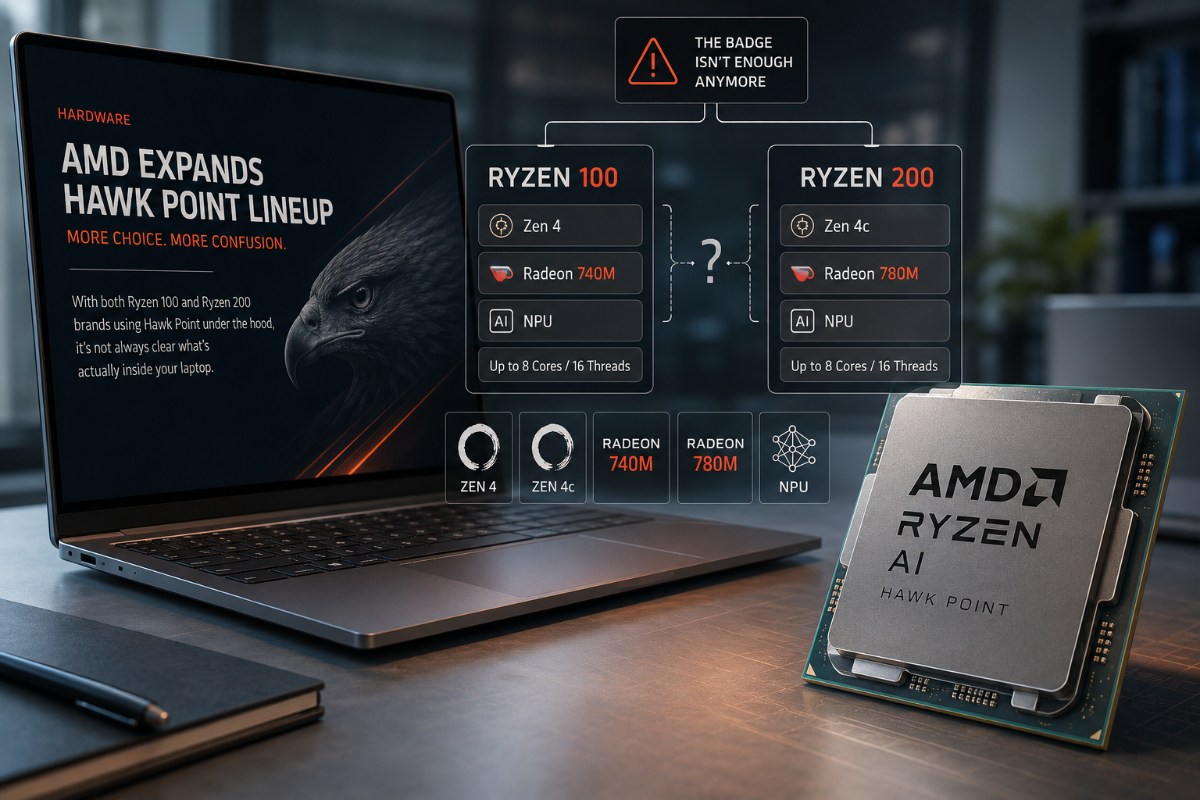
MD’s 11 New Hawk Point SKUs: AMD’s latest Ryzen 100 and 200 additions give OEMs more room on price, but they make the badge on a budget laptop less useful than ever.
Buying a budget AMD laptop is about to require a cheat sheet. AMD has added 11 more Hawk Point processors across the Ryzen 100 and Ryzen 200 series, expanding a mobile lineup that already had several overlapping parts. Instead of a clean generational launch, the company is recycling existing mobile APU silicon to widen its product stack. These chips combine CPU cores and integrated graphics into a single package. Some also support local AI acceleration through a dedicated NPU, but not all of the new additions do.
That distinction matters. A Ryzen badge used to give buyers a rough signal about what generation of CPU and graphics they were getting. This latest expansion weakens that signal. The same broad family can now include different CPU core designs, different integrated GPU tiers, and different AI hardware support. For laptop makers, the extra SKUs create more pricing flexibility. For buyers, the spec sheet has become harder to trust at a glance.
AMD Is Stretching Hawk Point Across More Price Bands
The Ryzen 200 additions include Ryzen 7 253, Ryzen 7 249, Ryzen 5 225, Ryzen 5 224, Ryzen 7 217, Ryzen 5 216, and Ryzen 3 205. AMD built these chips using either standard Zen 4 cores or a hybrid Zen 4 and Zen 4c configuration, pairing them with RDNA 3 integrated graphics.
The hybrid models are the important ones to watch. Ryzen 3 205, Ryzen 5 216, and Ryzen 7 217 use a mix of Zen 4 and Zen 4c cores. Zen 4c is a denser version of Zen 4 designed for efficiency and space savings. It is not simply a slower label, but it can behave differently depending on power limits and workload.
The graphics split is just as important. Some chips use Radeon 780M graphics with 12 Compute Units. Others drop to Radeon 740M with only 4 Compute Units. That is not a minor branding difference. A laptop with Radeon 740M will have much tighter limits in modern 1080p gaming, while a system with Radeon 780M has far more integrated graphics headroom.
Ryzen 100 Is Where the Naming Problem Becomes Harder to Defend
The Ryzen 100 additions are Ryzen 9 180, Ryzen 7 165, Ryzen 7 155, and Ryzen 5 125. This is where AMD’s naming approach becomes especially muddy.
Ryzen 100 had already been associated with older Rembrandt class chips, which used Zen 3 plus CPU cores and RDNA 2 graphics. The new Ryzen 100 additions, however, line up with Hawk Point class specifications, including 4nm manufacturing and RDNA 3 graphics. That makes the badge less reliable as a generation marker.
AMD’s own product pages initially made the confusion worse by labeling some of these new chips as Zen 3 plus, even though their listed specifications matched Hawk Point and Zen 4 class silicon. That kind of mismatch is not a small database error for buyers. It directly undercuts confidence in the product stack.
The NPU detail also deserves attention. Hawk Point is often associated with Ryzen AI support, but some of these newly added or rebadged parts do not include a dedicated NPU. Anyone shopping for local AI features should not assume that a newer Ryzen 100 or Ryzen 200 badge guarantees them.
The Badge No Longer Tells Buyers Enough
A confusing badge translates directly to real buying risk. CPU architecture affects responsiveness, multitasking, and battery behavior. Integrated graphics determine whether light gaming, creator apps, and media workloads feel smooth or limited. NPU support matters for buyers who want local AI features without relying only on the cloud.
These lower tier additions are likely to appear in budget OEM laptops and mini PCs, where shoppers often compare devices quickly by processor name. That is exactly where AMD’s naming system now creates the most friction.
The practical advice is simple. Do not buy on the Ryzen 100 or Ryzen 200 label alone. Check the exact SKU. Verify the CPU architecture. Look at the graphics model. Confirm whether the chip has a dedicated NPU.
AMD may be giving its partners a broader menu of chips for cheaper systems, but the company is also making its mobile lineup harder to read. In 2026, a Ryzen badge is no longer enough. The exact model number is the story.
Also Read: ASUS ROG Raikiri II Pro Brings 8000Hz Polling Rates And Modular Sticks To PC

Anup Singh is an independent technology journalist and content writer covering Apple, Android, AI, laptops, gaming, and the consumer tech industry. He focuses on delivering factual, well researched, and easy to understand reporting while explaining how new technologies impact everyday users.
1 thought on “AMD’s 11 New Hawk Point SKUs Make Buying a Ryzen Laptop Even More Confusing”