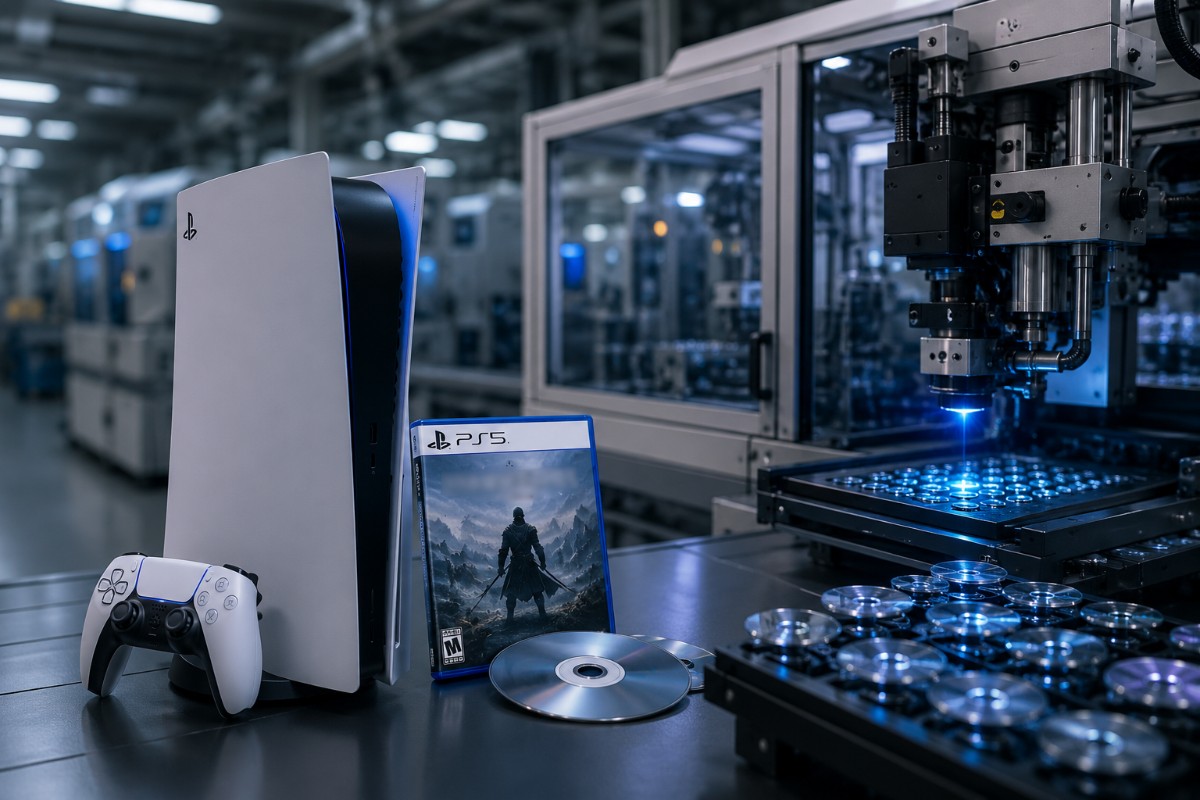
PlayStation digital shift: Sony’s Austrian disc plant is moving toward micro optics as the company prepares to end new physical PlayStation releases in 2028.
By January 2028, the familiar snap of a new PlayStation game case could sound like an older era. Sony Interactive Entertainment has said physical game disc production for all new games released on PlayStation consoles will end that month. After that date, Sony will sell new releases through PlayStation Store and retail partners in digital formats only. Titles released before the cutoff, or already planned for disc release before then, are not affected.
The announcement turns a long running industry trend into a formal platform policy. Reuters reported that digital downloads made up about 80% of Sony’s full game software sales in fiscal 2025, which explains why the company is ready to move away from plastic media. The factory response makes the shift feel more concrete. Sony is already moving its Austrian disc operation toward another future.
Sony Moves The Factory Before The Market Fully Moves
Sony is not waiting for the market to decide. At the Thalgau site in Austria, Sony DADC is redirecting capacity toward optical microlenses, tiny components that focus and guide light in compact systems.
The facility currently produces around 600,000 discs a day, with PlayStation accounting for roughly half of that volume. Sony DADC expects production to plummet by 2028 as new PlayStation discs vanish from the assembly line.
The Thalgau site employs roughly 300 workers. Management told staff about the restructuring this week and plans to retrain them for micro optics rather than cut the workforce. ORF Salzburg reported that about €30 million has recently gone into the new technology, with serial production of optical microlenses targeted for 2027.
Retaining the workforce helps Sony avoid the negative optics of a mass layoff during a major structural pivot. It also shows that the disc exit is not just a store policy. Sony is building it into the supply chain.
“You can’t sell a games console to hundreds of millions of consumers with optical drives, then halfway through the console’s life move the goalposts for a digital future,” X user chris germann, posting as Germann10600, wrote.
Why The Backlash Is About Ownership
Many PlayStation 5 Disc Edition owners bought into a hardware promise. A drive lets them buy used games, lend discs and preserve shelves of titles outside a digital storefront. Sony has not removed support for existing discs. The concern is about the future catalogue.
Physical discs offer tangible rights. Players can resell, loan, or physically preserve their games. Crucially, discs do not depend entirely on an active PSN account or a storefront that may change terms, payment support or regional availability.
Online criticism has focused less on nostalgia and more on control. Digital libraries are convenient, but players still want firm guarantees around refunds, delistings, preservation and access to purchased content.
For players, the shift feels like a loss of control over the games they buy. For Sony, the same shift solves a manufacturing problem. If discs are fading from PlayStation’s future, the equipment, workers and expertise behind them need a new commercial role.
Micro Optics Gives Sony A New Manufacturing Path
Optical microlenses are tiny optical structures used to shape light in compact devices. Sony DADC says its micro optics work can serve automobile, industrial and consumer applications. ORF quoted the division’s micro optics lead describing a car turn signal projected onto asphalt as one possible use.
That context matters because Sony’s future is not limited to game consoles. The company already works across imaging, sensors, entertainment and connected hardware. Redirecting a disc plant into precision optics gives Sony a path from a shrinking media business into components that could support vehicles, cameras, headsets and industrial systems.
The move is not a cultural replacement for boxed games. It is a practical manufacturing replacement. Sony’s post disc strategy now looks years in the making, and the company has started reshaping production before the 2028 cutoff arrives.
What remains unsettled is the user side of the deal. A digital future may suit Sony’s margins and buying patterns. It also gives the platform holder more control over pricing and availability. For PlayStation, the 2028 deadline is not only a logistics milestone. It is a trust test for the next console era.
Also Read: Asus Wants You To Stop Buying Gaming Laptops Just For Benchmark Scores

Anup Singh is an independent technology journalist and content writer covering Apple, Android, AI, laptops, gaming, and the consumer tech industry. He focuses on delivering factual, well researched, and easy to understand reporting while explaining how new technologies impact everyday users.
1 thought on “PlayStation’s Digital Shift Turns Real As Sony Retools Its Austrian Disc Factory”