Valve’s compact SteamOS box promises living-room simplicity, but its price puts it directly against consoles and custom gaming PCs.
When Valve announced that its long-awaited Steam Machine would start at $1,049, the conversation quickly moved from curiosity to component math. The new box is not a console in the traditional sense, and it is not priced like one. That makes its pitch much harder.
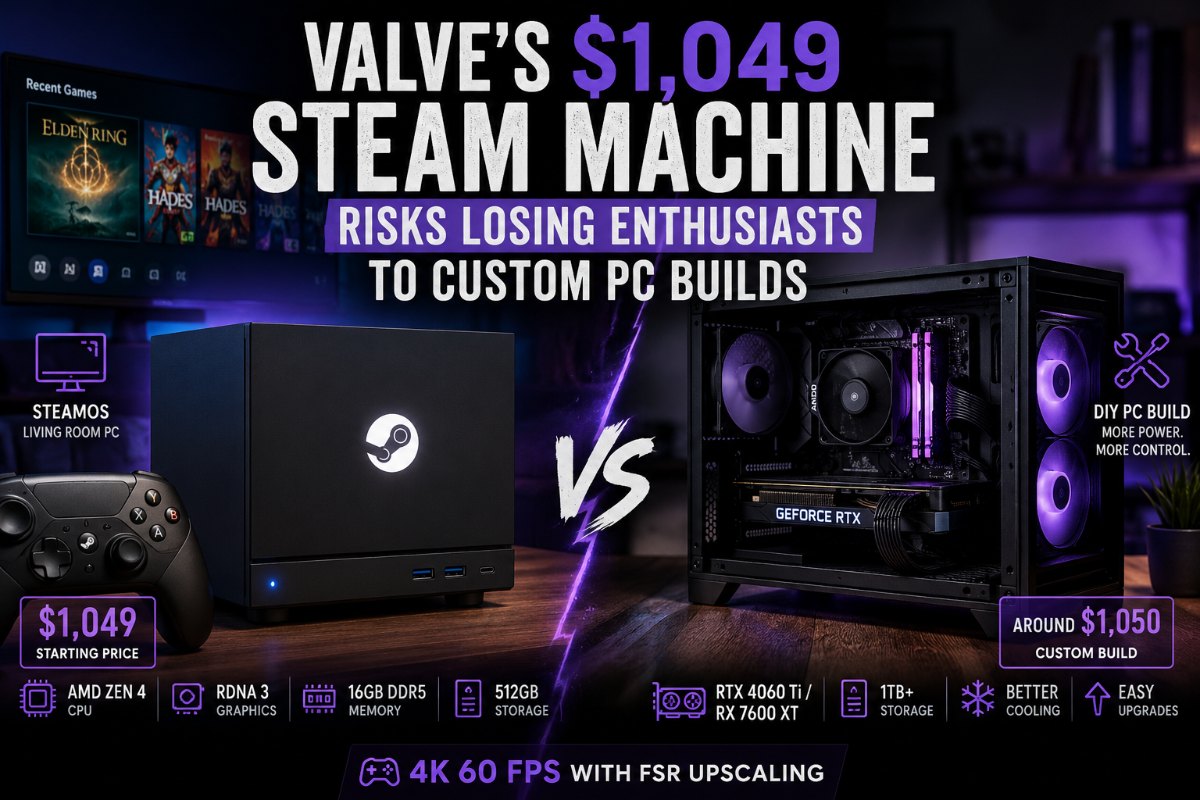
The base model includes 512 GB of storage. Inside, it uses a semi-custom AMD Zen 4 CPU, RDNA 3 graphics, 16 GB of DDR5 memory, and 8 GB of GDDR6 graphics memory. Maxing out the system with a 2 TB drive and the new Steam Controller pushes the price to $1,428.
Valve is selling a compact SteamOS living-room PC built around a 4K 60 FPS target with FSR upscaling, not native 4K brute force. That distinction matters. The machine promises a cleaner setup than Windows, direct access to Steam libraries, and a hardware design built around the TV. The problem is that $1,049 also buys a serious custom gaming PC, or a console with money left over.
The Price Problem Starts Before Performance
Valve has pointed to memory and storage pressure as part of the reason for the steep price. That explanation matters. The AI hardware boom has put heavy pressure on DRAM and NAND supply, raising costs across PCs, consoles, servers, and handhelds.
Still, gamers do not buy hardware from the supplier’s side of the spreadsheet. They compare what they pay with what they get. A PS5 Digital Edition now sits around $600 in the U.S., while the PS5 Pro is $900. That makes the entry Steam Machine roughly 75% more expensive than Sony’s cheapest current console.
Valve also chose a randomized reservation system rather than a simple open sale. Buyers had to sign up for a chance to purchase, with the approach designed to reduce scalping and first-click advantages. That limits chaos, but it also reinforces the sense that supply is tight and early demand is hard to predict.
Can Convenience Survive A $1,049 Price Tag?
Steam Machine does have a clear purpose. SteamOS 3, Proton compatibility, controller integration, and a simple living-room interface are real advantages for players who do not want to manage Windows updates, driver prompts, or keyboard-and-mouse setup on a TV.
That software layer is the reason Steam Deck worked so well. Valve made PC gaming feel less like PC maintenance. Steam Machine tries to extend that idea from the handheld to the couch.
NikTek wrote on X, “I’m sorry but $1000+ for a base 512GB Steam Machine without a controller is simply not worth it.”
If gamers are already balking at the price, Valve’s premium living-room pitch faces an uphill battle. A $1,049 SteamOS machine must deliver a frictionless experience to justify the premium.
DIY Gaming PCs Still Own The Flexibility Argument
The hardest comparison comes from custom PC builds. At this budget, enthusiasts can build or price out a compact system with stronger storage options, a clearer upgrade path, and graphics choices such as an RTX 4060 Ti or Radeon RX 7600 XT class card, depending on current deals.
PCWorld’s build challenge underlined that point by asking a simple question: can a custom PC beat Valve’s Steam Machine near the same $1,050 budget? Its example build came in lower than Valve’s base price while offering standard desktop upgrade flexibility.
By prioritizing simplicity, Valve sacrifices control. PC builders want to dictate their own thermals, choose their own cases, reuse existing parts, and carve out upgrade paths. Steam Machine removes that work, but it also removes that freedom.
Valve Is Not Chasing The Typical PC Builder
Even with fierce competition from DIY builds, the Steam Machine still serves a clear purpose. It targets the Steam Deck owner looking for a stronger living-room extension. It also appeals to the console gamer who wants access to a large Steam library without assembling a PC.
That audience exists, but the performance target sharpens the risk. Valve is asking buyers to accept FSR-assisted 4K 60 FPS as the living-room goal. If real-world results land closer to 1080p or 1440p in demanding games, buyers will question the premium. If prebuilt PCs or custom rigs offer visibly better frame rates for similar money, enthusiasts will not hesitate to walk away.
Valve does not need to beat every DIY build. It needs to make SteamOS on the TV feel polished enough that buyers stop comparing part lists. At $1,049, that is no longer an easy argument.
Also Read: The Legion 7a Ditches Dedicated GPUs To Bet Big On Shared Memory

Anup Singh is an independent technology journalist and content writer covering Apple, Android, AI, laptops, gaming, and the consumer tech industry. He focuses on delivering factual, well researched, and easy to understand reporting while explaining how new technologies impact everyday users.
1 thought on “Valve’s $1,049 Steam Machine Risks Losing Enthusiasts To Custom PC Builds”