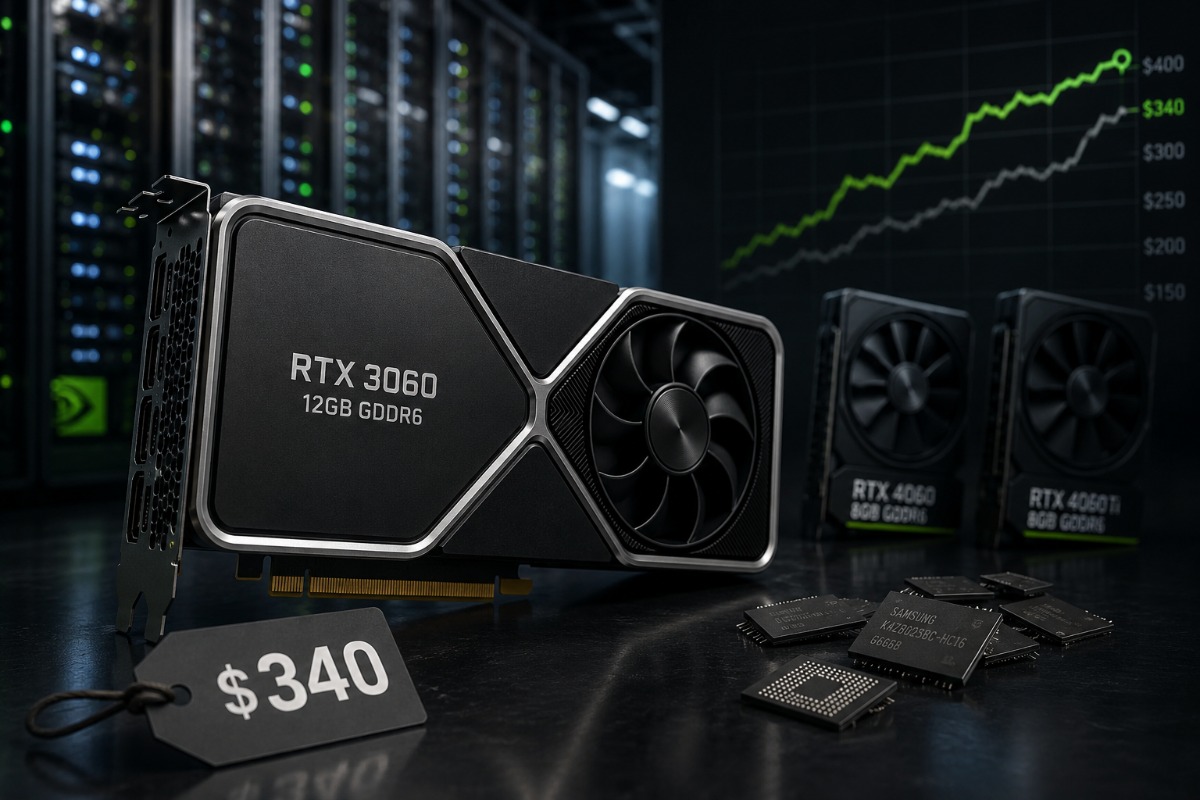
Nvidia RTX 3060: A 5 year old graphics card returning near launch price shows how memory costs, AI demand, and weak budget options are squeezing PC builders.
Five years in PC hardware usually feels like a lifetime. In 2026, it now looks more like a release cycle. Nvidia’s GeForce RTX 3060, a card that launched in 2021 with a $329 MSRP, has returned to retail shelves in new 12GB models, with listings around $339.99 and some prices climbing much higher.
That is the uncomfortable part. The RTX 3060 is not being treated like old stock priced to clear. It is being pushed back into a market where budget buyers are still hunting for enough video memory, reliable 1080p performance, and a graphics card that does not wreck a full system build.
The card still has one clear advantage: 12GB of VRAM. That matters in games that strain 8GB cards at high texture settings, including Cyberpunk 2077, The Last of Us Part 1, Alan Wake 2, and newer memory heavy releases. Yet the price forces a harder question. Why is a 2021 GPU still sitting close to its launch price in 2026?
A Familiar Card Returns To A Stagnant Budget Market
The RTX 3060 never really disappeared from PC gaming. It stayed popular because it hit a practical sweet spot: good 1080p performance, enough memory for heavier games, and broad support across drivers, streaming tools, and creative apps.
The new listings, though, are not just about popularity. They reflect a budget GPU market that has failed to give buyers enough clean choices. Many entry level and lower midrange cards still ship with 8GB of VRAM. That can work for 1080p gaming, but it leaves less room for high resolution textures, modern open world games, and creator workloads that lean on memory.
That is why the 12GB RTX 3060 still gets attention. For builders working around an $800 to $1,000 gaming PC budget, memory capacity can decide whether a card feels usable for 2 years or dated by the next major game release.
Still, this is not a free win for Nvidia or its board partners. The 3060 has not aged in reverse. The current budget GPU market is simply stagnant enough that a 5 year old card can look viable again.
The $340 Price Is A Bitter Pill
We could easily forgive the RTX 3060’s return if it came back as a true budget card. At $200 to $250, a 12GB Nvidia GPU would make sense for plenty of modest builds. Around $339.99, the value case gets much harder to defend.
That price is about $10 above the original 2021 MSRP. It also puts the card near newer options. Nvidia’s RTX 5060 starts at $299, while some RTX 5060 Ti models, AMD RX 9060 XT cards, and Intel Arc B570 listings give buyers other paths depending on local pricing and stock.
Those cards are not perfect substitutes. Some carry less VRAM. Others may have driver or game by game performance tradeoffs. Yet they make the RTX 3060 look awkward. At this price, buyers must accept older Ampere architecture, weaker ray tracing hardware, older Tensor cores, and no access to newer RTX 50 series features such as DLSS 4 Multi Frame Generation.
At CES 2026, Nvidia CEO Jensen Huang gave a short public nod to the idea of using older GeForce cards to ease pressure in the market, saying, “It’s a good idea.” From a supply standpoint, that answer makes sense. Older chips on mature production lines can help fill retail gaps while newer silicon and memory supply remain tight. Availability has value, especially when buyers face limited choices.
Price decides whether that availability actually helps consumers. A $340 RTX 3060 does not feel like relief. It feels like a compromise forced by a market where the newest hardware, the cheapest hardware, and the most memory rich hardware rarely line up in the same product.
That is where the retail problem connects directly to the larger economics of AI.
AI Demand Is Rewriting The Consumer GPU Market
The RTX 3060’s strange return is not only about one graphics card. It reflects a broader shift in how chip capacity, memory supply, and business priorities now shape what PC builders can buy.
Nvidia’s data center business has become the company’s financial engine. In Q4 fiscal 2026, Nvidia reported $62.3 billion in data center revenue. Gaming and AI PC revenue was $3.7 billion. That gap explains why the strongest pull in the supply chain now comes from AI servers, not home gaming rigs.
AI systems need advanced GPUs, high bandwidth memory, networking hardware, and huge production commitments. Cloud companies and enterprise customers can pay far more than a mainstream buyer looking for a midrange card. That changes the pressure on manufacturing, component allocation, and board partner decisions.
Limited stock, inflated prices, and strange product returns force consumers to carry the weight of that shift. Board partners can lean on older, readily available GPUs to fill gaps faster than waiting for the newest cards to reach every price point cleanly.
For Nvidia, the RTX 3060 return adds one more product to a strained shelf. For PC builders, it exposes how little real budget relief the market has delivered.
The 12GB Advantage Is Real, But Not Enough For Everyone
The RTX 3060’s strongest argument remains its memory. A 12GB buffer gives users more breathing room than many 8GB cards, especially at higher texture settings or in creator tools that can spill over when VRAM runs tight.
That does not make it the automatic buy. A gamer focused on newer features, power efficiency, ray tracing, or DLSS 4 support may be better served by a newer card. Someone who wants maximum VRAM per dollar may also compare AMD or Intel options before paying more than $300 for older Nvidia silicon.
This leaves the RTX 3060 in a narrow lane. It makes sense for buyers who specifically want 12GB of VRAM, prefer Nvidia software support, and cannot find a better deal. It makes much less sense as a broad answer to budget GPU frustration.
Hardware forums are already split for a reason. Some users are relieved to see another 12GB option under $350. Others are angry that a 2021 GPU is being positioned as a serious fix for a 2026 pricing problem.
That frustration is fair. The RTX 3060 remains a capable card, but its comeback should not be mistaken for progress. It is a patch for a market that still has not solved affordability.
The Bigger Warning For PC Builders
The RTX 3060’s return is not shocking because the card is bad. It is shocking because the price makes it look normal.
A healthy budget GPU market would push older cards downward as newer models arrived. Instead, memory pressure, AI demand, and uneven product segmentation have made the upgrade path feel messy and expensive. A 5 year old card can come back near launch price because buyers still lack enough affordable, memory rich alternatives.
That is the real signal. The PC market is not only dealing with expensive flagships. It is struggling at the level where mainstream builders make real buying decisions.
Nvidia may sell more RTX 3060 cards because the product still solves a specific problem. Consumers should be careful, though. At $340, the RTX 3060 is not a bargain. It is a reminder that the budget GPU market has drifted far from what budget buyers actually need.
Also Read: ASUS ROG NUC 16 Edition 20 Packs RTX 5090 Into 3 Liter Desktop
FAQs
1. Why is Nvidia bringing back the RTX 3060?
Nvidia is using an older, familiar GPU to help fill a strained budget market. The RTX 3060 still offers 12GB of VRAM.
2. Is the RTX 3060 worth buying in 2026?
It depends on price. At $340, the RTX 3060 is useful for 12GB VRAM, but newer cards may offer better features.
3. How much did the RTX 3060 cost at launch?
The RTX 3060 launched in 2021 with a $329 MSRP. New listings around $339.99 make its return feel awkward.
4. What makes the RTX 3060 different from newer budget GPUs?
The RTX 3060 has 12GB of VRAM, but it lacks newer RTX 50 series features like DLSS 4 Multi Frame Generation.
5. How does AI demand affect GPU prices?
AI demand pulls supply toward data center hardware. That can leave PC builders facing higher prices, limited stock, and strange product returns.

Anup Singh is an independent technology journalist and content writer covering Apple, Android, AI, laptops, gaming, and the consumer tech industry. He focuses on delivering factual, well researched, and easy to understand reporting while explaining how new technologies impact everyday users.
2 thoughts on “Nvidia’s 2021 RTX 3060 Is Back, Exposing A Broken GPU Market”