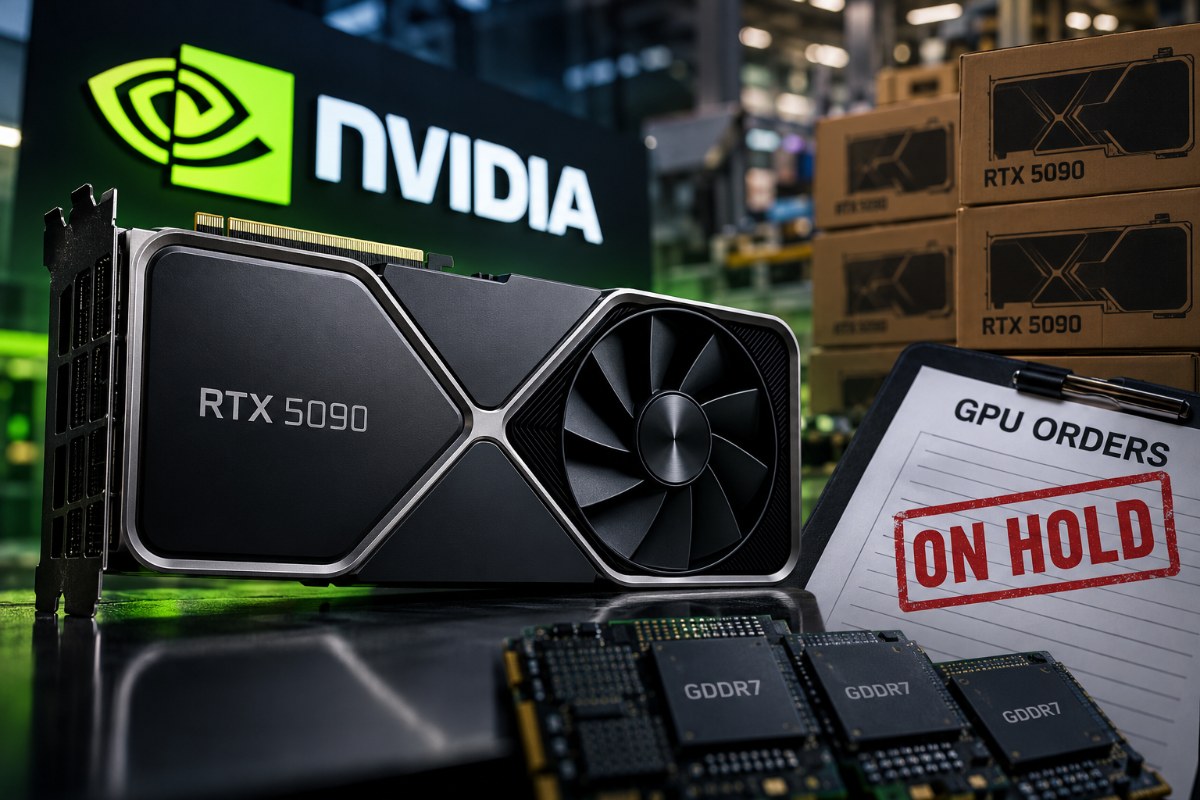
RTX 5090 Fresh supply chain reports raise questions about RTX 5090 availability as manufacturers face component restrictions and cooling suppliers forecast weaker demand for 2027.
Nvidia insists the GeForce RTX 5090 remains in production. However, an unnamed graphics card manufacturer says Nvidia has stopped accepting new orders, including backorders, for the GB202 chips and 32 GB GDDR7 memory kits needed to build its $1,999 flagship GPU.
German hardware specialist Roman “der8auer” Hartung revealed the supply restrictions in a YouTube investigation published in late October 2026. Hartung spoke with an Nvidia board partner and a separate graphics card cooling supplier to examine the RTX 5090’s uncertain availability.
The manufacturer claims it has received no official discontinuation notice. Yet it cannot order additional components and does not know when Nvidia might reopen ordering.
Meanwhile, the cooling supplier reports significantly lower RTX 5090 production forecasts for early 2027. Nvidia maintains that shipments will continue despite production capacity constraints, leaving manufacturers uncertain about their future supplies.
Inside the RTX 5090 Order Freeze
Nvidia supplies add-in-board (AIB) manufacturers such as Asus, MSI, and Gigabyte with GPU and memory packages. For the RTX 5090, the reported arrangement bundles the GB202 processor with 32 GB of GDDR7 memory.
The unnamed partner says Nvidia previously accepted backorders during shortages. That option is now unavailable, leaving future production dependent on existing component inventories and any shipments already scheduled.
Hartung’s cooling supplier reported a similar slowdown. Two board partners substantially reduced their projected RTX 5090 cooler orders for Q1 2027 compared with Q3 2026. The supplier added that it had received no RTX 5090 cooler orders for Q2 2027.
Those forecasts matter because the RTX 5090 launched in January 2025, placing early 2027 near Nvidia’s historical two-year graphics architecture cycle. However, reduced orders from a single supplier cannot establish a complete production shutdown or confirm a replacement launch.
Nvidia Denies Discontinuation as GB202 Supply Questions Grow
Nvidia Senior Vice President Jeff Fisher rejected discontinuation rumors during an October 16 briefing in Taipei. His comments were reported by Taiwanese technology publication 4Gamers in Chinese and subsequently translated into English.
“Nvidia will continue shipping, and this is very important,” Fisher said, according to the translated remarks.
Nvidia also reiterated its position in a written response to Hartung, acknowledging production constraints without specifying when new component orders might resume. The supply concerns have intensified speculation about Nvidia prioritizing professional GPUs, particularly as its workstation products share underlying silicon with gaming graphics cards.
Both the RTX 5090 and RTX PRO 6000 Blackwell use GB202 silicon, although their configurations differ. The professional workstation model offers 96 GB of GDDR7 memory and carried a $16,000 listing on Nvidia’s US Marketplace in August 2026.
That substantial price difference helps explain why industry observers suspect Nvidia might favor more profitable workstation products. However, Nvidia has not released wafer allocation figures establishing that it has redirected GB202 production away from gaming cards.
RTX 5090 Retail Availability and Pricing Remain Under Pressure
The RTX 5090 has disappeared from Nvidia’s main US Marketplace listings, although a direct Founders Edition product page remains accessible. Micro Center has also marked several Asus, MSI, Gigabyte, and Zotac models as “Not Carried” rather than simply “Out of Stock.” The change does not cover every RTX 5090 product listing.
Retail pricing highlights the premium attached to certain RTX 5090 models. On October 26, a liquid-cooled MSI RTX 5090 Lightning Z appeared in Micro Center listings at $4,299.99, more than double Nvidia’s $1,999 starting price. However, the Lightning Z is a limited-edition luxury halo model designed for enthusiasts, so its advertised price should not be treated as the typical street price of standard RTX 5090 partner cards. The listing also does not establish a confirmed completed sale.
The potential impact extends beyond gaming enthusiasts. AI developers running models locally, 3D rendering professionals, and boutique PC builders also rely on the RTX 5090’s 32 GB of GDDR7 memory. For these buyers, continued component restrictions could limit system availability and increase costs.
Nvidia’s official position remains unchanged: the RTX 5090 is not discontinued. What remains uncertain is when board partners will regain reliable access to the components needed to manufacture new cards.
Also Read: Newegg’s $1,700 RTX 5060 Ti PC Costs $100 More Than October Low

Anup Singh is an independent technology journalist and content writer covering Apple, Android, AI, laptops, gaming, and the consumer tech industry. He focuses on delivering factual, well researched, and easy to understand reporting while explaining how new technologies impact everyday users.