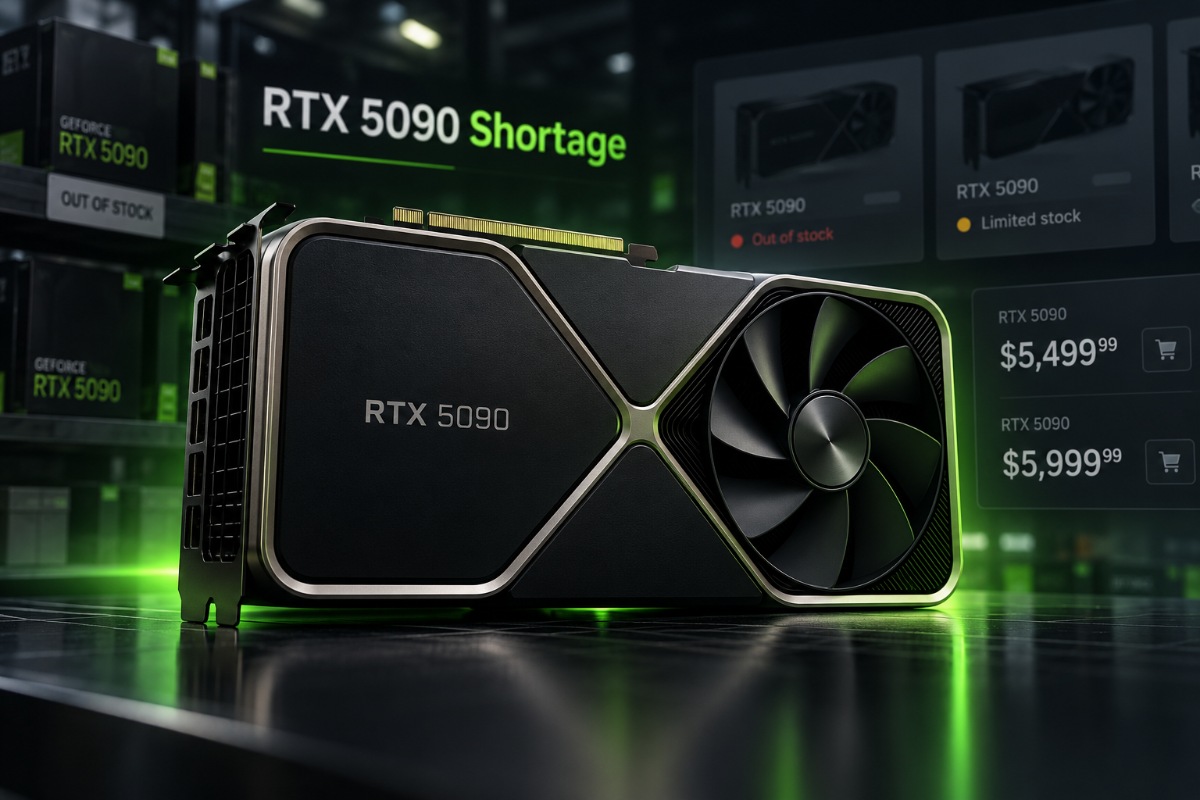
RTX 5090, Nvidia says its flagship GPU is still shipping. Store listings and steep markups tell buyers a different story.
Micro Center has marked several GeForce RTX 5090 models as “Not Carried,” and Nvidia has removed the flagship from the model selector on its own Marketplace. Meanwhile, retail offers have pushed prices beyond $5,000 for a graphics card launched at $1,999.
Nvidia says the RTX 5090 has not been discontinued. Jeff Fisher, the company’s senior vice president of personal computing, addressed the rumors after the RTX Spark Launch Party in Taipei on October 16, 2026. His response followed claims that Nvidia had stopped supplying GB202 graphics chips for consumer cards and was directing that silicon toward more expensive professional products.
The denial answers a narrow question about the RTX 5090’s status. It does not say how many cards Nvidia will ship, whether board partners are receiving fresh chips, or when stores might get regular stock again. Those unanswered questions have kept concerns about the GPU’s availability alive.
What Nvidia Actually Confirmed
Taiwanese publication 4Gamers reported Fisher’s remarks following the event. The Nvidia executive directly rejected the discontinuation claims, stating in remarks translated from the publication’s Chinese coverage:
“It has certainly not been discontinued. Nvidia will continue shipping it.”
Fisher acknowledged limited supply chain capacity and said Nvidia was working to get products to market. He also pointed to CUDA, Nvidia’s software platform for running calculations on GPUs. His argument was that GeForce helped build the computing ecosystem behind Nvidia’s AI business, so gamers still matter to the company.
Yet Nvidia has not clarified whether continued shipments refer to its finished Founders Edition cards, GB202 processors supplied to partners such as ASUS, MSI and Gigabyte, or both. Fisher gave no shipment targets or restock dates.
Store Listings and Prices Paint a Different Picture
The few RTX 5090 cards advertised by retailers carry steep markups. Tom’s Hardware tracked a Zotac Solid OC listed for $4,999 at Newegg in September and an Asus ROG Astral 4X OC offered around $6,000. In Germany, price comparison site Geizhals listed an MSI Gaming Trio OC at €4,850. These were advertised prices rather than verified sales.
Such prices put the flagship GPU far beyond its original $1,999 starting price. They also highlight the gap between Nvidia’s assurance of continued shipments and what buyers encounter when searching for available cards.
A retailer removing a product from its catalog does not prove manufacturing has stopped. However, the combination of withdrawn listings, limited inventory and steep markups explains why the discontinuation rumors gained attention.
Why Professional GPUs Matter to the GB202 Rumors
On October 10, hardware leaker MEGAsizeGPU claimed Nvidia would reserve future GB202 supplies for its RTX Pro range. German publication PC Games Hardware later reported that sources in distribution, retail and Nvidia’s partner network supported a halt in new allocations to GeForce partners. Nvidia has not confirmed that claim.
The RTX 5090 and RTX PRO 6000 Blackwell use variants of the GB202 chip design manufactured by TSMC. Both rely on GDDR7 memory, although the professional card carries 96GB against the gaming model’s 32GB. That creates competing demands for related components, but does not prove Nvidia shifted all gaming chip output to workstation products.
The price incentive is substantial. Nvidia’s US Marketplace listed the RTX PRO 6000 Blackwell for $16,000 in August 2026, compared with the RTX 5090’s $1,999 launch price. The products have different memory capacities, support and buyers, so the gap is not a direct measure of profit per chip.
Fisher has rejected discontinuation. Buyers now need evidence that more cards are reaching stores.
Also Read: Modder Bypasses RTX 5090’s Melting-Prone 16-Pin Connector With Four 8-Pin Ports

Anup Singh is an independent technology journalist and content writer covering Apple, Android, AI, laptops, gaming, and the consumer tech industry. He focuses on delivering factual, well researched, and easy to understand reporting while explaining how new technologies impact everyday users.