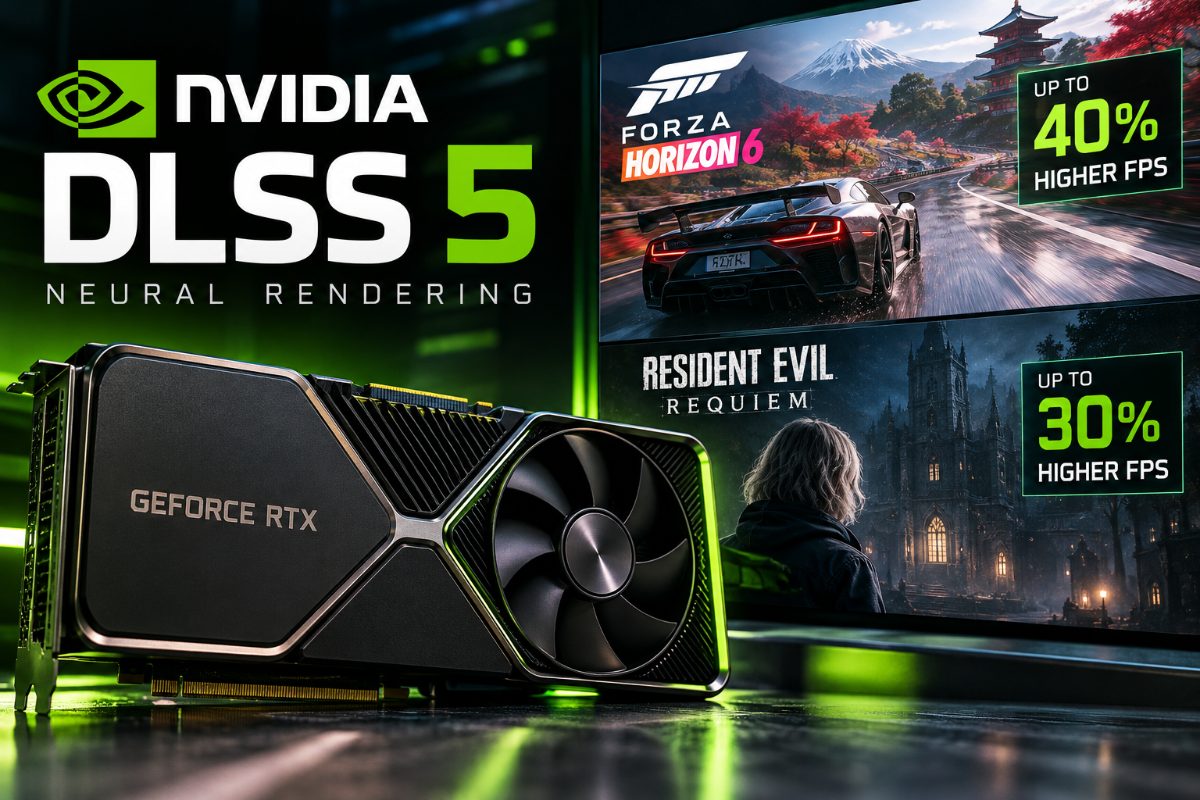
DLSS 5: Modders bring NVIDIA’s faster Neural Rendering model to unsupported games, but early tests raise concerns about weaker shadows and reduced facial detail.
Within hours of NVIDIA releasing its faster DLSS 5 Neural Rendering update for NBA 2K27, PC modders had extracted the new DLL and brought it to older RTX graphics cards. Early community tests show frame rate improvements approaching 40% in unsupported games, although some players report flatter lighting and reduced character detail.
The update officially targets GeForce RTX 50-series GPUs and NVIDIA RTX Spark devices. However, experimental modding tools now let RTX 40-series owners run the optimized model in games without native DLSS 5 support.
Neural Rendering uses AI to enhance lighting, skin appearance, and material details, adding visual effects beyond conventional upscaling. Those improvements require additional GPU processing, which previously caused substantial performance losses. NVIDIA’s latest update aims to reduce that overhead while preserving the visual improvements that make Neural Rendering useful.
NVIDIA’s Faster Model Cuts GPU Overhead
NVIDIA says its October update reduces the Neural Rendering model size by 24% to approximately 118 million parameters. It also cuts VRAM consumption by 20% at 4K and halves GPU processing overhead compared with the previous version. PC Gamer’s independent testing provides a useful measure of those efficiency gains.
PC Gamer tested NBA 2K27 on an ASUS ProArt P16 equipped with NVIDIA’s RTX Spark N1X processor, featuring a 20-core CPU and an integrated Blackwell GPU with 6,144 CUDA cores.
At 1440p, the updated model increased average performance from 107 FPS to 134 FPS. Disabling Neural Rendering entirely delivered 200 FPS. The tests used DLSS Balanced and 4x Multi Frame Generation.
The updated model therefore reduces the rendering penalty, although enabling Neural Rendering still costs 66 FPS compared with leaving the feature disabled.
Modders Bring DLSS 5 to Unsupported Games
The updated file, nvngx_dlssnr.dll, carries version 310.9.16.0 and replaces the older 310.8.x Neural Rendering builds.
A DLL, or Dynamic Link Library, contains reusable software code. PC players can sometimes replace these files to update graphics features without waiting for official game patches.
Experimental tools such as the OptiScaler Neural Rendering fork allow modders to introduce DLSS 5 effects into games without native support. Patched DLL files also extend experimental compatibility to older RTX hardware.
Modders can first introduce the older Neural Rendering implementation into unsupported games, then replace its DLL with NVIDIA’s optimized version to compare performance.
Gaming Optimized tested this approach in Forza Horizon 6 using an RTX 4060. Frame rates improved by nearly 40% with identical Neural Rendering intensity and resolution settings.
The same tester posted a Resident Evil Requiem comparison showing approximately 30% higher performance with the updated model. Gaming Optimized has also demonstrated the game running on an RTX 4060, although the specific GPU used for the 30% comparison was not identified in that post.
Both results come from community testing rather than standardized hardware benchmarks.
Higher FPS Comes With Visual Quality Concerns
While the performance gains have attracted attention, some early users have raised concerns about image quality. A tester discussing Control Resonant in the r/DLSS community reported that overall image quality remained close to the previous version, but character faces looked less affected by Neural Rendering.
The tester explained, “the effect on faces is definitely toned down compared to the older model.”
Other players reported reduced ambient occlusion (AO), the shading that makes corners, objects, and surfaces appear naturally dark. Losing that effect can make environments look flatter despite higher frame rates.
NVIDIA maintains that its optimized model preserves comparable visual fidelity. However, unofficial mods can apply different presets and processing methods, making it difficult to separate changes in NVIDIA’s model from problems introduced by the modifications.
Official Integration Remains Important
Native DLSS 5 support allows developers to control the strength of Neural Rendering across characters, materials, and individual scenes. Studios can tune lighting effects to preserve their intended visual style.
Unofficial DLL replacements cannot guarantee the same behavior. They may introduce inconsistent lighting, flickering, or compatibility problems.
For RTX 40-series owners experimenting with the new model, keeping the original DLL backed up remains sensible. A substantial frame rate improvement loses some of its appeal if the update removes the shadow depth and facial detail Neural Rendering was meant to provide.
Also Read: New PS5 Linux Loader Targets Firmware 13.60, but 13.20 Remains Unstable

Anup Singh is an independent technology journalist and content writer covering Apple, Android, AI, laptops, gaming, and the consumer tech industry. He focuses on delivering factual, well researched, and easy to understand reporting while explaining how new technologies impact everyday users.