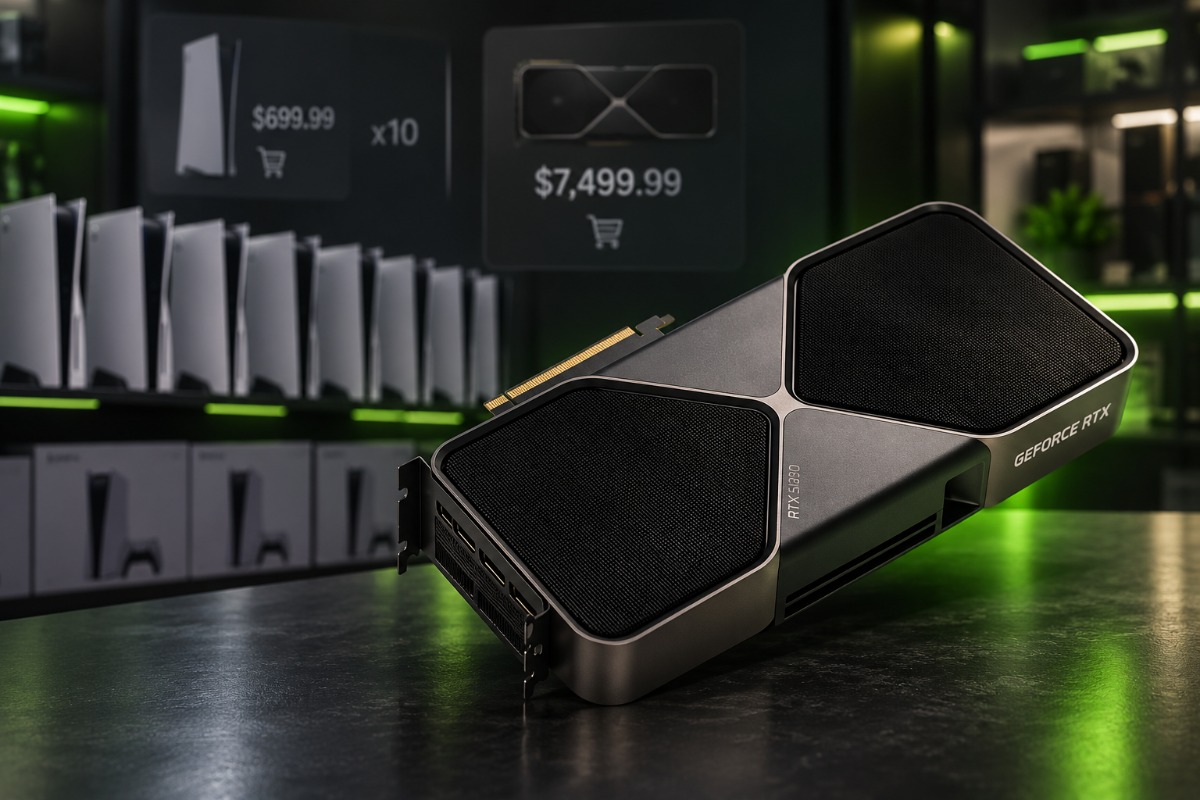
RTX 5090 listings: Nvidia’s $1,999 flagship is appearing at nearly $10,000 through marketplace sellers as scarce supply meets demand from gamers and AI system builders.
If you want Nvidia’s flagship RTX 5090 today, the official $1,999 launch price tells only part of the story. By mid September 2026, Newegg marketplace sellers were asking $6,699.99 for an MSI Ventus model and $9,659 for an ASUS ROG Astral. Another Astral listing sat at $9,290. These were third party marketplace prices, not prices set by Nvidia or Newegg.
That distinction matters. A $9,659 RTX 5090 is an extreme listing, not the normal street price. Still, the comparison is hard to ignore. At that price, 1 graphics card costs more than 10 PS5 Pro consoles at Sony’s current $899.99 US price, following its increase from the original $699.99 launch price.
The bigger story is why Nvidia’s top gaming card has become so difficult to buy at anything close to its official price.
Retail Prices Break Away
RTX 5090 pricing now varies wildly depending on where buyers look. Micro Center has listed models around $4,399 to $5,300 with local availability, while Best Buy listings have appeared around $7,500. Newegg’s most aggressive third party offers have climbed beyond $9,000.
Those figures do not represent Nvidia’s MSRP. They show what happens when normal retail inventory thins out and marketplace sellers control much of the visible supply.
Reports from Asia add another pressure point. Companies are reportedly buying consumer RTX 5090 cards for AI workstations instead of gaming PCs.
In a translated statement, HKEPC said, “Many manufacturers in China buy RTX 5090 cards from different sources and assemble them into AI workstations for sale.”
That report gives a plausible explanation for some additional demand, but it does not prove AI buyers caused the entire shortage. Public data still does not show how many retail cards are moving into commercial AI systems.
Why AI Buyers Want Them
The RTX 5090 works well beyond gaming. Nvidia equips the card with 32 GB of GDDR7 memory and substantial AI computing capability. That memory matters because larger local language models and other machine learning workloads need large amounts of fast video memory.
For smaller developers and AI companies, the economics can look surprisingly attractive. Nvidia currently lists the RTX PRO 6000 Blackwell Workstation Edition at $16,000. That professional card offers 96 GB of memory and features designed for demanding workstation use.
A $6,700 RTX 5090 therefore remains much cheaper in absolute terms. It does not replace professional hardware, but its 32 GB memory capacity gives smaller AI operations enough room for many local workloads. That makes gamers only one group competing for the same silicon.
Gamers Face A Different Market
For a PC builder, paying $9,659 for an RTX 5090 is difficult to justify. That figure comes from a marketplace seller, not Nvidia, and sits nearly 5 times above the card’s $1,999 launch price.
The problem is not that Nvidia suddenly turned the RTX 5090 into a $10,000 product. Ordinary buyers simply cannot reliably find it at anything close to the official number. Meanwhile, AI users value the same card for very different reasons. Gamers want frame rates, developers want its memory and compute capacity, and marketplace sellers see a product with more buyers than readily available supply.
The RTX 5090 launched as Nvidia’s ultimate consumer graphics card. In the current market, it increasingly occupies an awkward middle ground between premium gaming hardware and relatively affordable AI compute.
For PC builders, that competition has made an already expensive GPU considerably harder to buy.
Also Read: Sapphire’s New RX 9070 XT GPU Bundles Valor Mortis Without A Performance Bump

Anup Singh is an independent technology journalist and content writer covering Apple, Android, AI, laptops, gaming, and the consumer tech industry. He focuses on delivering factual, well researched, and easy to understand reporting while explaining how new technologies impact everyday users.